November 10, 2011

Microblogging is a broadcast medium in the form of blogging. A microblog differs from a traditional blog in that its content is typically smaller in both actual and aggregate file size. Microblogs ‘allow users to exchange small elements of content such as short sentences, individual images, or video links.’ As with traditional blogging, microbloggers post about topics ranging from the simple, such as ‘what I’m doing right now,’ to the thematic, such as ‘sports cars.’ Commercial microblogs also exist, to promote websites, services and/or products, and to promote collaboration within an organization. Some microblogging services offer features such as privacy settings, which allow users to control who can read their microblogs, or alternative ways of publishing entries besides the web-based interface. These may include text messaging, instant messaging, E-mail, or digital audio.
The first microblogs were known as tumblelogs. The term was coined by ‘why the lucky stiff’ in a blog post in 2005, while describing Christian Neukirchen’s Anarchaia: ‘Blogging has mutated into simpler forms (specifically, link- and mob- and aud- and vid- variant), but I don’t think I’ve seen a blog like Chris Neukirchen’s Anarchaia, which fudges together a bunch of disparate forms of citation (links, quotes, flickrings) into a very long and narrow and distracted tumblelog.’
read more »
Posted in Money, Politics, Technology |
1 Comment »
November 10, 2011

Weibo is the Chinese word for ‘microblog.’ It usually refers to one or all of the Twitter-like, China-based microblogging services, or one’s account at these services. Among the weibo services, Sina Weibo is the most visited one. Sina has used the domain name weibo.com for the service since 2011. Sometimes, the own published news of Sina.com and some other media use directly ‘Weibo’ to refer to Sina Weibo. However generally, when mentioning ‘Weibo,’ it may refer to one or all of the China-based microblogging services. After the 2009 Urumqi riots, China shut down most of the domestic weibo services, and many popular non China-based microblogging services like Twitter, Facebook, and Plurk have been blocked since then.
This led to the creation of services like Sina Weibo, operated by large Chinese Internet companies under the government’s control. Due to the Internet censorship in China, all of the China-based weibo services today is now controlled by various self-censorship policies and methods. They usually have blacklisted keywords list to be automatically checked, sometimes administrators check manually. Posts on sensitive topics forbidden in China (e.g. Human right, Liu Xiaobo) will be deleted and the user’s account may be blocked. However, compared to other Chinese media formats, weibo services are considered freer. Weibos are thought as influential tools that impact and change China. Some scandals and controversies such as Li Gang incident are made known to the public through weibos.
Posted in Politics, Technology, World |
Leave a Comment »
November 10, 2011

A Sybian is a masturbation device designed for use by females, developed by dance instructor Dave Lampert in the 1980s. It consists of a saddle-like seat containing an electric motor connected to a rod that protrudes from a hole in the center. Various attachments can be added to the rod, which vibrates, rotates and may also stimulate the clitoris externally. The intensity of the movements produced can be increased or decreased through a control box attached to the Sybian’s base. Lampert and his team initially called the device Master Better, shortened to ‘MB’ for about four years before selecting a new name for it. The prefix syb was derived from Sybaris, an Ancient Greek city in southern Italy which was associated with luxurious living.
Generally, the user of the Sybian straddles the machine and inserts the attachment vaginally. The vibration and rotation can be controlled by separate on/off switches and two rotary controls. The Sybian is sold with up to four phallus-shaped washable attachments of varying sizes made from synthetic rubber. Although the Sybian has been featured in many pornographic video productions since the early 2000s, primarily on the Internet, the device came to prominence on The Howard Stern Show since the show’s arrival on Sirius Satellite Radio. Howard Stern was given a Sybian as a birthday gift in 2006 and it remains in the Stern studio for use by willing guests.
Posted in Sex, Technology |
1 Comment »
November 10, 2011

A sex machine, also known as a fucking machine, is a mechanical device used to simulate human sexual intercourse. It is a more sophisticated version of the vibrator. These devices may be associated with, but are not limited to, BDSM play. Devices can be penetrative or extractive. A typical penetrative machine works by the transfer of rotational or reciprocating force from a motor to a directional motion on a shaft, which is tipped by a dildo. A hand-held modified reciprocating saw device is sometimes called a ‘fucksaw’ and a hand-held modified drill motor rotating device is sometimes called a ‘drilldo.’ An extractive device works like a milking machine and can be attached to the penis, breast, or other body part.
Modern automated erotic stimulation device differ from vibrators because they penetrate as well as throb. Mass attention is drawn to them on the Internet, while appetite for these powerful appliances has induced the establishment and growth of manufacturers to satisfy rising demand. Recently a new generation of these devices has hit the market under the name teledildonics. These devices are sometimes used as part of auto-erotic or partnered bondage play. Today the sex machines on the market include vacuum pumps, instruments that deliver calibrated electrical shocks to the nipples and genitals, and lifesize inflatable male and female dolls with penetrable and vibrating orifices.
Posted in Sex, Technology |
Leave a Comment »
November 10, 2011
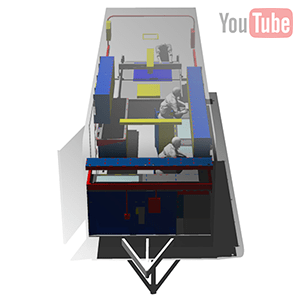
The mobile fab lab is a computer-controlled design and machining shop housed in a trailer. The first was built in 2007 by the Center for Bits and Atoms at the Massachusetts Institute of Technology. The mobile lab includes the same computer controlled fabrication machines found in fab labs world-wide. The fab lab trailer is 32′ long, 8′ wide, and 7′ high. The tailgate opens to add a 6′ deck at the back of the trailer. To run all the equipment in the lab at once (including AC and overhead lights) is about 20 kW.
This lab contains custom cabinetry which is example of a lab producing a part of another lab. The cabinetry was CAD-designed and fabricated on a CNC wood router similar to the wood router in the trailer. The router in the trailer is capable of making another set of cabinets. Two graffiti artists from the South Bronx were invited to design and paint the sides and top of the trailer in two weekends. It is now loaned to organizations for months or longer, typically to help create a permanent lab in that location.
Posted in Technology |
Leave a Comment »
November 10, 2011


A Fab Lab (fabrication laboratory) is a small-scale workshop offering (personal) digital fabrication generally equipped with an array of flexible computer controlled tools that cover several different length scales and various materials, with the aim to make ‘almost anything.’ This includes technology-enabled products generally perceived as limited to mass production. While Fab Labs have yet to compete with mass production and its associated economies of scale in fabricating widely distributed products, they have already shown the potential to empower individuals to create smart devices for themselves. These devices can be tailored to local or personal needs in ways that are not practical or economical using mass production.
The fab lab program was started in the Media Lab at MIT, a collaboration between the Grassroots Invention Group and the Center for Bits and Atoms (CBA) at the Massachusetts Institute of Technology, broadly exploring how the content of information relates to its physical representation, and how a community can be powered by technology at the grassroots level. While the Grassroots Invention Group is no longer in the Media Lab, The Center for Bits and Atoms consortium is still actively involved in continuing research in areas related to description and fabrication but does not operate or maintain any of the labs worldwide (with the exception of the mobile fab lab). The fab lab concept also grew out of a popular class at MIT named ‘How To Make (Almost) Anything.’
Posted in Technology |
Leave a Comment »
November 10, 2011

Artificial scarcity describes the scarcity of items even though the technology and production capacity exists to create an abundance. The term is aptly applied to non-rival resources, i.e. those that do not diminish due to one person’s use, although there are other resources which could be categorized as artificially scarce. The most common causes are monopoly pricing structures, such as those enabled by intellectual property rights or by high fixed costs in a particular marketplace. The inefficiency associated with artificial scarcity is formally known as a deadweight loss.
An example of artificial scarcity is often used when describing proprietary, or closed-source, computer software. Any software application can be easily duplicated billions of times over for a relatively cheap production price (an initial investment in a computer, an internet connection, and any power consumption costs; and these are already fixed costs in most environments). On the margin, the price of copying software is next to nothing, costing only a small amount of power and a fraction of a second. Things like serial numbers, license agreements, and intellectual property create artificial scarcity, and give monetary value to otherwise free copies. Technocrats argue that if the price system were removed, there would be no personal incentive to artificially create scarcity in products, and thus something similar to the open source model of distribution would dominate.
read more »
Posted in Money, Politics, Technology |
Leave a Comment »
November 10, 2011

Post scarcity is a hypothetical form of economy or society, in which things such as goods, services and information are free, or practically free. This would be due to an abundance of fundamental resources (matter, energy and intelligence), in conjunction with sophisticated automated systems capable of converting raw materials into finished goods, allowing manufacturing to be as easy as duplicating software.
Scarcity is the fundamental economic problem of having seemingly unlimited human needs and wants, in a world of limited resources. It states that society has insufficient productive resources to fulfill all human wants and needs. Alternatively, scarcity implies that not all of society’s goals can be pursued at the same time; trade-offs are made of one good against others. As such, the term post-scarcity economics may be somewhat paradoxical. To quote a 1932 essay by Lionel Robbins, economics is ‘the science which studies human behavior as a relationship between ends and scarce means which have alternative uses.’
read more »
Posted in Money, Politics, Technology |
Leave a Comment »
November 9, 2011

The development of the airliner has had a big effect on the wine business. It has made it easier for individuals to directly supervise viticulture and winemaking in different countries across the globe, rather than exchanging ideas by mail as they have for centuries. This means closer control of the wine, and has seen new technologies such as Drip irrigation, trellis systems, and other developments spread rapidly. This all leads to a homogenous product, influenced more by the winemaker’s background than the local terroir and history.
On the other hand, that ‘history’ often included overoaking and dirty facilities that partly oxidized the wines, which are rapidly fixed by flying winemakers. Many of the early flying winemakers were Australians who had been educated in modern techniques, and used the fact that their autumn was six months ahead of the Northern Hemisphere to ‘moonlight’ when things were quiet at home. They have had some dramatic success in improving the quality of Old World wines, particularly in the South of France and in the former Communist countries.
read more »
Posted in Food, Money, Technology |
Leave a Comment »
November 9, 2011

Ruin value (German: Ruinenwert) is the concept that a building be designed such that if it eventually collapsed, it would leave behind aesthetically pleasing ruins that would last far longer without any maintenance at all. The idea was pioneered by German architect Albert Speer while planning for the 1936 Summer Olympics and published as ‘The Theory of Ruin Value’ (‘Die Ruinenwerttheorie’), although he was not its original inventor. The intention did not stretch only to the eventual collapse of the buildings, but rather assumed such buildings were inherently better designed and more imposing during their period of use.
The idea was supported by Adolf Hitler, who planned for such ruins to be a symbol of the greatness of the Third Reich, just as Ancient Greek and Roman ruins were symbolic of those civilizations.
read more »
Posted in Language, Technology |
Leave a Comment »
November 9, 2011
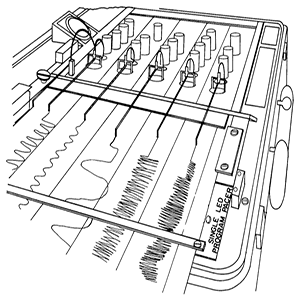
A polygraph (popularly referred to as a lie detector) measures and records several physiological indices such as blood pressure, pulse, respiration, and skin conductivity while the subject is asked and answers a series of questions. The belief is that deceptive answers will produce physiological responses that can be differentiated from those associated with non-deceptive answers. The polygraph was invented in 1921 by John Augustus Larson, a medical student at the University of California at Berkeley and a police officer of the Berkeley Police Department.
Many members of the scientific community consider polygraphy to be pseudoscience. Nonetheless, in some countries polygraphs are used as an interrogation tool with criminal suspects or candidates for sensitive public or private sector employment. US federal government agencies such as the FBI and the CIA and many police departments use polygraph examinations to interrogate suspects and screen new employees. Within the US federal government, a polygraph examination is also referred to as a psychophysiological detection of deception (PDD) examination.
read more »
Posted in Politics, Technology |
1 Comment »
November 9, 2011

Thought identification refers to the empirically verified use of technology to, in some sense, read people’s minds. Recent research using Neuroimaging has provided some early demonstrations of the technology’s potential to recognize high-order patterns in the brain. In some cases, this provides meaningful (and controversial) information to investigators.
With brain scanning technology becoming increasingly accurate, experts predict important debates over how and when it should be used. One potential area of application is criminal law. Haynes explains that simply refusing to use brain scans on suspects also prevents the wrongly accused from proving their innocence.
read more »
Posted in Health, Politics, Technology |
1 Comment »


 The Daily Omnivore