November 10, 2011
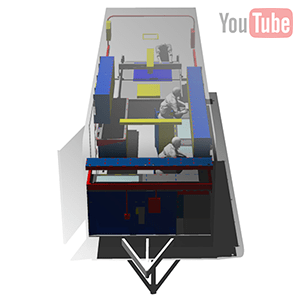
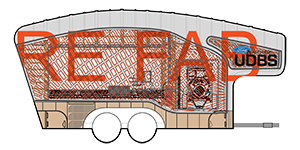
The mobile fab lab is a computer-controlled design and machining shop housed in a trailer. The first was built in 2007 by the Center for Bits and Atoms at the Massachusetts Institute of Technology. The mobile lab includes the same computer controlled fabrication machines found in fab labs world-wide. The fab lab trailer is 32′ long, 8′ wide, and 7′ high. The tailgate opens to add a 6′ deck at the back of the trailer. To run all the equipment in the lab at once (including AC and overhead lights) is about 20 kW.
This lab contains custom cabinetry which is example of a lab producing a part of another lab. The cabinetry was CAD-designed and fabricated on a CNC wood router similar to the wood router in the trailer. The router in the trailer is capable of making another set of cabinets. Two graffiti artists from the South Bronx were invited to design and paint the sides and top of the trailer in two weekends. It is now loaned to organizations for months or longer, typically to help create a permanent lab in that location.
Posted in Technology |
Leave a Comment »
November 10, 2011

A Fab Lab (fabrication laboratory) is a small-scale workshop offering (personal) digital fabrication generally equipped with an array of flexible computer controlled tools that cover several different length scales and various materials, with the aim to make ‘almost anything.’ This includes technology-enabled products generally perceived as limited to mass production. While Fab Labs have yet to compete with mass production and its associated economies of scale in fabricating widely distributed products, they have already shown the potential to empower individuals to create smart devices for themselves. These devices can be tailored to local or personal needs in ways that are not practical or economical using mass production.
The fab lab program was started in the Media Lab at MIT, a collaboration between the Grassroots Invention Group and the Center for Bits and Atoms (CBA) at the Massachusetts Institute of Technology, broadly exploring how the content of information relates to its physical representation, and how a community can be powered by technology at the grassroots level. While the Grassroots Invention Group is no longer in the Media Lab, The Center for Bits and Atoms consortium is still actively involved in continuing research in areas related to description and fabrication but does not operate or maintain any of the labs worldwide (with the exception of the mobile fab lab). The fab lab concept also grew out of a popular class at MIT named ‘How To Make (Almost) Anything.’
Posted in Technology |
Leave a Comment »
November 10, 2011

Artificial scarcity describes the scarcity of items even though the technology and production capacity exists to create an abundance. The term is aptly applied to non-rival resources, i.e. those that do not diminish due to one person’s use, although there are other resources which could be categorized as artificially scarce. The most common causes are monopoly pricing structures, such as those enabled by intellectual property rights or by high fixed costs in a particular marketplace. The inefficiency associated with artificial scarcity is formally known as a deadweight loss.
An example of artificial scarcity is often used when describing proprietary, or closed-source, computer software. Any software application can be easily duplicated billions of times over for a relatively cheap production price (an initial investment in a computer, an internet connection, and any power consumption costs; and these are already fixed costs in most environments). On the margin, the price of copying software is next to nothing, costing only a small amount of power and a fraction of a second. Things like serial numbers, license agreements, and intellectual property create artificial scarcity, and give monetary value to otherwise free copies. Technocrats argue that if the price system were removed, there would be no personal incentive to artificially create scarcity in products, and thus something similar to the open source model of distribution would dominate.
read more »
Posted in Money, Politics, Technology |
Leave a Comment »
November 10, 2011

Post scarcity is a hypothetical form of economy or society, in which things such as goods, services and information are free, or practically free. This would be due to an abundance of fundamental resources (matter, energy and intelligence), in conjunction with sophisticated automated systems capable of converting raw materials into finished goods, allowing manufacturing to be as easy as duplicating software.
Scarcity is the fundamental economic problem of having seemingly unlimited human needs and wants, in a world of limited resources. It states that society has insufficient productive resources to fulfill all human wants and needs. Alternatively, scarcity implies that not all of society’s goals can be pursued at the same time; trade-offs are made of one good against others. As such, the term post-scarcity economics may be somewhat paradoxical. To quote a 1932 essay by Lionel Robbins, economics is ‘the science which studies human behavior as a relationship between ends and scarce means which have alternative uses.’
read more »
Posted in Money, Politics, Technology |
Leave a Comment »
November 9, 2011

The development of the airliner has had a big effect on the wine business. It has made it easier for individuals to directly supervise viticulture and winemaking in different countries across the globe, rather than exchanging ideas by mail as they have for centuries. This means closer control of the wine, and has seen new technologies such as Drip irrigation, trellis systems, and other developments spread rapidly. This all leads to a homogenous product, influenced more by the winemaker’s background than the local terroir and history.
On the other hand, that ‘history’ often included overoaking and dirty facilities that partly oxidized the wines, which are rapidly fixed by flying winemakers. Many of the early flying winemakers were Australians who had been educated in modern techniques, and used the fact that their autumn was six months ahead of the Northern Hemisphere to ‘moonlight’ when things were quiet at home. They have had some dramatic success in improving the quality of Old World wines, particularly in the South of France and in the former Communist countries.
read more »
Posted in Food, Money, Technology |
Leave a Comment »
November 9, 2011

Ruin value (German: Ruinenwert) is the concept that a building be designed such that if it eventually collapsed, it would leave behind aesthetically pleasing ruins that would last far longer without any maintenance at all. The idea was pioneered by German architect Albert Speer while planning for the 1936 Summer Olympics and published as ‘The Theory of Ruin Value’ (‘Die Ruinenwerttheorie’), although he was not its original inventor. The intention did not stretch only to the eventual collapse of the buildings, but rather assumed such buildings were inherently better designed and more imposing during their period of use.
The idea was supported by Adolf Hitler, who planned for such ruins to be a symbol of the greatness of the Third Reich, just as Ancient Greek and Roman ruins were symbolic of those civilizations.
read more »
Posted in Language, Technology |
Leave a Comment »
November 9, 2011
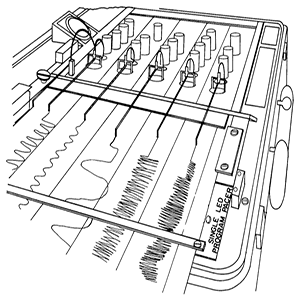
A polygraph (popularly referred to as a lie detector) measures and records several physiological indices such as blood pressure, pulse, respiration, and skin conductivity while the subject is asked and answers a series of questions. The belief is that deceptive answers will produce physiological responses that can be differentiated from those associated with non-deceptive answers. The polygraph was invented in 1921 by John Augustus Larson, a medical student at the University of California at Berkeley and a police officer of the Berkeley Police Department.
Many members of the scientific community consider polygraphy to be pseudoscience. Nonetheless, in some countries polygraphs are used as an interrogation tool with criminal suspects or candidates for sensitive public or private sector employment. US federal government agencies such as the FBI and the CIA and many police departments use polygraph examinations to interrogate suspects and screen new employees. Within the US federal government, a polygraph examination is also referred to as a psychophysiological detection of deception (PDD) examination.
read more »
Posted in Politics, Technology |
1 Comment »
November 9, 2011

Thought identification refers to the empirically verified use of technology to, in some sense, read people’s minds. Recent research using Neuroimaging has provided some early demonstrations of the technology’s potential to recognize high-order patterns in the brain. In some cases, this provides meaningful (and controversial) information to investigators.
With brain scanning technology becoming increasingly accurate, experts predict important debates over how and when it should be used. One potential area of application is criminal law. Haynes explains that simply refusing to use brain scans on suspects also prevents the wrongly accused from proving their innocence.
read more »
Posted in Health, Politics, Technology |
1 Comment »
November 1, 2011
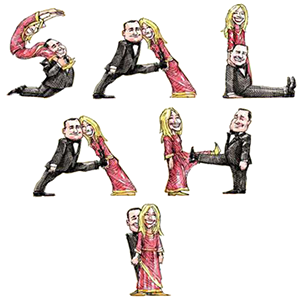
Gate-crashing, gatecrashing or party crashing is the act of attending an invite-only event without invitation. The person doing the gate-crashing is known as a gate-crasher. Gate crashing is also the act of tracing a signal through logic gates in electronics. Reasons for gate-crashing include avoiding entry fees, gaining access to free food and beverages (often alcoholic) , gaining access to a party that they wanted to be invited to, taking pictures of famous people, having pictures taken with famous people, and more serious crimes like stalking, kidnapping, murder, theft, fraud, and causing general disruptions.
Various techniques that involve blending in with the crowd can be used to gain access to some events. Various measures can be taken to prevent gate-crashers from gaining access such as collecting invitations at the door and employing staff to identify potential uninvited guests, but such measures can still be thwarted by a skilled gate-crasher. The 2009 U.S. state dinner security breaches occurred when Michaele and Tareq Salahi, from Virginia, allegedly gate-crashed the state dinner between President Barack Obama and Indian Prime Minister Manmohan Singh.
Posted in Language, Politics, Technology |
1 Comment »
November 1, 2011

In security, piggybacking refers to when a person tags along with another person who is authorized to gain entry into a restricted area, or pass a certain checkpoint. The act may be legal or illegal, authorized or unauthorized, depending on the circumstances. However, the term more often has the connotation of being an illegal or unauthorized act.
To describe the act of an unauthorized person who follows someone to a restricted area without the consent of the authorized person, the term tailgating is also used. ‘Tailgating’ implies without consent (similar to a car tailgating another vehicle on the freeway), while ‘piggybacking’ usually implies consent of the authorized person.
read more »
Posted in Politics, Technology |
Leave a Comment »
October 31, 2011
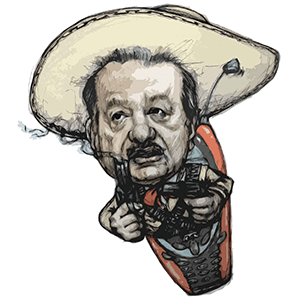
Carlos Slim (b. 1940) is a Mexican businessman, and the richest person in the world, worth more than US$60 billion. He owns the Mexican phone company Telmex, which provides a telephone service to most Mexicans. After graduating, Slim expanded on his father’s ownings of real estate in Mexico City. By age 26, he was worth $40 million. During the 1980s and 1990s, Slim bought several companies that were bankrupt or being privatized. Slim owns about 7% of the New York Times.
The Mexican magnate’s growing fortune has caused a controversy because it has been amassed in a developing country where per capita income does not surpass $14,500 a year, and nearly 17% of the population lives in poverty. Critics claim that Slim is a monopolist, pointing to Telmex’s control of 90% of the Mexican landline telephone market. Slim’s wealth is the equivalent of roughly 5% of Mexico’s annual economic output. Telmex, of which 49.1% is owned by Slim and his family, charges among the highest usage fees in the world, according to the Organisation for Economic Co-operation and Development.
read more »
Posted in Money, Technology, World |
Leave a Comment »
October 29, 2011
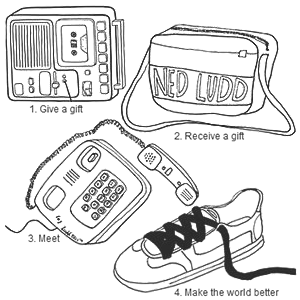
DaruDar is an international community where people give away things, their skills and time to each other for absolutely free requiring nothing in return. The community is based on principles of self-organization. Main condition of participation is following the rules of gift giving and communication set on the site. The global mission of DaruDar is to create a widespread social practice of gift-giving, to make it a daily and routine act. Words like ‘lot,’ ‘exchange,’ ‘freebie,’ ‘junk,’ or ‘crap’ are considered obscene on DaruDar. The service was launched in Russian in 2008. It was created by four friends who had worked with Habrahabr project earlier, a collaborative blog. They were inspired by flashmobs, Russian philosopher Peter Kropotkin and Gandhi.
Darudar users call themselves comembers (‘community members’). DaruDar gift is a thing, skill or service of a comember that he/she wants to give away to someone. In order to offer a gift a comember creates a publication describing what he gives. Other comembers can wish it. Later the gift giver chooses someone to promise their gift. Every gift can be commented, wished, promised and thanked. Only those offers which simultaneously satisfy all three of the following conditions and cannot exist without them should be considered gifts on Darudar: It can be wished; It can be promised; and It can be given.
Posted in Money, Technology, World |
Leave a Comment »



