October 17, 2011

The Spamhaus Project is an international organization (founded by Steve Linford in 1998) to track e-mail spammers and spam-related activity. It is named for the anti-spam jargon term coined by Linford, ‘spamhaus,’ a pseudo-German expression for an ISP or other firm which spams or willingly provides service to spammers.
Spamhaus is responsible for a number of very widely used anti-spam DNS-based Blocklists (DNSBLs) and Whitelists (DNSWLs). Many internet service providers and Internet networks use these services to reduce the amount of spam they take on. The Spamhaus blocks 80 billion spam emails per day globally on the internet (almost 1 million spams per second). Like all DNSBLs, their use is considered controversial by some.
read more »
Posted in Money, Politics, Technology |
Leave a Comment »
October 15, 2011

A facial composite is a graphical representation of an eyewitness’s memory of a face, as recorded by a composite artist. Facial composites are used mainly by police in their investigation of (usually serious) crimes. Construction of the composite was originally performed by a trained artist, through drawing, sketching, or painting, in consultation with a witness or crime victim. In the 1960s techniques were devised for use by those less artistically skilled, employing interchangeable templates of separate facial features, such as ‘Photofit’ in the UK and Smith & Wesson’s ‘Identi-Kit’ in the US. In the last two decades, a number of computer based facial composite systems have been introduced, amongst the most widely used systems are ‘Identi-Kit 2000,’ ‘FACES,’ and ‘E-FIT.’ In the U.S. the FBI maintains that hand-drawing is its preferred method for constructing a facial composite. Many other police agencies, however, use software, since suitable artistic talent is often not available.
Until quite recently, the facial composite systems used by international police forces were exclusively based on a construction methodology in which individual facial features (eyes, nose, mouth, eyebrows, etc.) are selected one at a time from a large database and then electronically ’overlaid’ to make the composite image. Such systems are often referred to as feature-based since they essentially rely on the selection of individual features in isolation. However, after a long period of research and development work conducted largely within British Universities, systems based on a rather different principle are finding increasing use by police forces. These systems may be broadly described as holistic or global in that they primarily attempt to create a likeness to the suspect through an evolutionary mechanism in which a witness’s response to groups of complete faces (not just features) converges towards an increasingly accurate image.
Posted in Politics, Technology |
Leave a Comment »
October 15, 2011


The ring of steel is the popular name for the security and surveillance cordon surrounding the City of London, installed to deter the IRA and other threats. The term was borrowed from an earlier stage of the Troubles when the centre of Belfast was fortified against attacks, the perimeter of which was known as the ring of steel. Roads entering the City are narrowed and have small chicanes to force drivers to slow down and be recorded by CCTV cameras. These roads typically have a concrete median with a sentry box where police can stand guard and monitor traffic. City planners call these types of precautions ‘fortress urbanism.’
Initially the ring of steel consisted of plastic cones and on duty policemen which the locals described as the ‘ring of plastic.’ It served the purpose of providing a visible sign to the public that the City authorities were taking the threats of more attacks by the IRA seriously. This was replaced by more permanent structures consisting of concrete barriers, checkpoints and thousands of video cameras. Following IRA ceasefires the police presence was curtailed. However, following the September 11 attacks, and a reported increased terrorist threat to the United Kingdom, security was stepped up again somewhat, with occasional spot checks on vehicles entering the cordon, although not to previous levels.
Posted in Politics, Technology, World |
Leave a Comment »
October 14, 2011

Future Shock is a book written by the futurist Alvin Toffler in 1970. In the book, Toffler defines the term ‘future shock’ as a certain psychological state of individuals and entire societies. His shortest definition for the term is a personal perception of ‘too much change in too short a period of time.’ The book, which became an international bestseller, grew out of an article ‘The Future as a Way of Life’ in ‘Horizon’ magazine in 1965.
Toffler argues that society is undergoing an enormous structural change, a revolution from an industrial society to a ‘super-industrial society.’ This change will overwhelm people, the accelerated rate of technological and social change leaving them disconnected and suffering from ‘shattering stress and disorientation’ – future shocked. Toffler stated that the majority of social problems were symptoms of the future shock. In his discussion of the components of such shock, he also popularized the term ‘information overload.’
Posted in Language, Politics, Technology |
1 Comment »
October 13, 2011

Binaural [bahy-nawr-uhl] beats or binaural tones are auditory processing artifacts, or apparent sounds, the perception of which arises in the brain for specific physical stimuli. This effect was discovered in 1839 by Heinrich Wilhelm Dove, and earned greater public awareness in the late 20th century based on claims that binaural beats could help induce relaxation, meditation, creativity and other desirable mental states. The effect on the brainwaves depends on the difference in frequencies of each tone, for example, if 300 Hz was played in one ear and 310 in the other, then the Binaural beat would have a frequency of 10 Hz.
The brain produces a phenomenon resulting in low-frequency pulsations in the amplitude and sound localization of a perceived sound when two tones at slightly different frequencies are presented separately, one to each of a subject’s ears, using stereo headphones. A beating tone will be perceived, as if the two tones mixed naturally, out of the brain. The frequencies of the tones must be below 1,000 hertz for the beating to be noticeable. The difference between the two frequencies must be small (less than or equal to 30 Hz) for the effect to occur; otherwise, the two tones will be heard separately and no beat will be perceived. Binaural beats reportedly influence the brain in more subtle ways through the entrainment of brainwaves and have been claimed to reduce anxiety and provide other health benefits such as control over pain.
read more »
Posted in Health, Science, Technology |
1 Comment »
October 13, 2011

A mind machine (or psychowalkman) uses pulsing rhythmic sound and/or flashing light to alter the brainwave frequency of the user. Mind machines are said to induce deep states of relaxation, concentration, and in some cases altered states of consciousness that have been compared to those obtained from meditation and shamanic rituals. The process applied by these machines is also known as brainwave synchronization or entrainment. Mind machines typically consist of a control unit, a pair of headphones and/or strobe light goggles. The unit controls the sessions and drives the LEDs in the goggles. Professionally, they are usually referred to as Auditory Visual Stimulation devices (AVS). Sessions will typically aim at directing the average brainwave frequency from a high level to a lower level by ramping down in several sequences. Target frequencies typically correspond to delta (1-3 hertz), theta (4–7 Hz), alpha (8–12 Hz) or beta brain waves (13–40 Hz), and can be adjusted by the user based on the desired effects.
There have been a number of claims regarding binaural beats (auditory processing artifacts or apparent sounds), among them that they may help people memorize and learn, stop smoking, tackle erectile dysfunction and improve athletic performance. However, research into binaural beats is very limited. No conclusive studies have been released to support marketing claims for binaural beat systems. Mind machines are often used together with biofeedback or neurofeedback equipment in order to adjust the frequency on the fly. Modern mind machines can connect to the Internet to update the software and download new sessions. When sessions are used in conjunction with meditation, neurofeedback, etc. the effect can be amplified. Rapidly flashing lights may be dangerous for people with photosensitive epilepsy or other nervous disorders. It is thought that one out of 10,000 adults will experience a seizure while viewing such a device; about twice as many children will have a similar ill effect.
Posted in Health, Money, Technology |
Leave a Comment »
October 11, 2011

A Friendly Artificial Intelligence or FAI is an artificial intelligence (AI) that has a positive rather than negative effect on humanity. Friendly AI also refers to the field of knowledge required to build such an AI. This term particularly applies to AIs which have the potential to significantly impact humanity, such as those with intelligence comparable to or exceeding that of humans (e.g. superintelligence, strong AI, technological singularity).
This specific term was coined by Eliezer Yudkowsky of the Singularity Institute for Artificial Intelligence as a technical term distinct from the everyday meaning of the word ‘friendly,’ however, the concern is much older.
read more »
Posted in Politics, Technology |
Leave a Comment »
October 11, 2011

Humans United Against Robots (often abbreviated as HUAR) is a semi-tongue-in-cheek organization designed to unify the human race and prepare them for a futuristic robotic uprising. HUAR was created by humorist Keith Malley.
‘HUAR was designed to educate and awaken the citizenry of the world to the impending attack that computers and robots will put into effect against humans. It is a collection of human beings that spread the word of this impending doom as well as doing what they can to help minimize the threat. Between computer programs that can identify human speech and match that up with their computerized dictionaries in order to understand our weaknesses to jokester scientists building robots specifically made to breathe fire from their mouths and shoot lasers from their eyes, it is evident that a task force had to be formed of members that take being at the top of the food chain seriously. Robots will uprise. HUAR will be there.’
Posted in Humor, Technology, War |
Leave a Comment »
October 11, 2011
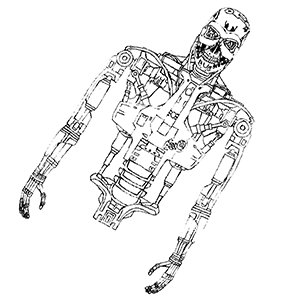
Cybernetic revolt is a scenario in which an artificial intelligence (either a single supercomputer, a computer network, or sometimes a ‘race’ of intelligent machines) decide that humans (and/or organic non-humans) are a threat (either to the machines or to themselves), are inferior, or are oppressors and try to destroy or to enslave them potentially leading to machine rule. In this fictional scenario, humans are often depicted to prevail using ‘human’ qualities, for example using emotions, illogic, inefficiency, duplicity, unpredictability, or exploiting the supposedly rigid, rules-based thinking and lack of innovation of the computer’s black/white mind.
Fear of humanity being made obsolete by technology taps into some of modern humans’ deepest fears. This can be shown to have been the case even before the computer became prominent, as in Karel Capek’s 1921 play ‘R.U.R.’ (Rossum’s Universal Robots). However, even as they were slowly being displaced from most physical tasks, humans have always prided themselves on their brains, taking the mechanistic ‘thoughts’ of early computers as proof that they would not be overtaken by their ‘Frankenstein’ creations.
read more »
Posted in Technology, War |
Leave a Comment »
October 11, 2011

‘Why the future doesn’t need us‘ is an article written by Bill Joy (then Chief Scientist at Sun Microsystems) in the April 2000 issue of ‘Wired’ magazine. In the article, he argues (quoting the sub title) that ‘Our most powerful 21st-century technologies — robotics, genetic engineering, and nanotech — are threatening to make humans an endangered species.’ Joy warns: ‘The experiences of the atomic scientists clearly show the need to take personal responsibility, the danger that things will move too fast, and the way in which a process can take on a life of its own. We can, as they did, create insurmountable problems in almost no time flat. We must do more thinking up front if we are not to be similarly surprised and shocked by the consequences of our inventions.’
While some critics have characterized Joy’s stance as obscurantism (the practice of deliberately preventing the facts or the full details of some matter from becoming known) or neo-Luddism, others share his concerns about the consequences of rapidly expanding technology.
read more »
Posted in Money, Politics, Technology |
Leave a Comment »
October 11, 2011

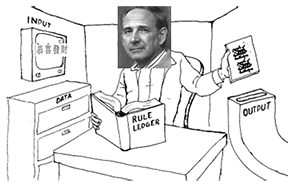
Strong AI is artificial intelligence that matches or exceeds human intelligence — the intelligence of a machine that can successfully perform any intellectual task that a human being can. It is a primary goal of artificial intelligence research and an important topic for science fiction writers and futurists.
Strong AI is also referred to as ‘artificial general intelligence’ or as the ability to perform ‘general intelligent action.’ Science fiction associates strong AI with such human traits as consciousness (subjective experience and thought), sentience (subjective feelings and emotion), sapience (wisdom) and self-awareness (identification of oneself as a separate individual, especially to be aware of one’s own thoughts). Some references emphasize a distinction between strong AI and ‘applied AI’ (also called ‘narrow AI’ or ‘weak AI’): the use of software to study or accomplish specific problem solving or reasoning tasks that do not encompass (or in some cases are completely outside of) the full range of human cognitive abilities.
read more »
Posted in Language, Philosophy, Technology |
1 Comment »
October 7, 2011

In Internet culture, a lurker is a person who reads discussions on a message board, newsgroup, chatroom, file sharing or other interactive system, but rarely or never participates actively.
Research indicates that lurkers make up over 90% of online groups. Lack of trust represents one of the reasons explaining lurking behavior.
read more »
Posted in Language, Technology |
Leave a Comment »



