September 29, 2011


Technophobia is the fear or dislike of advanced technology or complex devices, especially computers. The term is generally used in the sense of an irrational fear, but others contend fears are justified. It is the opposite of technophilia. First receiving widespread notice during the Industrial Revolution, technophobia has been observed to affect various societies and communities throughout the world. This has caused some groups to take stances against some modern technological developments in order to preserve their ideologies. In some of these cases, the new technologies conflict with established beliefs, such as the personal values of simplicity and modest lifestyles.
A number of examples of technophobic ideas can be found in multiple forms of art, ranging from literary works such as ‘Frankenstein’ to films like ‘Metropolis.’ Many of these works portray the darker side of technology as seen by the technophobic. As technologies become increasingly complex and difficult to understand, people are more likely to harbor anxieties relating to their use of modern technologies.
read more »
Posted in Health, Language, Technology |
Leave a Comment »
September 29, 2011


The concept known as the law of the instrument, Maslow’s hammer, or a golden hammer is an over-reliance on a familiar tool; as psychologist Abraham Maslow said in 1966, ‘It is tempting, if the only tool you have is a hammer, to treat everything as if it were a nail.’ The sentiment that people look for cure-alls, and over-use familiar tools, is likely traditional; see panacea. Likewise, the use of a hammer and nail as imagery are likely as old as hammers and nails, or even the use of rocks as tools, which the hammer evokes.
The hammer and nail metaphor may not be original to Kaplan or Maslow, and has been attributed to Mark Twain, though there is no documentation of this origin in Twain’s published writings. Under the name of ‘Baruch’s Observation,’ it is also been attributed to Bernard M. Baruch, a stock market speculator and author.
read more »
Posted in Humor, Philosophy, Technology |
Leave a Comment »
September 28, 2011

Morphing is a special effect in motion pictures and animations that changes (or morphs) one image into another through a seamless transition. Most often it is used to depict one person turning into another through technological means or as part of a fantasy or surreal sequence. Traditionally such a depiction would be achieved through cross-fading techniques on film. Since the early 1990s, this has been replaced by computer software to create more realistic transitions.
Though the 1986 movie ‘The Golden Child’ implemented very crude morphing effects from animal to human and back, the first movie to employ detailed morphing was ‘Willow,’ in 1988. A similar process was used a year later in ‘Indiana Jones and the Last Crusade’ to create Walter Donovan’s gruesome demise. Both effects were created by Industrial Light and Magic using grid warping techniques developed by Tom Brigham and Doug Smythe.
read more »
Posted in Art, Money, Technology |
1 Comment »
September 27, 2011

The concept of multiple discovery is the hypothesis that most scientific discoveries and inventions are made independently and more or less simultaneously by multiple scientists and inventors. The concept of multiple discovery opposes a traditional view—the ‘heroic theory’ of invention and discovery. When Nobel laureates are announced annually—especially in physics, chemistry, physiology-or-medicine, and economics—increasingly, in the given field, rather than just a single laureate, there are two or the maximally-permissible three, who often have independently made the same discovery.
Commonly cited examples of multiple independent discovery are the 17th-century independent formulation of calculus by Isaac Newton, Gottfried Wilhelm Leibniz and others, described by British historian A. Rupert Hall; the 18th-century discovery of oxygen by Carl Wilhelm Scheele, Joseph Priestley, Antoine Lavoisier and others; and the theory of evolution of species, independently advanced in the 19th century by Charles Darwin and Alfred Russel Wallace.
read more »
Posted in Science, Technology |
Leave a Comment »
September 27, 2011

Hypermiling is the act of driving using techniques that maximize fuel economy. Those who practice these techniques are referred to as ‘hypermilers.’ Hypermiling can be practiced in any vehicle regardless of its fuel economy. It gained popularity as a result of the rise in gasoline prices during the 2000s. Some hypermiling techniques are illegal in some jurisdictions because they are dangerous. Hypermiling has come under fire from several quarters due to claims of dangerous or unlawful behavior by some hypermilers, such as tailgating larger vehicles on freeways to save fuel by drafting. As a result, the Hypermiling Safety Foundation was formed in August 2008 to promote a safety and public awareness program, advocating legal fuel-saving techniques.
Hypermiling contests have been held on selected courses. The Maximum Fuel Economy contest was held in Indiana, where ‘world records’ for the Honda Insight (213 miles per gallon), Toyota Prius (136 miles per gallon) and the Ford Escape Hybrid (76 miles per gallon) were set. Contestants used techniques which included rolling through all stop signs and having the vehicle tires inflated well beyond recommended specifications. Another contest is the Tour to the Shore, held in New Jersey, which evaluates drivers of cars and trucks.
Posted in Games, Money, Technology |
Leave a Comment »
September 26, 2011

Titanium rings are jewelry rings or bands which have been primarily constructed from titanium. The actual compositions of titanium can vary, such as ‘commercial pure’ (99.2% titanium) or ‘aircraft grade’ (90% titanium). Rings crafted from titanium are a modern phenomenon, becoming widely available on the market around the 1990s.
They offer several unique properties: they are biocompatible (hypoallergenic), lightweight, corrosion-resistant, and have the highest strength-to-weight ratio of any metal. Titanium was discovered in England in 1791 by William Gregor.
read more »
Posted in Art, Money, Technology |
Leave a Comment »
September 26, 2011


Real-time ridesharing (also known as dynamic carpooling) is a service that arranges one-time shared rides on very short notice. This type of carpooling generally makes use of three recent technological advances: GPS navigation devices to determine a driver’s route and arrange the shared ride; Smartphones for a traveler to request a ride from wherever they happen to be; and social networks to establish trust and accountability between drivers and passengers. These elements are coordinated through a network service, which can instantaneously handle the driver payments and match rides using an optimization algorithm.
Real-time ridesharing is promoted as a way to better utilize the empty seats in most passenger cars, thus lowering fuel usage and transport costs. It can serve areas not covered by a public transit system and act as a transit feeder service. It is also capable of serving one-time trips, not only recurrent commute trips. Furthermore, it can serve to limit the volume of car traffic, thereby reducing congestion and mitigating traffic’s environmental impact.
Posted in Money, Technology |
Leave a Comment »
September 26, 2011


A simulation video game describes a diverse super-category of video games, generally designed to closely simulate aspects of a real or fictional reality. Construction and management simulation (CMS) is a subtype in which players build, expand or manage fictional communities or projects with limited resources.
Strategy games sometimes incorporate CMS aspects into their game economy, as players must manage resources while expanding their project. But pure CMS games differ from strategy games in that ‘the player’s goal is not to defeat an enemy, but to build something within the context of an ongoing process.’ Games in this category are sometimes also called ‘management games.’
read more »
Posted in Games, Technology |
Leave a Comment »
September 26, 2011

A ‘shoot ’em up’ is a subgenre of video games in which the player controls a lone character, often in a spacecraft or aircraft, facing large numbers of enemies while dodging their attacks. A variation arose in the early 1990s called ‘maniac shooters’ and ‘bullet hell,’ which required the player to dodge overwhelming numbers of enemy projectiles and called for still faster reactions. Bullet hell games arose from the need for 2D shoot ’em up developers to compete with the emerging popularity of 3D games: huge numbers of missiles on screen were intended to impress players. Toaplan’s ‘Batsugun’ (1993) provided the prototypical template for this new breed, with ‘Cave’ (formed by former employees of Toaplan, including ‘Batsugun’ creator Tsuneki Ikeda, after the latter company collapsed) inventing the type proper with 1995’s ‘DonPachi.’
Manic shooter games marked another point where the shoot ’em up genre began to cater to more dedicated players. Games such as ‘Gradius’ had been more difficult than ‘Space Invaders’ or ‘Xevious,’ but bullet hell games were yet more inward-looking and aimed at fans of the genre looking for greater challenges. Treasure’s shoot ’em up, ‘Radiant Silvergun’ (1998), introduced an element of narrative to the genre. It was lavished with critical acclaim for its refined design, though it was never released outside of Japan and remains a much sought after collectors’ item. Its successor ‘Ikaruga’ (2001) featured improved graphics and was again acclaimed as one of the best games in the genre. The genre has undergone something of a resurgence with the release of the Xbox 360 and Wii online services, and games like ‘Geometry Wars: Retro Evolved,’ while in Japan arcade shoot ’em ups retain a deep-rooted niche popularity.
Posted in Games, Money, Technology |
Leave a Comment »
September 25, 2011

The Voyager Golden Records are phonograph records which were included aboard both Voyager spacecraft, which were launched in 1977. They contain sounds and images selected to portray the diversity of life and culture on Earth, and are intended for any intelligent extraterrestrial life form, or for future humans, who may find them. As the probes are extremely small compared to the vastness of interstellar space, the probability of a space faring civilization encountering them is very small, especially since the probes will eventually stop emitting any kind of electromagnetic radiation. If they are ever found by an alien species, it will most likely be far in the future as the nearest star on Voyager 1’s trajectory will only be reached in 40,000 years. Voyager 1 passed the orbit of Pluto in 1990, and left the solar system in 2004. In 2009, it was over 16.5 billion km from the Sun and traveling at a speed of 38,000 mph.
As Carl Sagan noted, ‘The spacecraft will be encountered and the record played only if there are advanced space-faring civilizations in interstellar space. But the launching of this ‘bottle’ into the cosmic ‘ocean’ says something very hopeful about life on this planet.’ Thus the record is best seen as a time capsule or a symbolic statement rather than a serious attempt to communicate with extraterrestrial life. The inscription, by President Jimmy Carter, reads: ‘This is a present from a small, distant world, a token of our sounds, our science, our images, our music, our thoughts and our feelings. We are attempting to survive our time so we may live into yours.’
read more »
Posted in Art, Language, Technology |
Leave a Comment »
September 25, 2011

Whole body vibration (WBV) therapy was explored by Russian scientist Vladimir Nazarov, who tested vibration on cosmonauts in an effort to decrease the loss of muscle and bone mass in space. As there is minimal gravitational force in space, muscles and bones are not loaded as they normally are on earth. Humans in space lose their muscular strength very quickly, which is why they are not able to easily walk when they come back to earth. The decrease of bone density increases the risk of bone fractures, so it’s not safe to stay in space for extended periods. The aerospace industry in the former Soviet Union worked with vibration training. Before their departure, cosmonauts were subjected to special training sessions so that the density of their bones would increase and their muscular strength would rise.
A particular form of WBV is vibration training, which is becoming increasingly popular. Initially, vibration training was mainly used in the fitness industry, but the use of vibration equipment is expanding quickly. It is now widely used in physical therapy, rehabilitation and professional sports, but it is also increasingly used for beauty and wellness applications.
read more »
Posted in Health, Money, Technology |
Leave a Comment »
September 25, 2011
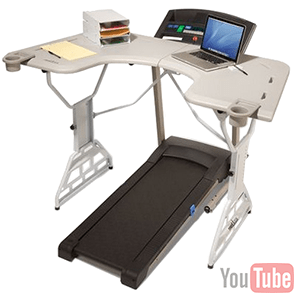
A treadmill desk is a work desk built around a treadmill. A person using the treadmill desk walks slowly on the treadmill while continuing to perform office tasks at the desk. There are several types of treadmill desks available on the open market. Some incorporate a traditional treadmill with a desktop built over it, while most are now commercially built for this specific use. The aim of a treadmill desk is to integrate movement and gentle exercise into the working day of an otherwise sedentary office worker. Rather than sitting all day in a chair, a treadmill desk allows desk-based workers to stand and take a slow walk while working.
A treadmill desk is not typically used for a cardio workout, as most users find walking at a speed of 1.0 – 2.0 mph the ideal range. At slower walking speeds, most able-bodied people can undertake desk-based tasks such as typing or talking on the telephone. However, even at these slower speeds, a person may burn 100 – 150 calories per hour, which may result in increased fitness and weight loss. The aim of the treadmill desk is to improve fitness and reduce obesity in office workers. Scientific research has also shown that walking, like other forms of mild exercise, can also improve one’s mental alertness, heighten creativity, fight depression, increase productivity and improve one’s mood.
Posted in Health, Money, Technology |
Leave a Comment »