September 26, 2011

A ‘shoot ’em up’ is a subgenre of video games in which the player controls a lone character, often in a spacecraft or aircraft, facing large numbers of enemies while dodging their attacks. A variation arose in the early 1990s called ‘maniac shooters’ and ‘bullet hell,’ which required the player to dodge overwhelming numbers of enemy projectiles and called for still faster reactions. Bullet hell games arose from the need for 2D shoot ’em up developers to compete with the emerging popularity of 3D games: huge numbers of missiles on screen were intended to impress players. Toaplan’s ‘Batsugun’ (1993) provided the prototypical template for this new breed, with ‘Cave’ (formed by former employees of Toaplan, including ‘Batsugun’ creator Tsuneki Ikeda, after the latter company collapsed) inventing the type proper with 1995’s ‘DonPachi.’
Manic shooter games marked another point where the shoot ’em up genre began to cater to more dedicated players. Games such as ‘Gradius’ had been more difficult than ‘Space Invaders’ or ‘Xevious,’ but bullet hell games were yet more inward-looking and aimed at fans of the genre looking for greater challenges. Treasure’s shoot ’em up, ‘Radiant Silvergun’ (1998), introduced an element of narrative to the genre. It was lavished with critical acclaim for its refined design, though it was never released outside of Japan and remains a much sought after collectors’ item. Its successor ‘Ikaruga’ (2001) featured improved graphics and was again acclaimed as one of the best games in the genre. The genre has undergone something of a resurgence with the release of the Xbox 360 and Wii online services, and games like ‘Geometry Wars: Retro Evolved,’ while in Japan arcade shoot ’em ups retain a deep-rooted niche popularity.
Posted in Games, Money, Technology |
Leave a Comment »
September 25, 2011

The Voyager Golden Records are phonograph records which were included aboard both Voyager spacecraft, which were launched in 1977. They contain sounds and images selected to portray the diversity of life and culture on Earth, and are intended for any intelligent extraterrestrial life form, or for future humans, who may find them. As the probes are extremely small compared to the vastness of interstellar space, the probability of a space faring civilization encountering them is very small, especially since the probes will eventually stop emitting any kind of electromagnetic radiation. If they are ever found by an alien species, it will most likely be far in the future as the nearest star on Voyager 1’s trajectory will only be reached in 40,000 years. Voyager 1 passed the orbit of Pluto in 1990, and left the solar system in 2004. In 2009, it was over 16.5 billion km from the Sun and traveling at a speed of 38,000 mph.
As Carl Sagan noted, ‘The spacecraft will be encountered and the record played only if there are advanced space-faring civilizations in interstellar space. But the launching of this ‘bottle’ into the cosmic ‘ocean’ says something very hopeful about life on this planet.’ Thus the record is best seen as a time capsule or a symbolic statement rather than a serious attempt to communicate with extraterrestrial life. The inscription, by President Jimmy Carter, reads: ‘This is a present from a small, distant world, a token of our sounds, our science, our images, our music, our thoughts and our feelings. We are attempting to survive our time so we may live into yours.’
read more »
Posted in Art, Language, Technology |
Leave a Comment »
September 25, 2011
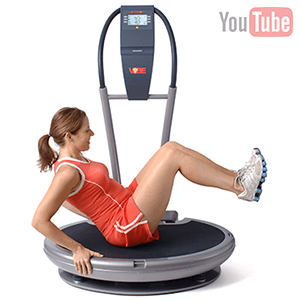
Whole body vibration (WBV) therapy was explored by Russian scientist Vladimir Nazarov, who tested vibration on cosmonauts in an effort to decrease the loss of muscle and bone mass in space. As there is minimal gravitational force in space, muscles and bones are not loaded as they normally are on earth. Humans in space lose their muscular strength very quickly, which is why they are not able to easily walk when they come back to earth. The decrease of bone density increases the risk of bone fractures, so it’s not safe to stay in space for extended periods. The aerospace industry in the former Soviet Union worked with vibration training. Before their departure, cosmonauts were subjected to special training sessions so that the density of their bones would increase and their muscular strength would rise.
A particular form of WBV is vibration training, which is becoming increasingly popular. Initially, vibration training was mainly used in the fitness industry, but the use of vibration equipment is expanding quickly. It is now widely used in physical therapy, rehabilitation and professional sports, but it is also increasingly used for beauty and wellness applications.
read more »
Posted in Health, Money, Technology |
Leave a Comment »
September 25, 2011
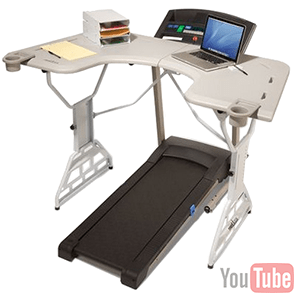
A treadmill desk is a work desk built around a treadmill. A person using the treadmill desk walks slowly on the treadmill while continuing to perform office tasks at the desk. There are several types of treadmill desks available on the open market. Some incorporate a traditional treadmill with a desktop built over it, while most are now commercially built for this specific use. The aim of a treadmill desk is to integrate movement and gentle exercise into the working day of an otherwise sedentary office worker. Rather than sitting all day in a chair, a treadmill desk allows desk-based workers to stand and take a slow walk while working.
A treadmill desk is not typically used for a cardio workout, as most users find walking at a speed of 1.0 – 2.0 mph the ideal range. At slower walking speeds, most able-bodied people can undertake desk-based tasks such as typing or talking on the telephone. However, even at these slower speeds, a person may burn 100 – 150 calories per hour, which may result in increased fitness and weight loss. The aim of the treadmill desk is to improve fitness and reduce obesity in office workers. Scientific research has also shown that walking, like other forms of mild exercise, can also improve one’s mental alertness, heighten creativity, fight depression, increase productivity and improve one’s mood.
Posted in Health, Money, Technology |
Leave a Comment »
September 25, 2011

A standing desk is both an antique desk and a modern desk form conceived for writing and/or reading while standing up or while sitting on a high stool. The term stand-up or stand up desk is also used. During the 18th and 19th centuries, standing desks were popular in the homes and offices of the rich. While most modern desks are 30 inches (76 cm.) high and most antique desks 29 inches high (73.7 cm), there is no such average for standing desks.
Users of a ‘sitting desk’ are fairly immobile so it is relatively easy to adjust the height of a seat to compensate for variations in the individual height of the users. Users of a standing desk move around a bit more, so it is not practical to have them stand on a small pedestal or some other object. Thus, standing desks tend to vary greatly in height.
read more »
Posted in Health, Money, Technology |
2 Comments »
September 22, 2011

Nymwars is the name given to the conflicts over policies mandating that users of internet service identify using real names. They began in the summer of 2011 when nascent social networking site Google+ began enforcing such a policy by suspending the accounts of users it deemed in breach. Pseudonyms, nicknames, and non-standard real names (for example, mononyms or names that include scripts from multiple languages) have all been blocked.
The term was coined from ‘pseudonym’ and appears to have gained prominence as the hashtag ‘#nymwars’ on Twitter. The resulting discussions has raised many issues regarding naming, cultural sensitivity, public and private identity, and the role of social media in modern discourse. At the time of launch, the site’s user content and conduct policy stated, ‘To help fight spam and prevent fake profiles, use the name your friends, family or co-workers usually call you.’
read more »
Posted in Money, Politics, Technology |
2 Comments »
September 22, 2011

Cleverbot is an artificial intelligence (AI) web application that learns how to mimic human conversations by communicating with humans. It was created by AI scientist Rollo Carpenter, who also created Jabberwacky, a similar web application. In the first decade of its existence after being created in 1988, Cleverbot held several thousand conversations with Carpenter and his associates. Since being launched on the web in 1997, the number of conversations has exceeded 65 million. Cleverbot, a learning Artificial Intelligence conversationalist, took part alongside humans in a formal Turing Test at the Techniche 2011 festival at IIT Guwahati, India. Cleverbot was judged to be 59.3% human, far exceeding expectations. The humans in the event achieved just 63.3%.
Cleverbot differs from traditional chatterbots in that the user is not holding a conversation with a bot that directly responds to entered text. Instead, when the user enters text, the algorithm selects previously entered phrases from its database of prior conversations. It has been claimed that ‘talking to Cleverbot is a little like talking with the collective community of the Internet.’
Posted in Humor, Technology |
Leave a Comment »
September 21, 2011

The Leslie speaker is a specially constructed amplifier/loudspeaker used to create special audio effects using the Doppler effect. Named after its inventor, Donald Leslie, it is particularly associated with the Hammond organ, an electric organ invented by Laurens Hammond in 1934 and manufactured by the Hammond Organ Company. While the Hammond organ was originally sold to churches as a lower-cost alternative to the wind-driven pipe organ, in the 1960s and 1970s it became a standard keyboard instrument for jazz, blues, rock music, church and gospel music. The Hammond/Leslie combination has become an element in many genres of music. Both brands are currently owned by Suzuki Musical Instrument Corporation.
Unlike a high fidelity loudspeaker, the Leslie is specifically designed, via reproduction of the Doppler effect, to alter or modify sound. Although there have been many variations over the years, the classic Leslie speaker consists of two driver units – a treble unit with horns, and a bass unit, and a crossover that divided the frequencies between the horn and the woofer. The key feature is that both the horns (in reality one working horn with a dummy to counter-balance it) and a sound baffle or scoop for the bass are electrically rotated to create ‘Doppler effect based’ vibrato, tremolo and chorus effects. The rotating elements can be stopped, switched between slow (chorale) and fast (tremolo), or transitioned between the two settings.
read more »
Posted in Art, Money, Technology |
Leave a Comment »
September 16, 2011

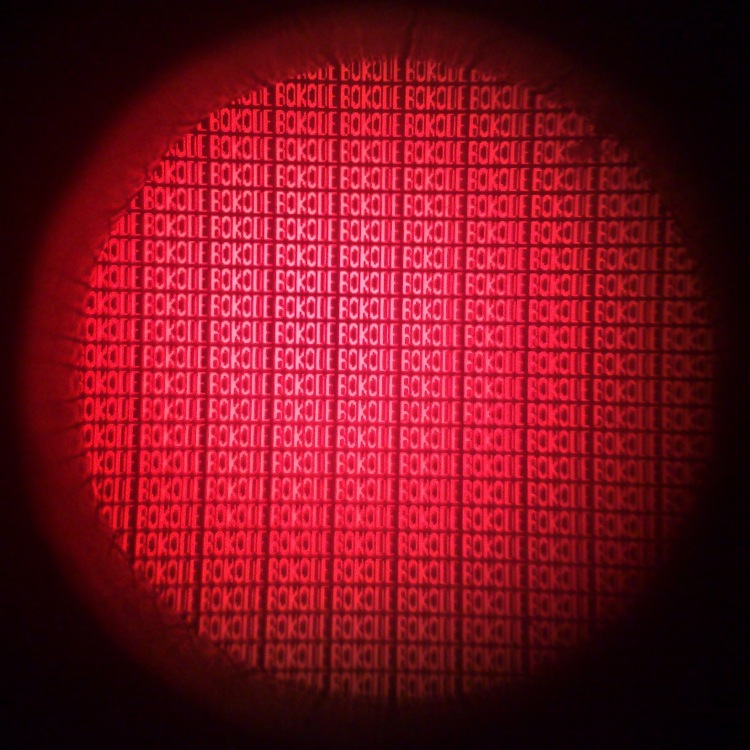
A bokode is a type of data tag which holds thousands of times more information than a barcode. They were developed by a team at the MIT Media Lab. The bokode pattern is a tiled series of Data Matrix codes. The name is a portmanteau of the words bokeh (a photographic term) and barcode – rewritable bokodes are called bocodes. They are much smaller than a barcode and are circular in shape with a diameter of 3mm. A bokode consists of an LED covered with a mask and a lens. They are readable from different angles and from 4 meters (13 feet) away by an SLR camera.
Currently they are expensive to produce as the LED requires power, but there are prototypes which manage with reflected light. Bokodes represent a privacy advantage compared to Radio-frequency identification tags (RFID): bokodes can be covered up, whereas active as well as passive RFID tags can be read from a distance with equipment that can receive radio signals.
Posted in Money, Technology |
Leave a Comment »
September 16, 2011

In photography, bokeh [boh-kay] is the blur, or the aesthetic quality of the blur, in out-of-focus areas of an image, or ‘the way the lens renders out-of-focus points of light.’ Differences in lens aberrations and aperture shape cause some lens designs to blur the image in a way that is pleasing to the eye, while others produce blurring that is unpleasant or distracting—’good’ and ‘bad’ bokeh, respectively. Bokeh occurs for parts of the scene that lie outside the depth of field. Photographers sometimes deliberately use a shallow focus technique to create images with prominent out-of-focus regions.
Bokeh is often most visible around small background highlights, such as specular reflections and light sources, which is why it is often associated with such areas. However, bokeh is not limited to highlights; blur occurs in all out-of-focus regions of the image.
read more »
Posted in Art, Language, Technology |
2 Comments »
September 12, 2011

Easy Cheese is the trademark for a processed cheese product distributed by Kraft Foods, also referred to as aerosol cheese or spray cheese, and is a descendant of squeeze cheese (a semi-solid cheesefood from the 1970s packaged in a squeezable plastic tube). It comes packaged in a spray can, much like canned whipped cream and does not require refrigeration. Easy Cheese contains milk, water, whey protein concentrate, canola oil, milk protein concentrate, sodium citrate, sodium phosphate, calcium phosphate, lactic acid, sorbic acid, sodium alginate, apocarotenal, annatto, cheese culture, and enzymes.
Although sometimes called ‘aerosol cheese,’ its container is not actually an aerosol spray can. Rather, the can contains a piston and a barrier plastic cap which squeezes the cheese through the nozzle in a solid column when the nozzle is pressed and the propellant expands in volume. The propellant, therefore, does not mix with the cheese. This explains why the can has a small rubber plug on its base. The can design also ensures that the cheese can be dispensed with the can upright or inverted.
Posted in Food, Money, Technology |
Leave a Comment »
September 11, 2011

The US government, led by the CIA’s Special Activities Division, has made a series of attacks on targets in northwest Pakistan since 2004 using drones (unmanned aerial vehicles). These attacks are part of the US’ War on Terrorism campaign, seeking to defeat Taliban and Al-Qaeda militants in Pakistan. Most of these attacks are on targets in the Federally Administered Tribal Areas along the Afghan border in Northwest Pakistan. These strikes have increased substantially under the Presidency of Barack Obama. Generally the UAVs used are MQ-1 Predator and more recently MQ-9 Reaper firing AGM-114 Hellfire missiles. The drones have become a weapon of choice for the United States in the fight against al-Qaeda. Some media refer to the series of attacks as a ‘drone war.’ The US defence budget for 2011 asked for a 75% increase in funds to enhance the drone operations.
There is tremendous debate over the civilian casualty ratio of drone strikes. The CIA claims very few civilians are killed in relation to militants. Pakistan’s government, on the other hand publicly condemns these attacks; its Interior Minister has said ‘Drone missiles cause collateral damage. A few militants are killed, but the majority of victims are innocent citizens.’ The strikes are often linked to Anti-American sentiment in Pakistan and the growing unease with the scope of CIA activity there. However, in secret cables leaked by Wikileaks, Pakistan’s Army Chief not only tacitly agreed to the drone flights but in 2008 requested Americans to increase them.
read more »
Posted in Politics, Technology, War |
Leave a Comment »




 The Daily Omnivore