September 25, 2011

A standing desk is both an antique desk and a modern desk form conceived for writing and/or reading while standing up or while sitting on a high stool. The term stand-up or stand up desk is also used. During the 18th and 19th centuries, standing desks were popular in the homes and offices of the rich. While most modern desks are 30 inches (76 cm.) high and most antique desks 29 inches high (73.7 cm), there is no such average for standing desks.
Users of a ‘sitting desk’ are fairly immobile so it is relatively easy to adjust the height of a seat to compensate for variations in the individual height of the users. Users of a standing desk move around a bit more, so it is not practical to have them stand on a small pedestal or some other object. Thus, standing desks tend to vary greatly in height.
read more »
Posted in Health, Money, Technology |
2 Comments »
September 22, 2011

Nymwars is the name given to the conflicts over policies mandating that users of internet service identify using real names. They began in the summer of 2011 when nascent social networking site Google+ began enforcing such a policy by suspending the accounts of users it deemed in breach. Pseudonyms, nicknames, and non-standard real names (for example, mononyms or names that include scripts from multiple languages) have all been blocked.
The term was coined from ‘pseudonym’ and appears to have gained prominence as the hashtag ‘#nymwars’ on Twitter. The resulting discussions has raised many issues regarding naming, cultural sensitivity, public and private identity, and the role of social media in modern discourse. At the time of launch, the site’s user content and conduct policy stated, ‘To help fight spam and prevent fake profiles, use the name your friends, family or co-workers usually call you.’
read more »
Posted in Money, Politics, Technology |
2 Comments »
September 22, 2011

Cleverbot is an artificial intelligence (AI) web application that learns how to mimic human conversations by communicating with humans. It was created by AI scientist Rollo Carpenter, who also created Jabberwacky, a similar web application. In the first decade of its existence after being created in 1988, Cleverbot held several thousand conversations with Carpenter and his associates. Since being launched on the web in 1997, the number of conversations has exceeded 65 million. Cleverbot, a learning Artificial Intelligence conversationalist, took part alongside humans in a formal Turing Test at the Techniche 2011 festival at IIT Guwahati, India. Cleverbot was judged to be 59.3% human, far exceeding expectations. The humans in the event achieved just 63.3%.
Cleverbot differs from traditional chatterbots in that the user is not holding a conversation with a bot that directly responds to entered text. Instead, when the user enters text, the algorithm selects previously entered phrases from its database of prior conversations. It has been claimed that ‘talking to Cleverbot is a little like talking with the collective community of the Internet.’
Posted in Humor, Technology |
Leave a Comment »
September 21, 2011

The Leslie speaker is a specially constructed amplifier/loudspeaker used to create special audio effects using the Doppler effect. Named after its inventor, Donald Leslie, it is particularly associated with the Hammond organ, an electric organ invented by Laurens Hammond in 1934 and manufactured by the Hammond Organ Company. While the Hammond organ was originally sold to churches as a lower-cost alternative to the wind-driven pipe organ, in the 1960s and 1970s it became a standard keyboard instrument for jazz, blues, rock music, church and gospel music. The Hammond/Leslie combination has become an element in many genres of music. Both brands are currently owned by Suzuki Musical Instrument Corporation.
Unlike a high fidelity loudspeaker, the Leslie is specifically designed, via reproduction of the Doppler effect, to alter or modify sound. Although there have been many variations over the years, the classic Leslie speaker consists of two driver units – a treble unit with horns, and a bass unit, and a crossover that divided the frequencies between the horn and the woofer. The key feature is that both the horns (in reality one working horn with a dummy to counter-balance it) and a sound baffle or scoop for the bass are electrically rotated to create ‘Doppler effect based’ vibrato, tremolo and chorus effects. The rotating elements can be stopped, switched between slow (chorale) and fast (tremolo), or transitioned between the two settings.
read more »
Posted in Art, Money, Technology |
Leave a Comment »
September 16, 2011

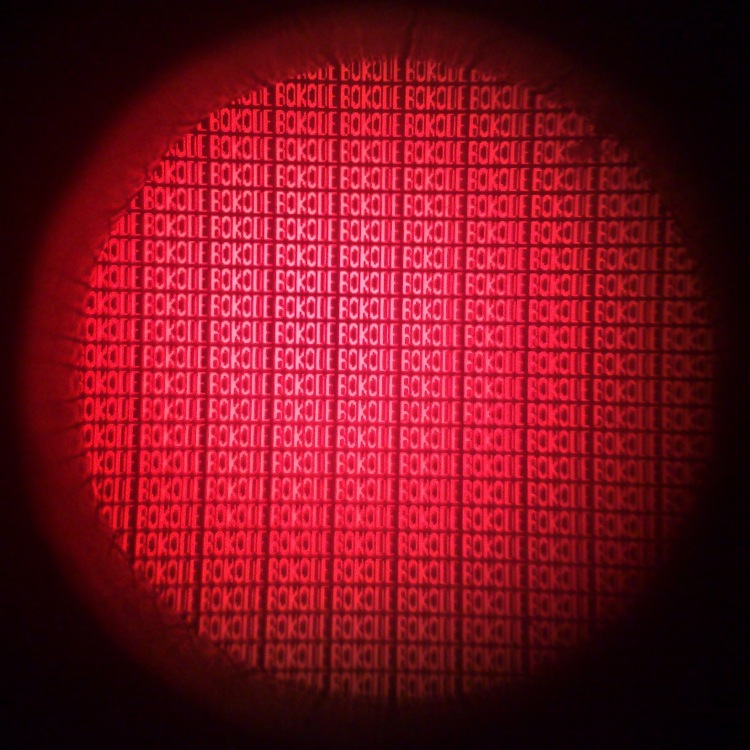
A bokode is a type of data tag which holds thousands of times more information than a barcode. They were developed by a team at the MIT Media Lab. The bokode pattern is a tiled series of Data Matrix codes. The name is a portmanteau of the words bokeh (a photographic term) and barcode – rewritable bokodes are called bocodes. They are much smaller than a barcode and are circular in shape with a diameter of 3mm. A bokode consists of an LED covered with a mask and a lens. They are readable from different angles and from 4 meters (13 feet) away by an SLR camera.
Currently they are expensive to produce as the LED requires power, but there are prototypes which manage with reflected light. Bokodes represent a privacy advantage compared to Radio-frequency identification tags (RFID): bokodes can be covered up, whereas active as well as passive RFID tags can be read from a distance with equipment that can receive radio signals.
Posted in Money, Technology |
Leave a Comment »
September 16, 2011

In photography, bokeh [boh-kay] is the blur, or the aesthetic quality of the blur, in out-of-focus areas of an image, or ‘the way the lens renders out-of-focus points of light.’ Differences in lens aberrations and aperture shape cause some lens designs to blur the image in a way that is pleasing to the eye, while others produce blurring that is unpleasant or distracting—’good’ and ‘bad’ bokeh, respectively. Bokeh occurs for parts of the scene that lie outside the depth of field. Photographers sometimes deliberately use a shallow focus technique to create images with prominent out-of-focus regions.
Bokeh is often most visible around small background highlights, such as specular reflections and light sources, which is why it is often associated with such areas. However, bokeh is not limited to highlights; blur occurs in all out-of-focus regions of the image.
read more »
Posted in Art, Language, Technology |
2 Comments »
September 12, 2011

Easy Cheese is the trademark for a processed cheese product distributed by Kraft Foods, also referred to as aerosol cheese or spray cheese, and is a descendant of squeeze cheese (a semi-solid cheesefood from the 1970s packaged in a squeezable plastic tube). It comes packaged in a spray can, much like canned whipped cream and does not require refrigeration. Easy Cheese contains milk, water, whey protein concentrate, canola oil, milk protein concentrate, sodium citrate, sodium phosphate, calcium phosphate, lactic acid, sorbic acid, sodium alginate, apocarotenal, annatto, cheese culture, and enzymes.
Although sometimes called ‘aerosol cheese,’ its container is not actually an aerosol spray can. Rather, the can contains a piston and a barrier plastic cap which squeezes the cheese through the nozzle in a solid column when the nozzle is pressed and the propellant expands in volume. The propellant, therefore, does not mix with the cheese. This explains why the can has a small rubber plug on its base. The can design also ensures that the cheese can be dispensed with the can upright or inverted.
Posted in Food, Money, Technology |
Leave a Comment »
September 11, 2011

The US government, led by the CIA’s Special Activities Division, has made a series of attacks on targets in northwest Pakistan since 2004 using drones (unmanned aerial vehicles). These attacks are part of the US’ War on Terrorism campaign, seeking to defeat Taliban and Al-Qaeda militants in Pakistan. Most of these attacks are on targets in the Federally Administered Tribal Areas along the Afghan border in Northwest Pakistan. These strikes have increased substantially under the Presidency of Barack Obama. Generally the UAVs used are MQ-1 Predator and more recently MQ-9 Reaper firing AGM-114 Hellfire missiles. The drones have become a weapon of choice for the United States in the fight against al-Qaeda. Some media refer to the series of attacks as a ‘drone war.’ The US defence budget for 2011 asked for a 75% increase in funds to enhance the drone operations.
There is tremendous debate over the civilian casualty ratio of drone strikes. The CIA claims very few civilians are killed in relation to militants. Pakistan’s government, on the other hand publicly condemns these attacks; its Interior Minister has said ‘Drone missiles cause collateral damage. A few militants are killed, but the majority of victims are innocent citizens.’ The strikes are often linked to Anti-American sentiment in Pakistan and the growing unease with the scope of CIA activity there. However, in secret cables leaked by Wikileaks, Pakistan’s Army Chief not only tacitly agreed to the drone flights but in 2008 requested Americans to increase them.
read more »
Posted in Politics, Technology, War |
Leave a Comment »
September 7, 2011

Hilti develops, manufactures, and markets products for the construction and building maintenance industries, primarily to the professional end-user. It concentrates primarily on hammer drills, firestops, and installation systems, but manufactures and markets an array of tools (including cordless electric drills, heavy angle drills, laser levels, power saws, and fasteners). Hilti is based in Liechtenstein, and is the principality’s largest employer. The company employs more than 20,000 people worldwide with over 2,500 employees in the United States. Hilti’s North American headquarters has been located in Tulsa, Oklahoma, since 1979.
The Hilti Group invests over US$160 million annually in researching and developing safer and more efficient building technologies. A recent example of this R&D in power tool technology is Hilti’s TPS (Theft Protection System), which relies on RF technology to prevent unauthorized users from activating power tools, thus discouraging theft. Similarly, Hilti’s ATC (Active Torque Control) technology monitors tool-body movement to prevent equipment from twisting out of the operator’s grip and causing injury. Other developments include improved design of chemical and mechanical anchors for better durability during seismic events, thus helping to save lives during natural disasters.
Posted in Money, Technology |
1 Comment »
September 7, 2011
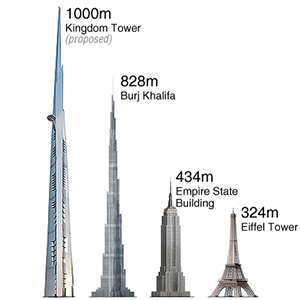
Kingdom Tower is a supertall skyscraper approved for construction in Jeddah, Saudi Arabia at a preliminary cost of US$1.23 billion. It will be the centerpiece and first phase of a US$20 billion proposed development known as Kingdom City that will be located along the Red Sea on the north side of Jeddah. If completed as planned, the tower will reach unprecedented heights, becoming the tallest building in the world, as well as the first structure to reach the one-kilometer mark. The design, created by American architect Adrian Smith, incorporates many unique structural and aesthetic features.
The creator and leader of the project is Saudi Arabian Prince Al-Waleed bin Talal, the wealthiest Arab in the Middle East, and nephew of King Abdullah. Talal is the chairman of Kingdom Holding Company (KHC), the largest company in Saudi Arabia, which owns the project, and a partner in Jeddah Economic Company (JEC), which was formed in 2009 for the development of Kingdom Tower and City. Reception of the proposal has been highly polarized, receiving high praise from some as a culturally significant icon that will symbolize the nation’s wealth and power, while others question its socioeconomic motives, and forecast that it will actually have negative financial consequences.
Posted in Money, Technology, World |
1 Comment »
September 7, 2011

Mountainboarding is a well established, if little-known extreme sport, derived from snowboarding. A mountainboard is made up of components including a deck, bindings to secure the rider to the deck, four wheels with pneumatic tires, and two steering mechanisms known as trucks.
Mountainboarders ride specifically designed boardercross tracks, slopestyle parks, grass hills, woodlands, gravel tracks, streets, skateparks, ski resorts, BMX courses and mountain bike trails. It is this ability to ride such a variety of terrain that separates mountainboarding from other board sports.
read more »
Posted in Games, Technology |
Leave a Comment »
September 6, 2011
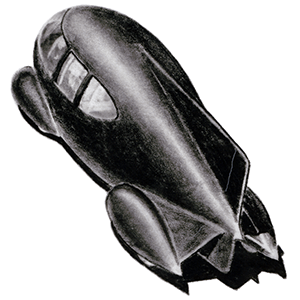
Norman Bel Geddes [bel-ged-eez] (1893 – 1958) was an American theatrical and industrial designer who focused on aerodynamics. His book ‘Horizons’ (1932) had a significant impact: ‘By popularizing streamlining when only a few engineers were considering its functional use, he made possible the design style of the thirties.’
He designed the General Motors Pavilion, known as Futurama, for the 1939 New York World’s Fair. For that famous and enormously influential installation, Bel Geddes exploited his earlier work in the same vein: he had designed a “Metropolis City of 1960′ in 1936.
read more »
Posted in Art, Technology |
Leave a Comment »