June 23, 2011


A sugar substitute is a food additive that duplicates the effect of sugar in taste, usually with less food energy. Some sugar substitutes are natural and some are synthetic. Those that are not natural are, in general, called artificial sweeteners.
Animal studies have indicated that a sweet taste induces an insulin response in rats. The release of insulin causes blood sugar to be stored in tissues (including fat). In the case of a response to artificial sweeteners, because blood sugar does not increase there can be increased hypoglycemia (low blood sugar) and increased food intake the next time there is a meal. Rats given sweeteners have steadily increased calorie intake, increased body weight, and increased adiposity (fatness).
read more »
Posted in Food, Health, Technology |
Leave a Comment »
June 21, 2011

Rustic buses are old artisan modified buses used in rural Colombia and Ecuador where they are known as chivas (kid goats) or escaleras (ladders). They are used as public transport and more recently used as party buses in both countries. These are varied but characterized for being painted colorfully (usually with the yellow, blue, and red colors of the flags of Ecuador and Colombia) with local arabesques and figures.
Most have a ladder to the rack on the roof which is also used for carrying people, livestock and merchandise. They are built upon a bus chassis with a modified body made out either metal or wood. Seats are bench alike, made out of wood and with doors instead of windows.
read more »
Posted in Art, Technology, World |
Leave a Comment »
June 21, 2011

The Wall of Sound was an enormous public address system designed specifically for the Grateful Dead’s live performances by audio engineer Owsley ‘Bear’ Stanley. Used in 1974, the Wall of Sound fulfilled the band’s desire for a distortion-free sound system that could also serve as its own monitoring system. The Wall of Sound was the largest concert sound system built at that time.
As Stanley described it, ‘The Wall of Sound is the name some people gave to a super powerful, extremely accurate PA system that I designed and supervised the building of in 1973 for the Grateful Dead. It was a massive wall of speaker arrays set behind the musicians, which they themselves controlled without a front of house mixer. It did not need any delay towers to reach a distance of half a mile from the stage without degradation.’
read more »
Posted in Art, Money, Technology |
Leave a Comment »
June 21, 2011

Space art is a general term for art emerging from knowledge and ideas associated with outer space, both as a source of inspiration and as a means for visualizing and promoting space travel. Whatever the stylistic path, the artist is generally attempting to communicate ideas somehow related to space, often including appreciation of the infinite variety and vastness which surrounds us.
In some cases, artists who consider themselves space artists use more than illustration and painting to communicate scientific discoveries or works depicting space; a new breed of space artists work directly with space flight technology and scientists as an opportunity to expand the arts, humanities and cultural expression relative to space exploration.
read more »
Posted in Art, Technology |
Leave a Comment »
June 21, 2011

American artist, Frank Pietronigro, is co-founder of the Zero Gravity Arts Consortium. The organization was founded in 1999 by Laura Knott, Lorelei Lisowsky and Frank Pietronigro. Zero Gravity Arts Consortium (ZGAC) is an international space arts organization dedicated to fostering greater access for artists to space flight technology and zero gravity space through the creation of international partnerships with space agencies, space industry entrepreneurs, arts and science organizations and leading universities.
ZGAC is the first organization of its kind, based in the United States, that is facilitating parabolic flight projects that will help in the international effort to set the stage for teams of artists to have permanent access to space transportation systems including the International Space Station. ZGAC supports arts, humanities and culture in space education, international outreach and conference programs that are being organized as a way for artists, from all over the globe, to affiliate with us and experience the possibilities of collaborating with space flight technologists.
Posted in Art, Technology |
Leave a Comment »
June 21, 2011
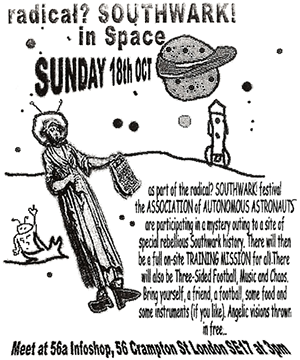
The Association of Autonomous Astronauts is a worldwide network of community based groups dedicated to building their own spaceships. The AAA was founded in 1995. Although many of their activities were reported as serious participation in conferences or protests against the militarization of space, some were also considered art pranks, media pranks, or just an elaborate spoof. The AAA had numerous local chapters which operated independently of one another, with the AAA effectively operating as a collective pseudonym along the lines of a nom de plume.
The Association’s ostensible five-year mission, a reference to Star Trek, was to ‘establish a planetary network to end the monopoly of corporations, governments and the military over travel in space.’ Artists who became involved were often connected to the zine scene or mail art movements. The five year mission’s completion was marked at the 2000 Fortean Times conference, although some chapters have continued activities to the present day. Several AAAers have experienced zero-gravity training flights.
read more »
Posted in Art, Politics, Technology |
Leave a Comment »
June 21, 2011

Lume is a short term for the luminous phosphorescent glowing solution applied on watch dials. There are some people who ‘relume’ watches, or replace faded lume. Formerly lume consisted mostly of radium; however, radium is radioactive and has been mostly replaced on new watches by less bright, but less toxic compounds.
Common pigments used in lume include the phosphorescent pigments zinc sulfide and strontium aluminate. Use of zinc sulfide for safety related products dates back to the 1930s. However, the development of strontium oxide aluminate, with a luminance approximately 10 times greater than zinc sulfide, has relegated most zinc sulfide based products to the novelty category. Strontium oxide aluminate based pigments are now used in exit signs, pathway marking, and other safety related signage.
Posted in Language, Technology |
Leave a Comment »
June 21, 2011
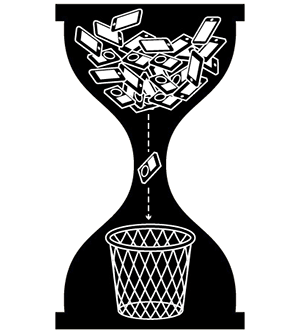
Planned obsolescence in industrial design is a policy of deliberately planning a product with a limited useful life, so it will become obsolete or nonfunctional after a certain period of time. Planned obsolescence has potential benefits for a producer because to obtain continuing use of the product the consumer is under pressure to purchase again, whether from the same manufacturer (a replacement part or a newer model), or from a competitor.
For an industry, planned obsolescence stimulates demand by encouraging purchasers to buy sooner if they still want a functioning product. Built-in obsolescence is used in many different products. There is, however, the potential backlash of consumers who learn that the manufacturer invested money to make the product obsolete faster; such consumers might turn to a producer (if any exists) that offers a more durable alternative.
read more »
Posted in Money, Technology |
1 Comment »
June 20, 2011

A Claude glass (or black mirror) is a small mirror, slightly convex in shape, with its surface tinted a dark color. Bound up like a pocket-book or in a carrying case, black mirrors were used by artists, travellers and connoisseurs of landscape and landscape painting.
Black Mirrors have the effect of abstracting the subject reflected in it from its surroundings, reducing and simplifying the colour and tonal range of scenes and scenery to give them a painterly quality.
read more »
Posted in Art, Technology |
Leave a Comment »
June 20, 2011

A camera lucida [loo-si-duh] (Latin: ‘light room’) is an optical device used as a drawing aid by artists. The camera lucida performs an optical superimposition of the subject being viewed upon the surface upon which the artist is drawing. The artist sees both scene and drawing surface simultaneously, as in a photographic double exposure. This allows the artist to duplicate key points of the scene on the drawing surface, thus aiding in the accurate rendering of perspective. At times, the artist can even trace the outlines of objects.
The camera lucida was patented in 1807 by William Hyde Wollaston. There seems to be evidence his idea was actually nothing but a reinvention of a device clearly described 200 years earlier by Johannes Kepler. By the 19th century, Kepler’s description had totally fallen into obscurity.
read more »
Posted in Art, Technology |
Leave a Comment »
June 16, 2011

Jimmy Joe Roche is an American visual artist and underground filmmaker, based in Baltimore, Maryland. He is a long-time collaborator of the Baltimore-based musician Dan Deacon. His recent collaboration, ‘Ultimate Reality’, with musician Dan Deacon has gained critical attention.
In 2006 he shot and edited the Neil Young ‘Heart of Gold: Behind the Scenes’ featurette. Recently Roche’s short film ‘Baltimore Shopping Network’ was featured on the New Museum’s website Rizhome, and his music video for Deacon’s ‘Crystal Cat’ was featured on the front page of YouTube, gathering over a million views.
Posted in Art, Technology |
Leave a Comment »
June 14, 2011


Vaporware is a term in the computer industry that describes a product, typically computer hardware or software, that is announced to the general public but is never actually released nor officially canceled. The term also generally applies to a product that is announced months or years before its release, and for which public development details are lacking.
The word has been applied to a growing range of products including consumer electronics, automobiles, and some stock trading practices. At times, vendors are criticized for intentionally producing vaporware in order to keep customers from switching to competitive products that offer more features.
read more »
Posted in Money, Technology |
Leave a Comment »