June 7, 2011

A seasoned pan has a stick-resistant coating of polymerized fat and oil on the surface (a polymer is a molecule, made from joining together many small molecules called monomers). Seasoning is desirable on cast-iron cookware and carbon steel cookware, because otherwise they are very sticky to foods and rust-prone. For other pans (e.g., stainless, aluminum, enamelled), the same chemical phenomenon can occur, but seasoning may not be desired for cosmetic reasons (it makes a pan look splotchy), or the pan may already be stick-resistant (e.g., at medium heat, a clean stainless pan with oil is very stick resistant to many foods).
The process of heating a pan to cause the oil to oxidize is analogous to the hardening of drying oil used in oil paints, or to varnish a painting. When oils or fats are heated in a pan, multiple degradation reactions occur, including: autoxidation, thermal oxidation, polymerization, cyclization and fission.
read more »
Posted in Food, Technology |
Leave a Comment »
June 6, 2011
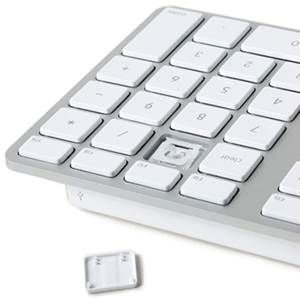
A chiclet keyboard or island-style keyboard is a computer keyboard built with an array of small, flat rectangular or lozenge-shaped rubber or plastic keys that look like erasers or ‘Chiclets,’ a brand of chewing gum manufactured in the shape of small squares with rounded corners. Most often the tops of the keys are hard, but sometimes they were made of the same material as the rubber dome itself. For example, the keys on Sinclair ZX Spectrum computers were ‘rubber dome key’ which were sometimes described as ‘dead flesh,’ while the American version of the Timex Sinclair 2068 was described as having ‘chiclet keys.’
Chiclet keyboards are characterized by having each key surrounded (and held in place) by a perforated plate, so there is a space between the keys.
read more »
Posted in Technology |
Leave a Comment »
June 6, 2011

The multiplane camera is a special motion picture camera used in the traditional animation process that moves a number of pieces of artwork past the camera at various speeds and at various distances from one another. This creates a three-dimensional effect, although not actually stereoscopic.
Various parts of the artwork layers are left transparent, to allow other layers to be seen behind them. The movements are calculated and photographed frame-by-frame, with the result being an illusion of depth by having several layers of artwork moving at different speeds – the further away from the camera, the slower the speed. The multiplane effect is sometimes referred to as a parallax process.
read more »
Posted in Art, Technology |
Leave a Comment »
June 6, 2011

Audiosurf is a 2008 puzzle/rhythm hybrid game created by Invisible Handlebar, a personal company created by Dylan Fitterer. Its track-like stages visually mimic the music the player chooses, while the player races across several lanes collecting colored blocks that appear in sync with the music. The music used in the game is chosen from the user’s own library, from almost any DRM-free format, as well as stamdard CDs. Upon completing the track, the score is uploaded to the score server together with the track length and form, any feats achieved, and the character used including the ironmode option if this was enabled. Scores are stored per song title, allowing people to compete. The uploaded length and track form make it possible to detect mislabelled or variant versions of songs in the score browser.
Audiosurf synchronizes the environment, traffic patterns and scenery with the events in the current song. Each music file imported to the game by the user is first analyzed by the game engine, and an ASH file (containing the dynamics of the sounds and how the track and blocks are arranged) associated to the music is created and saved (typically around 30 kilobytes). This helps speed up the loading time of future replays of the same sound file. The game loads the environment from the ASH files, with the track’s elevation, surface and layout reflected in the dynamics of the music being played. For example, if a player were to choose to play a very soft and mellow song, the track would be uphill, very slow, relaxing and rich in cool colors. If a player were to choose a very intense and loud song, the track would be downhill, sped up, thick with traffic and lit up with hot colors.
Posted in Art, Games, Technology |
Leave a Comment »
June 6, 2011

B of the Bang was a sculpture designed by Thomas Heatherwick, in Manchester, England, located next to the City of Manchester Stadium at Sportcity. It was dismantled in 2009 because of structural problems. It was taller and leaned at a greater angle than the Leaning Tower of Pisa. The sculpture took its name from a quotation of British sprinter Linford Christie, in which he said that he started his races not merely at the ‘bang’ of the starting pistol, but at ‘the B of the Bang.’ The artwork had been nicknamed ‘KerPlunk’ by the locals after the popular children’s game from the 1970s.
The sculpture was made from the same weathering steel (also known as Cor-Ten) as the ‘Angel of the North’ sculpture, which gradually develops a tightly adhering oxide layer as it is exposed to the elements. This layer inhibits further corrosion by reducing its permeability to water. As part of the design, the spikes swayed slightly in the wind in order to withstand gusts in excess of 100 mph (160 km/h). At the time of construction a time capsule was placed in one of the spikes of the sculpture, containing children’s poems and paintings, due to be opened circa 2300. The location of the time capsule after dismantling is currently unknown.
Posted in Art, Technology |
Leave a Comment »
June 3, 2011

Starship Troopers is a military science fiction novel by Robert A. Heinlein, first published (in abridged form) as a serial in ‘The Magazine of Fantasy & Science Fiction’ in 1959, published hardcover later that year. The first-person narrative is about a young soldier named Juan ‘Johnnie’ Rico and his exploits in the Mobile Infantry, a futuristic military unit equipped with powered armor.
Rico’s military career progresses from recruit to non-commissioned officer and finally to officer against the backdrop of an interstellar war between mankind and an arachnoid species known as ‘the Bugs.’ Through Rico’s eyes, Heinlein examines moral and philosophical aspects of suffrage, civic virtue, the necessities of war and capital punishment, and the nature of juvenile delinquency.
read more »
Posted in Art, Technology, War |
Leave a Comment »
June 3, 2011

Ender’s Game is a 1985 science fiction novel by American author Orson Scott Card that originated as the short story published in a 1977 issue of ‘Analog Science Fiction and Fact.’ Card released an updated version of Ender’s Game in 1991, changing some political facts to accurately reflect the times, including the decline of the Soviet Union. In his 1991 introduction, he discussed the influence of Isaac Asimov’s ‘Foundation’ series on the novel. Historian Bruce Catton’s work on the American Civil War also influenced him heavily. Set in Earth’s future, the novel presents an imperiled humankind who have barely survived two conflicts with the Formics (an insectoid alien race).
In preparation for an anticipated third invasion, an international fleet maintains a school to find and train future fleet commanders. The world’s most talented children, including the novel’s protagonist, Ender Wiggin, are taken at a very young age to a training center known as the Battle School. There, teachers train them in the arts of war through increasingly difficult games including ones undertaken in zero gravity in the Battle Room where Ender’s tactical genius is revealed. Reception to the book was generally positive, though some critics have denounced Card’s perceived justification of his characters’ violent actions. It has also become suggested reading for many military organizations, including the United States Marine Corps.
Posted in Art, Technology, War |
Leave a Comment »
June 3, 2011
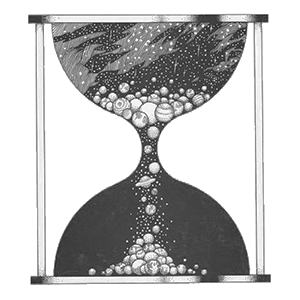
The Forever War is a 1974 science fiction novel by American author Joe Haldeman, telling the contemplative story of soldiers fighting an interstellar war between humanity and the enigmatic Tauran species.
The pithy, insightful explorations of the inhumanity of war and of bureaucracy, and of the psychological effects resulting from time dilation space travel (a soldier returns home after centuries away), won acclaim immediately.
read more »
Posted in Art, Technology, War |
Leave a Comment »
June 3, 2011
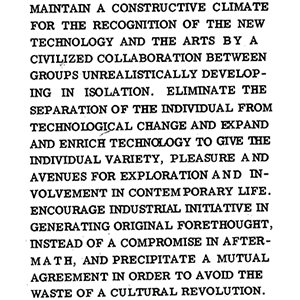
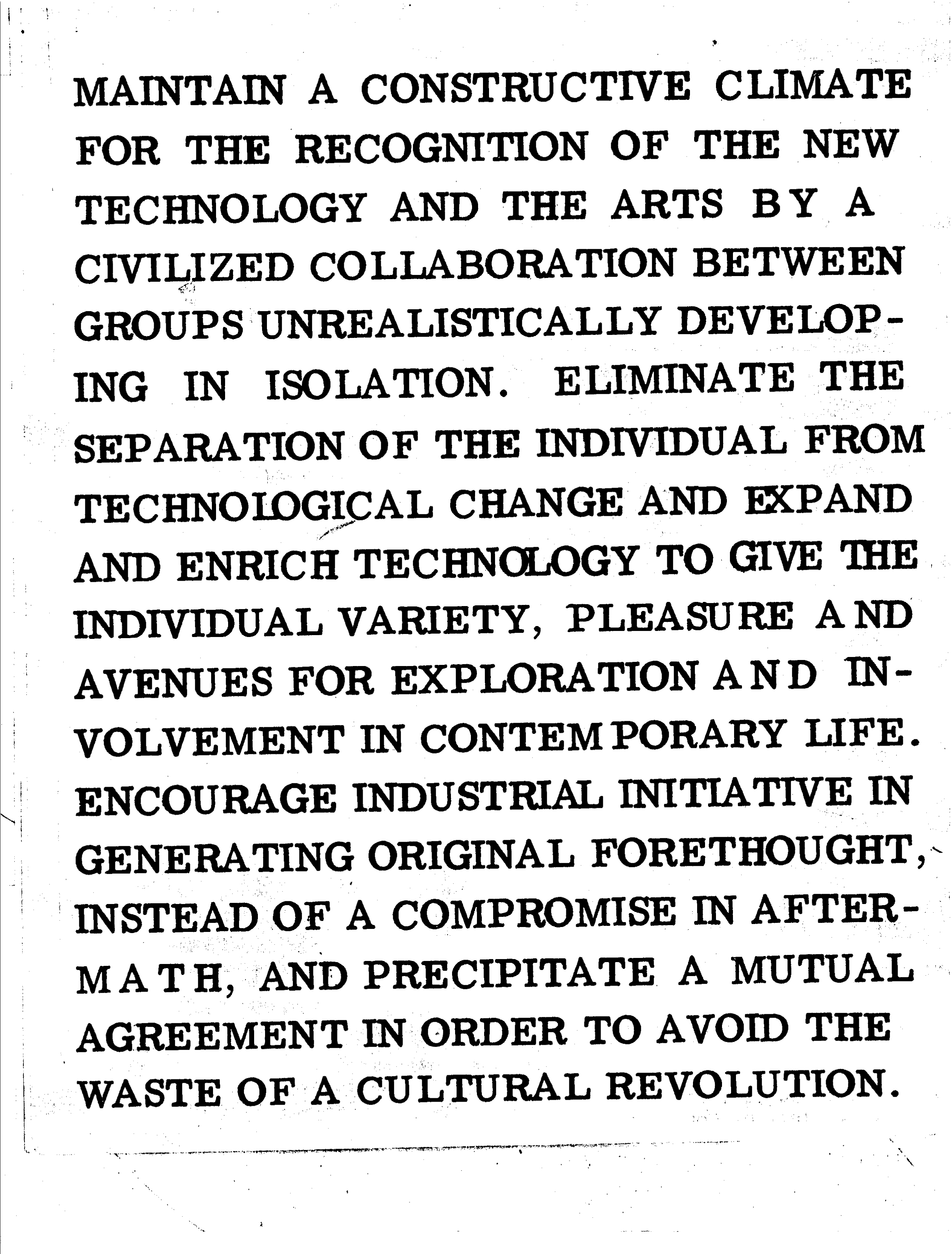
Experiments in Art and Technology (E.A.T.) was a non-profit established in 1967 to develop collaborations between artists and engineers by the engineers Billy Klüver and Fred Waldhauer and the artists Robert Rauschenberg and Robert Whitman. They had previously collaborated, most notably in 1966 for ‘9 Evenings: Theatre and Engineering,’ a series of performance art presentations that united artists and engineers. Also in 1966, 10 New York artists worked with 30 engineers and scientists from the world renowned Bell Telephone Laboratories to create groundbreaking performances that incorporated new technology. Video projection, wireless sound transmission, and Doppler sonar had never been seen in art.
The installation gathered the vast and insightful but also often undecipherable shards, artifacts, apparatus, photographs, drawings, diagrams, correspondence, and documentary film footage that provides information, but little if any comprehensive understanding of a series of ten individual works that, although wildly uneven on every level from aesthetic to technical, have entered the canon of performance art, experimental music and theater, bridging the gap from the eras of Dada, Fluxus and the Happenings/Actions of the 1960s, through the current generation of arts for whom multimedia and technology are the norm. The pinnacle of E.A.T. activity is generally considered to be the Pepsi Pavilion at Expo ’70 at Osaka Japan where E.A.T. artists and engineers collaborated to design and program an immersive dome that included a fog sculpture by Fujiko Nakaya.
Posted in Art, Technology |
Leave a Comment »
June 3, 2011
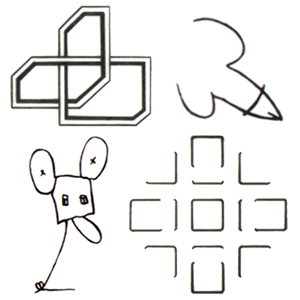
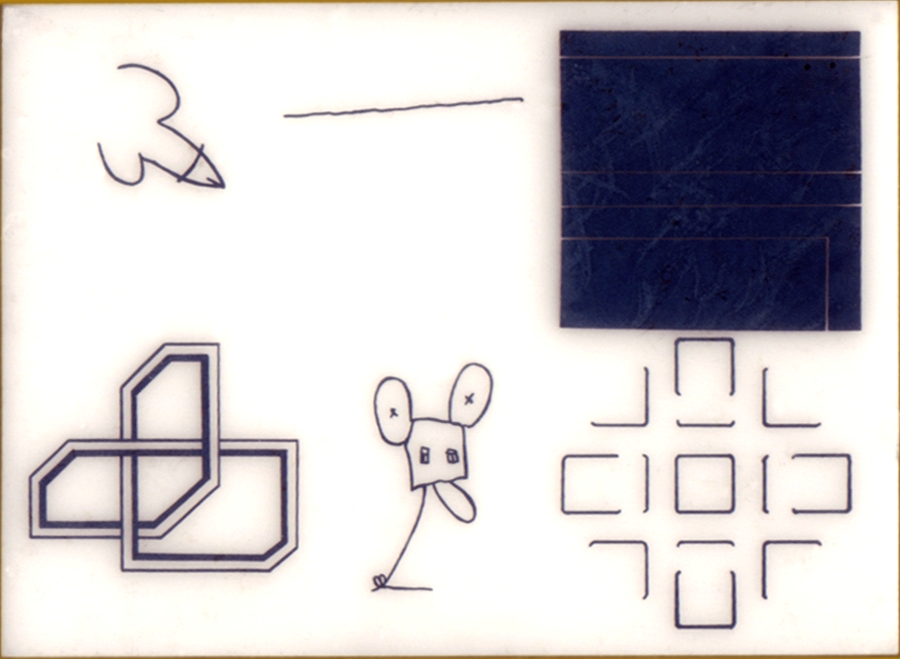
The Moon Museum is a small ceramic wafer three-quarters of an inch by half an inch in size, containing artworks by six prominent artists from the late 1960s. The artists with works in the ‘museum’ are Robert Rauschenberg, David Novros, John Chamberlain, Claes Oldenburg, Forrest Myers, and Andy Warhol.
This wafer was supposedly covertly attached to a leg of the Intrepid landing module, and subsequently left on the moon during Apollo 12. The moon museum is considered the first Space Art object. While it is impossible to tell if the Moon Museum is actually on the moon without sending another mission to look, many other personal effects were smuggled onto the Apollo 12 lander and hidden in the layers of gold blankets that wrapped parts of the spacecraft.
read more »
Posted in Art, Humor, Technology |
Leave a Comment »
June 3, 2011

Dagen H (H day), today mostly called ‘Högertrafikomläggningen’ (‘The right-hand traffic diversion’), was the day in 1967 on which traffic in Sweden switched from driving on the left-hand side of the road to the right. There were more major arguments for the change: All Sweden’s immediate neighbors drove on the right (including Norway, with which Sweden has a long land border). Most Swedes drove left-hand drive (LHD) vehicles. This led to many head-on collisions when passing on two-lane highways, which were common in Sweden because of its low population density and traffic levels.
Nonetheless, the change was widely unpopular, and had repeatedly been voted down over the previous forty years. In a 1955 referendum, 83 percent voted to keep driving on the left. In 1963, the Riksdag (the Swedish parliament) approved the change. It also began implementing a four-year education program, with the advice of psychologists. The campaign included displaying the Dagen H logo on various commemorative items, including milk cartons, men’s shorts, and women’s underwear.
read more »
Posted in Politics, Technology, World |
Leave a Comment »
May 26, 2011


Addictive TV is a UK film remixer and chop-up duo formed in 1992. The DJ/producers and audiovisual artists are the team behind Optronica – the visual music and VJ festival held in London. In 1998 they produced Transambient for Channel 4 in the UK and from 2000 – 2005 produced the ground-breaking DJ:VJ music series Mixmasters for the UK’s ITV1. In 2003, working closely with the R&D area of Japanese manufacturer Pioneer Electronics they became instrumental with the testing and development of their DVD turntables, the first being the Pioneer DVJ-X1 released in 2004.
They are known for their bootleg film remixes, and in 2006 they became the first group to officially remix a Hollywood film, reworking New Line Cinema’s dance-centric Take the lead into an audiovisual Viral video. In 2006 they also worked on Snakes on a Plane remixing the film for its TV commercials.
Posted in Art, Technology |
Leave a Comment »