September 29, 2013
Kwangmyong (lit. ‘Bright’) is a North Korean ‘walled garden’ national intranet opened in 2000. It may be accessed by web browsers, incorporates email services, news groups, and an internal web search engine. In North Korea, only a small number of government-authorized persons are allowed to use the global Internet, so Kwangmyong is the only computer network available to common people. It is a free service for public use.
Given that there is no direct connection to the outside Internet, unwanted information cannot enter the network. Information is filtered and processed by government agencies before being hosted on the North Korean Intranet. Cuba and Myanmar also use a similar network system that is separated from the rest of the Internet, and Iran has been reported as having future plans to implement such a network.
Posted in Politics, Technology, World |
Leave a Comment »
September 28, 2013
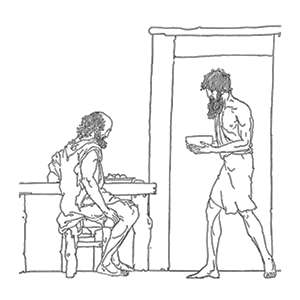
Xenia [zee-nee-uh] (Greek: ‘guest-friendship’) is the ancient Greek concept of hospitality, the generosity and courtesy shown to those who are far from home and/or associates of the person bestowing guest-friendship. The rituals of hospitality created and expressed a reciprocal relationship between guest and host expressed in both material benefits (such as the giving of gifts to each party) as well as non-material ones (such as protection, shelter, favors, or certain normative rights).
The Greek god Zeus is sometimes called Zeus Xenios in his role as a protector of travelers. He thus embodied the religious obligation to be hospitable to travelers. Theoxeny or theoxenia is a theme in Greek mythology in which humans demonstrate their virtue or piety by extending hospitality to a humble stranger (xenos), who turns out to be a disguised deity (theos) with the capacity to bestow rewards. These stories caution mortals that any guest should be treated as if potentially a disguised divinity and help establish the idea of xenia as a fundamental Greek custom.
read more »
Posted in Philosophy, World |
Leave a Comment »
September 27, 2013

Ding zui [ding zoo-ee] is the Chinese practice of hiring impostors or body doubles to stand trial and receive punishment in one’s place. The term translates as ‘substitute criminal,’ and is reported to be a relatively common practice among China’s wealthy elite.
Accusations of ding zui surfaced in 2012 during the trial of Gu Kailai. The term ‘body double’ quickly became popular on Chinese Internet fora, and Chinese authorities attempted to censor related messages. Similar allegations had arisen in 2009 after the trial Hu Bin.
Posted in Money, Politics, World |
1 Comment »
September 24, 2013

‘Music for a French Elevator and Other Short Format Oddities by The Books‘ is a 2006 release by NY electronic duo The Books. It is a compendium on mini CD of four pieces created for the ‘1%’ art and sound installation in the Ministry of Culture in Paris, France in 2004.
The pieces were created to be played in the elevator of the Ministry, giving the release its title. Following the initial four tracks (those designed for the elevator) are ‘several ‘classic’ spoken word tracks’ taken from The Books’ sample libraries.
Posted in Art, World |
Leave a Comment »
September 12, 2013

Ailanthus altissima, commonly known as tree of heaven is a deciduous tree originating from China known for its ability to thrive in inhospitable urban environments; it has acquired the derisive nicknames of ‘ghetto palm,’ ‘stink tree,’ and ‘tree of Hell.’ The tree grows rapidly and is capable of reaching heights of 49 ft in 25 years. However, the species is also short lived and rarely lives more than 50 years.
In has become an invasive species due to its ability both to colonize disturbed areas quickly, including areas of rubble in war-torn Afghanistan, and to suppress competition with allelopathic chemicals. It is considered a noxious weed in Australia, the United States, New Zealand and several countries in southern and eastern Europe. The tree also resprouts vigorously when cut, making its eradication difficult and time consuming.
read more »
Posted in Language, Science, World |
Leave a Comment »
September 11, 2013
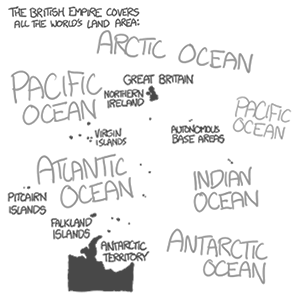
The phrase “the empire on which the sun never sets” has been used with variations to describe certain global empires that were so extensive that there was always at least one part of their territory in daylight.
It was originally used for the Spanish Empire in the 16th and 17th centuries, and for the British Empire in the 19th and early 20th centuries. German historian of language Georg Büchmann traces the idea to a speech in Herodotus’ Histories, made by Xerxes I of Persia before invading Greece.
read more »
Posted in Language, Politics, World |
3 Comments »
September 7, 2013

Sacred cow is an idiom, a figurative reference to sacred cows in some religions. It is based on the popular understanding of the elevated place of cows in Hinduism and appears to have emerged in America in the late 19th century. A literal sacred cow or sacred bull is an actual cow or bull that is treated with sincere reverence. A figurative sacred cow is something else that is considered immune from question or criticism, especially unreasonably so.
There is an element of paradox in the concept of reverence for a sacred cow, as illustrated in a comment about the novelist V. S. Naipaul: ‘[He] has the ability to distinguish the death of an ordinary ox, which, being of concern to no one, may be put quickly out of its agony, from that of a sacred cow, which must be solicitously guarded so that it can die its agonizing death without any interference. ‘Irreverence is our only sacred cow’ is the motto of ‘The Realist,’ a pioneering magazine of social-political-religious criticism and satire.
Posted in Language, Philosophy, World |
Leave a Comment »
September 6, 2013

Julian L. Simon and Paul Ehrlich entered in a famous scientific wager in 1980, betting on a mutually agreed-upon measure of resource scarcity over the decade leading up to 1990. Simon had Ehrlich choose five commodity metals. Copper, chromium, nickel, tin, and tungsten were chosen and Simon bet that their prices would decrease, while Ehrlich bet they would increase. Ehrlich lost the bet, as all five commodities that were bet on declined in price from 1980 through 1990, the wager period.
In 1968, Ehrlich published ‘The Population Bomb,’ which argued that mankind was facing a demographic catastrophe with the rate of population growth quickly outstripping growth in the supply of food and resources. Simon was highly skeptical of such claims, so proposed a wager, telling Ehrlich to select any raw material he wanted and select ‘any date more than a year away,’ and Simon would bet that the commodity’s price on that date would be lower than what it was at the time of the wager.
read more »
Posted in Money, Science, World |
Leave a Comment »
September 6, 2013

‘The Ultimate Resource‘ is a 1981 book written by Julian Lincoln Simon challenging the notion that humanity was running out of natural resources. It was revised in 1996 as ‘The Ultimate Resource 2.’
The overarching thesis is that there is no resource crisis because as a particular resource becomes more scarce, its price rises, creating an incentive for people to discover more of the resource, ration and recycle it and, eventually, develop substitutes. The ‘ultimate resource’ is not any particular physical object but the capacity for humans to invent and adapt.
read more »
Posted in Language, Money, World |
1 Comment »
September 4, 2013
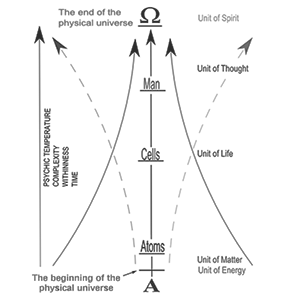
The Law of Complexity/Consciousness is the tendency in matter to become more complex over time and at the same time to become more conscious. The law was first formulated by 20th century Jesuit priest and paleontologist Pierre Teilhard de Chardin, who held that at all times and everywhere, matter is endeavoring to complexify upon itself, as observed in the evolutionary history of the Earth.
Matter complexified from inanimate matter, to plant life, to animal-life, to human-life. Or, from the geosphere, to the biosphere, to the noosphere (of which humans represented, because of their possession of a consciousness which reflects upon themselves). As evolution rises through the geosphere, biosphere, and noosphere, matter continues to rise in a continual increase of both complexity and consciousness.
read more »
Posted in Philosophy, Science, World |
3 Comments »
September 2, 2013
‘Childhood’s End‘ is a 1953 science fiction novel by the British author Arthur C. Clarke. The story follows the peaceful alien invasion of Earth by the mysterious Overlords, whose arrival ends all war, helps form a world government, and turns the planet into a near-utopia.
Many questions are asked about the origins and mission of the aliens, but they avoid answering, preferring to remain in their spacecraft, governing through indirect rule. Decades later, the Overlords show themselves, and their impact on human culture leads to a final utopic Golden Age, but at the cost of humanity’s identity and eventually the planet itself.
read more »
Posted in Language, Philosophy, World |
Leave a Comment »
September 1, 2013

Swedish Fish is a fish-shaped wine gum (gum drop type) candy. In 1957, Malaco, a Swedish confectionery manufacturer, expanded its business by exporting a few of their products to North America. Various licorice ribbon and licorice lace candies were the first products to be exported. Malaco CEO Thor Fjørgerson called the move ‘a landmark day for Sweden/US relations.’
International trade experts hailed the move, as it allowed Malaco to extend its brand beyond the Scandinavian Peninsula. Malaco’s export trade grew and in the late 1960s and early 1970s, Swedish Fish and Swedish Berries were developed specifically for the North American market. Malaco was eventually acquired by Leaf International.
read more »
Posted in Food, World |
Leave a Comment »


 The Daily Omnivore