February 19, 2013

Jejemon is a pop culture phenomenon in the Philippines. According to ‘Urban Dictionary,’ a Jejemon is a person ‘who has managed to subvert the English language to the point of incomprehensibility.’ ‘The Philippine Daily Inquirer’ describes Jejemons as a ‘new breed of hipster who have developed not only their own language and written text but also their own subculture and fashion.’ Short-hand typing was first popularized by text messaging (limited to 160 characters per text). As a result, an ‘SMS language’ developed in which words were shortened in order to fit the 160-character limit.
The Jejemons are said to be the new jologs, a term used for Filipinos of the lower income class. The sociolect of the Jejemons, called Jejenese, is derived from English, Filipino and their code-switched variant, Taglish. It has its own, albeit unofficial, orthography, known as Jejebet, which uses the Filipino variant of the Roman alphabet, Arabic numerals and other special characters. Words are created by rearranging letters in a word, alternating capitalization, with an over-usage of the letters H, X or Z, and silent letters. It has similarities with Leetspeak, primarily the alphanumeric nature of its writing.
Posted in Humor, Language, World |
Leave a Comment »
February 19, 2013


The Chaos Computer Club (CCC) is one of the world’s biggest hackers organizations. The CCC is based in Germany and other German-speaking countries. The CCC describes itself as ‘a galactic community of life forms, independent of age, sex, race or societal orientation, which strives across borders for freedom of information….’ In general, the CCC advocates more transparency in government, freedom of information, and the human right to communication.
Supporting the principles of the hacker ethic, the club also fights for free universal access to computers and technological infrastructure. The CCC was founded in Berlin in 1981 at a table which had previously belonged to the Kommune 1 (the first politically motivated commune in Germany) in the rooms of the newspaper ‘Die Tageszeitung’ by Wau Holland and others in anticipation of the prominent role that information technology would play in the way people live and communicate.
read more »
Posted in Politics, Technology, World |
Leave a Comment »
February 18, 2013
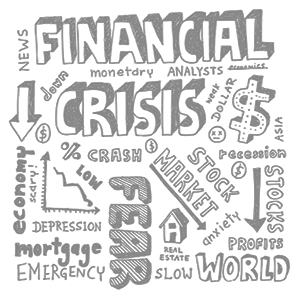
The Great Recession is a marked global economic decline that began in December 2007 and took a particularly sharp downward turn in September 2008. The active phase of the crisis, which manifested as a liquidity crisis, can be dated from August 7, 2007 when BNP Paribas (one of the world’s largest global banking groups) terminated withdrawals from three hedge funds citing ‘a complete evaporation of liquidity.’
The bursting of the U.S. housing bubble, which peaked in 2006, caused the values of securities tied to U.S. real estate pricing to plummet, damaging financial institutions globally. The global recession affected the entire world economy, with higher detriment in some countries than others. As of December 2012, the economic side effects of the European sovereign debt crisis and limited prospects for global growth in 2013 and 2014 continue to provide obstacles to full recovery.
read more »
Posted in Money, World |
Leave a Comment »
February 11, 2013

Commodification (or commoditization) is the transformation of goods, ideas, or other entities that may not normally be regarded as goods into a commodity. American author and feminist bell hooks refers to cultural commodification [kuh-mod-uh-fi-key-shuhn] as ‘eating the other.’ By this she means that cultural expressions, revolutionary, or post modern, can be sold to the dominant culture. Any messages of social change are not marketed for their messages but used as a mechanism to acquire a piece of the ‘primitive.’ Any interests in past historical culture almost always have a modern twist.
According to Mariana Torgovnick, ‘What is clear now is that the West’s fascination with the primitive has to do with its own crises in identity, with its own need to clearly demarcate subject and object even while flirting with other ways of experiencing the universe.’ Hooks states that marginalized groups are seduced by this concept because of ‘the promise of recognition and reconciliation.’ ‘When the dominant culture demands that the Other be offered as sign that progressive political change is taking place, that the American Dream can indeed be inclusive of difference, it invites a resurgence of essentialist cultural nationalism.’
read more »
Posted in Money, Politics, World |
1 Comment »
February 11, 2013
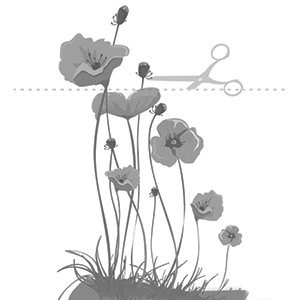
Tall poppy syndrome (TPS) is a pejorative term primarily used in the UK, Canada, New Zealand, and other Anglosphere nations to describe a social phenomenon in which people of genuine merit are resented, attacked, cut down, or criticized because their talents or achievements elevate them above or distinguish them from their peers.
Australia’s usage of the term has evolved and is not uniformly negative. In Australia, a long history of ‘underdog’ culture and profound respect for humility in contrast to that of Australia’s English feudal heritage results in a different understanding of the concept.
read more »
Posted in Language, War, World |
Leave a Comment »
February 8, 2013

‘A Study of History‘ is the 12-volume magnum opus of British historian Arnold J. Toynbee, finished in 1961, in which the author traces the development and decay of all of the major world civilizations in the historical record. Toynbee applies his model to each of these civilizations, detailing the stages through which they all pass: genesis, growth, time of troubles, universal state, and disintegration.
The major civilizations, as Toynbee sees them, are: Egyptian, Andean, Sinic, Minoan, Sumerian, Mayan, Indic, Hittite, Hellenic, Western, Orthodox Christian (Russia), Far Eastern, Orthodox Christian (main body), Persian, Arabic, Hindu, Mexican, Yucatec, and Babylonic. There are four ‘abortive civilizations’ (Abortive Far Western Christian, Abortive Far Eastern Christian, Abortive Scandinavian, Abortive Syriac) and five ‘arrested civilizations’ (Polynesian, Eskimo, Nomadic, Ottoman, Spartan).
read more »
Posted in Language, Politics, World |
1 Comment »
February 5, 2013

Democratic peace theory posits that democracies are hesitant to engage in armed conflict with other identified democracies. In contrast to theories explaining war engagement, it is a ‘Theory Of Peace’ outlining motives that dissuade state-sponsored violence. Some theorists prefer terms such as ‘mutual democratic pacifism’ or ‘inter-democracy nonaggression hypothesis’ so as to clarify that a state of peace is not singular to democracies, but rather that it is easily sustained between democratic nations. Several factors are held as motivating peace between liberal states:
Democratic leaders are forced to accept culpability for war losses to a voting public; Publicly accountable statesmen are more inclined to establish diplomatic institutions for resolving international tensions; Democracies are less inclined to view countries with adjacent policy and governing doctrine as hostile; and Democracies tend to possess greater public wealth than other states, and therefore eschew war to preserve infrastructure and resources.
read more »
Posted in Politics, War, World |
Leave a Comment »
February 5, 2013
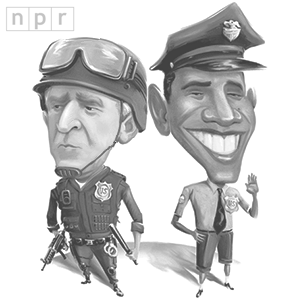
Pax Americana (Latin: ‘American Peace’) is a term applied to the historical concept of relative peace in the Western Hemisphere and later the Western world resulting from the preponderance of power enjoyed by the United States beginning around the start of the 20th century. Although the term finds its primary utility in the later half of the 20th century, it has been used in various places and eras, such as the post-Civil War era in North America and globally during the time between the World Wars.
Pax Americana is primarily used in its modern connotations to refer to the peace established after the end of World War II in 1945. In this modern sense, it has come to indicate the military and economic position of the United States in relation to other nations. The term derives from and is inspired by the Pax Romana of the Roman Empire, the Pax Britannica of the British Empire, and the Pax Mongolica of the Mongol Empire.
read more »
Posted in Politics, War, World |
Leave a Comment »
February 5, 2013
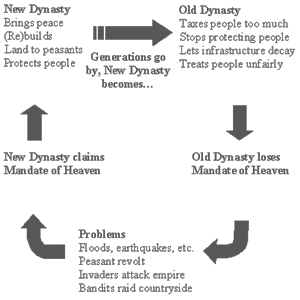
Social cycle theories are among the earliest social theories in sociology. Unlike the theory of social evolutionism, which views the evolution of society and human history as progressing in some new, unique direction(s), sociological cycle theory argues that events and stages of society and history are generally repeating themselves in cycles. Such a theory does not necessarily imply that there cannot be any social progress. In the early theory of ancient Chinese historian Sima Qian and the more recent theories of long-term (‘secular’) political-demographic cycles as well as in the Varnic theory of 20th century Indian philosopher P.R. Sarkar an explicit accounting is made of social progress.
The interpretation of history as repeating cycles of Dark and Golden Ages was a common belief among ancient cultures. The more limited cyclical view of history defined as repeating cycles of events was put forward in the academic world in the 19th century in historiosophy (a branch of historiography) and is a concept that falls under the category of sociology. However, Polybius, Ibn Khaldun, and Giambattista Vico can be seen as precursors of this analysis. The Saeculum (a length of time roughly equal to the potential lifetime of a person or the equivalent of the complete renewal of a human population) was identified in Roman times.
read more »
Posted in Politics, Science, World |
Leave a Comment »
January 31, 2013
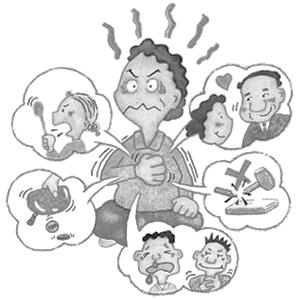
Han is a concept in Korean culture attributed as a national cultural trait. Han denotes a collective feeling of oppression and isolation in the face of overwhelming odds. It connotes aspects of lament and unavenged injustice.
The minjung theologian Suh Nam-dong describes han as a ‘feeling of unresolved resentment against injustices suffered, a sense of helplessness because of the overwhelming odds against one, a feeling of acute pain in one’s guts and bowels, making the whole body writhe and squirm, and an obstinate urge to take revenge and to right the wrong—all these combined.’ In some occasions, anthropologists have recognized han as a culture-specific medical condition whose symptoms include shortness of breath, heart palpitation, and dizziness. Someone who dies of han is said to have died of ‘hwabyeong’ (‘anger illness’ or ‘fire illness’).
read more »
Posted in Health, World |
Leave a Comment »
January 31, 2013

Hwabyeong, literally ‘anger illness’ or ‘fire illness,’ is a Korean culture-bound somatization disorder (e.g. panic disorder), a mental illness. It manifests as one or more of a wide range of physical symptoms, in response to emotional disturbance, such as stress from troublesome interpersonal relationships or life crises. It most often occurs in middle-aged, menopausal women with relatively low socio-economic status. The individuals typically live in traditional families, which stress the value of males while devaluing women, and in which a woman’s virtue is to quietly bear misfortune and unhappiness while maintaining harmony.
Hwabyung is believed to be caused by a build-up of unresolved anger, which disturbs the balance of the five bodily elements. The triggering cause is external events, particularly intra-familiar stressors such as spousal infidelity and conflict with in-laws. Because of the cultural emphasis on familial harmony and peace, expressing anger is not acceptable, so the anger is suppressed, and builds on itself over time. The suppressed anger, hate and despair is known as ‘han,’ or ‘everlasting woe.’
read more »
Posted in Health, World |
Leave a Comment »
January 30, 2013
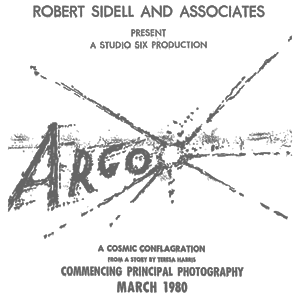
The ‘Canadian Caper‘ was the popular name given to the joint covert rescue by the Canadian government and the Central Intelligence Agency of six American diplomats who had evaded capture during the seizure of the United States embassy in Tehran, and taking of embassy personnel as hostages by Islamist students and militants on November 4, 1979.
The ‘caper’ involved CIA agents (Tony Mendez and a man known as ‘Julio’) joining the six diplomats to form a fake film crew made up of six Canadians, one Irishman and one Latin American who were finished scouting for an appropriate location to shoot a scene for the notional sci-fi film ‘Argo.’ The charade was carried off on the morning of Monday, January 28, 1980, at the Mehrabad Airport in Tehran. The eight Americans successfully boarded a Swissair flight to Zurich, Switzerland, and escaped Iran.
read more »
Posted in Politics, War, World |
Leave a Comment »


 The Daily Omnivore