April 26, 2012

Orbital are a British electronic dance music duo from England consisting of brothers Phil and Paul Hartnoll. Their career initially ran from 1989 until 2004, but in 2009 they announced that they would be reforming and headlining The Big Chill, (an annual festival of alternative, dance, and chill-out music, and comedy, held in the grounds of Eastnor Castle during early August) in addition to a number of other live shows in 2009.
The band’s name was taken from Greater London’s orbital motorway, the M25, which was central to the early rave scene and party network in the South East during the early days of acid house. One of the biggest names in British electronica during the 1990s, Orbital were both critically and commercially successful, and known particularly for their element of live improvisation during shows, a rarity among techno acts. They were initially influenced by early electro and punk rock.
read more »
Posted in Art, Technology, World |
Leave a Comment »
April 25, 2012

Copenhagen Distortion is a festival for club culture in the streets of Copenhagen, Denmark, and in dozens of unusual locations around city, every year during the week of the first Saturday in June. The festival’s cultural focus is on club culture, upfront dance music, street life, contemporary art (only when related to nightlife or public space), social art and Copenhagen’s new independent media (print and web).
Copenhagen Distortion is ‘a celebration of streetlife & nightlife’ orchestrating 150+ dancefloors hosted by 150+ local and international icons of streetlife and nightlife (people, shops, clubs, galleries, labels, and magazines). The characteristic Distortion atmosphere involves high-energy impulsive chaos with a strong ‘streetlife freedom’ feel. The music selection is sharp and upfront: names like Hot Chip, Simian Mobile Disco, Spank Rock, and Sebastien Tellier were booked for Distortion events before they had become underground heroes of international scope. The festival has always been a Copenhagen leader in the field of using urban space and unusual locations.
Posted in Art, World |
1 Comment »
April 23, 2012

In traditional Chinese culture, qì [chee] is an active principle forming part of any living thing. Qi is frequently translated as life energy, lifeforce, or energy flow. Qi is the central underlying principle in traditional Chinese medicine and martial arts. The literal translation is ‘breath,’ ‘air,’ or ‘gas.’ Concepts similar to qi can be found in many cultures, for example, Prana in Vedantic philosophy, mana in Hawaiian culture, Lüng in Tibetan Buddhism, and Vital energy in Western philosophy.
Some elements of qi can be understood in the term ‘energy’ when used by writers and practitioners of various esoteric forms of spirituality and alternative medicine. Elements of the qi concept can also be found in popular culture, for example ‘The Force’ in ‘Star Wars’ Notions in the west of energeia, élan vital, or vitalism are purported to be similar.
read more »
Posted in Health, Philosophy, World |
Leave a Comment »
April 23, 2012

BosWash is a name coined by futurist Herman Kahn in a 1967 essay describing a theoretical United States megalopolis extending from the metropolitan area of Boston to that of Washington, D.C. The publication also coined ‘SanSan’ for the areas on the Pacific coast of California.
The general concept for the area described by BosWash was first identified in French geographer Jean Gottmann’s 1961 book ‘Megalopolis: The Urbanized Northeastern Seaboard of the United States.’ Kahn’s essay was the product of a study commissioned in 1965 by the American Academy of Arts and Sciences. Kahn discussing urbanization, began by writing: ‘The United States in the year 2000 will probably see at least three gargantuan megalopolises. We have labeled these—only half frivolously—’Boswash,’ ‘Chipitts,’ and ‘SanSan.”
read more »
Posted in Politics, Science, World |
Leave a Comment »
April 23, 2012

The Blue Banana (also known as the Hot Banana, European Megalopolis or European Backbone) is a discontinuous corridor of urbanization in Western Europe, with a population of around 110 million. It stretches approximately from North West England to Milan.
The curvature of this corridor (hence the ‘banana’ in the name) takes in cities such as Leeds, Liverpool, Manchester, Birmingham, London, Amsterdam, The Hague, Rotterdam, Brussels, Antwerp, Eindhoven, the Ruhr, Düsseldorf, Cologne, Frankfurt am Main, Luxembourg, Strasbourg, Stuttgart, Munich, Zürich, Turin, Milan, Venice, and Genoa and covers one of the world’s highest concentrations of people, money and industry.
read more »
Posted in Money, Politics, World |
Leave a Comment »
April 23, 2012

Ecumenopolis [ek-yoo-meh-nop-oh-lys] (Greek: ‘world city’) is a word invented in 1967 by the Greek city planner Constantinos Doxiadis to represent the idea that in the future urban areas and megalopolises would eventually fuse and there would be a single continuous worldwide city as a progression from the current urbanization and population growth trends.
Before the word was coined, the American religious leader Thomas Lake Harris (1823–1906) mentioned city-planets in his verses, and science fiction author Isaac Asimov uses the city-planet Trantor as the setting of some of his novels.
read more »
Posted in Politics, Technology, World |
Leave a Comment »
April 23, 2012
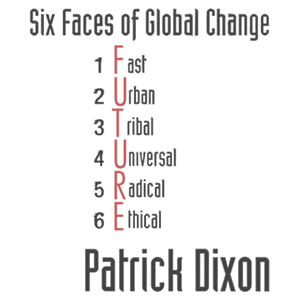
Futurewise is a book on global trends written by the futurist Patrick Dixon in 1998, with new editions in 2001, 2003, and 2007. ‘Futurewise’ contains over 500 expectations about what future life will be like, and divides future trends into six dimensions, which spell the word FUTURE: Fast (combinations of events bring new opportunities for agile leaders—and risks); Urban (demographics and lifestyle issues including megacities); Tribal (the most powerful force in the world today is tribalism—basis of culture, belonging, teams, brands); Universal (globalization at cost of local identity, risking international tensions, and the impact of the digital age); Radical (the rise of single issue activism and the death of left-right politics); and Ethical (the passions people have and personal values, including spirituality– the glue holding our future together)
A key thesis of ‘Futurewise’ is that the future is about emotion, and that emotional reactions to events are usually more important than the events themselves. Therefore a deep understanding is needed of how people are likely to feel in the future. The book also focuses on managing uncertainty. Risk management is a major challenge for all large corporations, including responding to wild cards – low probability but potentially high impact events.
Posted in Language, Politics, World |
Leave a Comment »
April 19, 2012

Pornochanchada is the name given to a genre of sexploitation films produced in Brazil that was popular during the 1970s and early 1980s. ‘Chanchada’ means ‘light comedy’ in Portuguese. Pornochanchadas were initially produced in the downtown quarter of São Paulo that was nicknamed ‘Boca do Lixo’ (‘Garbage Mouth’). The genre was usually seen as a part of low-budget films produced there, collectively known as ‘cinema da Boca’ (‘movies of the Mouth’).
Later, there were productions in Rio de Janeiro as well, creating the sub-genre ‘pornochanchada carioca,’ which was to find its star in Alba Valeria during early 1980s. Pornochanchadas were generally in line with ‘sex comedies’ produced in other countries, but also featured some Brazilian peculiarities. Despite conditions of strict censorship in Brazil in that era, the state-run film company Embrafilme was generally eager to support pornochanchadas, because they weren’t critical of the government and did not depict explicit sex.
Posted in Humor, Sex, World |
Leave a Comment »
April 19, 2012

Bavarian porn is a campy subgenre of softcore porn comedy. The apogee of the genre was the late 1960s and early 1970s, corresponding roughly to the chancellorship of Willy Brandt, but these films continued to be produced up to about 1980. Today they live on as staples of late night European cable and satellite channels. Alois Brummer was the producer of many of these films.
After some ‘Report’ movies (so-called documentaries about ‘German housewifes’ or ‘schools for girls,’ as a reaction to serious documentaries about sexual items in Germany’s late 60’s) he became produced a number of films, which were mainly situated in the Alpes. Director Franz Marischka got the idea from a newspaper article in 1972 about wealthy female tourists in Bavaria who tried to seduce local young men or the landlord of the inn where they were staying.
read more »
Posted in Humor, Sex, World |
Leave a Comment »
April 18, 2012
An underground restaurant, sometimes known as a supper club or ‘closed door restaurant,’ is an eating establishment operated out of someone’s home, generally (though not invariably) bypassing local zoning and health-code regulations. They are, in effect, commercial dinner parties. They are usually advertised by word of mouth or guerilla advertising, often on Facebook, and may require references to make a reservation. An underground restaurant is also known as a ‘guestaurant,’ which is a hybrid between being a guest in a dinner party and a restaurant.
Underground restaurants are popular in Latin America, where they’re known as either a ‘paladar’ or a ‘restaurante de puertas cerradas’ (‘closed door restaurant’). Depending on local licensing laws, they may or may not be illegal; either way, they’ve been built into the culture for decades, and often have higher standards than many licensed establishments. The attraction of the underground restaurant for the customer is to sample new food, often at low cost outside the traditional restaurant experience, which can be expensive and disappointing—underground restaurants have been described as ‘anti-restaurants.’
Posted in Food, Games, World |
Leave a Comment »
April 18, 2012

A locavore [loh-kuh-vawr] is a person interested in eating food that is locally produced, not moved long distances to market. The locavore movement in the United States and elsewhere was spawned as interest in sustainability and eco-consciousness became more prevalent. ‘Locavore’ was the word of the year for 2007 in the Oxford American Dictionary. The word is the creation of Jessica Prentice of the San Francisco Bay Area at the time of World Environment Day, 2005. Locavore food may be grown in home gardens or by local commercial groups interested in keeping the environment as clean as possible and selling food close to where it is grown. One often cited, but not universal, definition of ‘local’ food is food grown within 100 miles of its point of purchase or consumption.
Farmers’ markets play a role in efforts to eat what is local. Preserving food for those seasons when it is not available fresh from a local source is one approach some locavores include in their strategies. Living in a mild climate can make eating locally grown products very different from living where the winter is severe or where no rain falls during certain parts of the year. Those in the movement generally seek to keep use of fossil fuels to a minimum, thereby releasing less carbon dioxide into the air and preventing greater global warming. Keeping energy use down and using food grown in heated greenhouses locally would be in conflict with each other, so there are decisions to be made by those seeking to follow this lifestyle.
Posted in Food, Politics, World |
Leave a Comment »
April 17, 2012

Media Consolidation is a process whereby progressively fewer individuals or organizations control increasing shares of the mass media. As of 2010, The Walt Disney Company is the largest media conglomerate in the US, with News Corporation, Time Warner, and Viacom ranking second, third and fourth respectively. Net neutrality is at stake when media mergers are occurring. Net neutrality involves a lack of restrictions on content on the internet, however, with big businesses supporting campaigns financially they tend to have influence over political issues, which can translate into their mediums.
Critics of consolidation raise the issue of whether monopolistic or oligopolistic control of a local media market can be fully accountable and dependable in serving the public interest. On the local end, reporters have often seen their stories refused or edited beyond recognition. An example would be the repeated refusal of networks to air ‘ads’ from anti-war advocates to liberal groups like MoveOn.org, or religious groups like the United Church of Christ. Journalists and their reports may be directly sponsored by parties who are the subject of their journalism leading to reports which favor the sponsor. Consequently, if the companies dominating a media market choose to suppress stories that do not serve their interests, the public suffers, since they are not adequately informed of some crucial issues that may affect them.
Posted in Money, Politics, World |
Leave a Comment »


 The Daily Omnivore