December 13, 2011


Black Volga [vol-guh] refers to an urban legend widespread in Poland, Russia, Belarus, Ukraine, and Mongolia, mainly in the 1960s and 1970s. It was about a black (in some versions red) Volga limousine (with white wheel rims, white curtains or other white elements) that was allegedly used to abduct people, especially children. According to different versions, it was driven by priests, nuns, Jews, vampires, satanists or Satan himself. Children were kidnapped to use their blood as a cure for rich westerners or Arabs suffering from leukemia; other variants used organ theft as the motive, combining it with another famous legend about kidney theft by the KGB.
The legend surfaced again in the late 20th century, with a BMW or Mercedes car taking the Volga’s place, sometimes depicted with horns instead of wing mirrors. In this version, the driver would ask passers-by for the time and kill them when they approached the car to answer (in another version of the legend, they died at the same time a day later).
Posted in Humor, World |
1 Comment »
December 13, 2011

In ethnolinguistics, an endonym [en-doe-nim] or autonym is a local name for a geographical feature, and an exonym [ex-o-nim] or xenonym is a foreign language name for it. Exonyms and endonyms can be names of places (toponym), ethnic groups (ethnonym), languages (glossonym), or individuals (personal name).
For example, China, India, Germany, Greece, Japan, and Korea are the English exonyms corresponding to the endonyms Zhongguo, Bharat, Deutschland, Hellas, Nippon, and Goryeo, respectively.
read more »
Posted in Language, Politics, World |
Leave a Comment »
December 13, 2011


Groundhopping is a hobby that involves attending matches at as many different stadiums or grounds as possible. Largely a soccer-related pastime, groundhopping probably found its origin in the 1970s in England. From the late 1980s fans in Germany started groundhopping as well. Currently it is especially popular in the United Kingdom, Germany, the Netherlands and Belgium.
There is no universal set of rules for counting ‘hopped grounds’, although a generally accepted one is that a match must have been seen at the ground. There are some formal organizations for groundhoppers, including the 92 club in England, which consists of groundhoppers who have visited matches in all stadiums of the Premier and Football League.
Posted in Games, World |
Leave a Comment »
December 13, 2011

Billboard Utilising Graffitists Against Unhealthy Promotions, or B.U.G.A. U.P. is an Australian subvertising artistic movement that detourns or modifies with graffiti billboard advertising that promotes something they deem unhealthy. The movement started in inner-city Sydney in 1979 and has been active ever since, although the late 70’s and early-mid 1980s is considered their most prolific period. The movement’s founder was Bill Snow, who continues to be active in anti-smoking and littering campaigns.
The movement aimed mainly at Cigarette and Alcohol advertising, often blanking out letters and adding others to promote their view that the product is unhealthy. Cola and soft drink ads were also targeted.
Posted in Money, Politics, World |
Leave a Comment »
December 13, 2011


Wok racing was developed by the German TV host Stefan Raab. Modified Chinese woks are used to make timed runs down an Olympic bobsled track. There are competitions for one-person-woksleds and four-person-woksleds, the latter using four woks per sled. Wok racing was inspired by a bet on a German TV show in 2003. Participants are mostly b-list celebrities. The typical racing woks are the ordinary round-bottomed Chinese pans, usually directly imported from China. The only modifications are that the bottom is reinforced with an epoxy filling and the edges of the wok are coated with polyurethane foam to avoid injuries.
Four-person woksleds consist of two pairs of woks, each of them is held together by a rounded frame. The two pairs are connected by a coupling. Due to the rather risky nature of the sport the participants wear heavy protective gear, usually similar to ice hockey equipment. To further reduce friction and the risk of injuries, the athletes wear ladles under their feet. To improve performance, the underside of the woks are often heated with a blowlamp before the race.
Posted in Games, Humor, World |
Leave a Comment »
December 12, 2011


Internet in a suitcase is a program reportedly developed or spearheaded by the U.S. Department of State to provide Internet and mobile phone service to dissidents that can bypass government censorship or shut down of telecommunications in countries such as the Islamic Republic of Iran, Syria and Libya. The plan reportedly involves utilizing common hardware components ‘into a package that could easily’ be smuggled ‘into a repressive country and quickly assembled to deliver wireless service across a wide area to maintain crucial communications between legitimately protesting citizens.’
Part of the operation includes a prototype ‘Internet in a suitcase’ being developed by a ‘group of young entrepreneurs’ led by Sascha Meinrath of the New America Foundation, a public policy think tank. Other projects employ tools ‘that have already been created by hackers in a so-called liberation-technology movement sweeping the globe,’ and stealth wireless networks.
Posted in Politics, Technology, World |
Leave a Comment »
December 12, 2011

The term First World Problems refers to issues perceived as difficult to those residing in the more developed nations in the global arena (i.e., the First World), but which are banal when compared to the difficulties encountered by those in the less developed Third World. First World Problems is often used in a derisive manner towards those who complain about the problems they experience in the ‘First World’ on a regular basis. However, it is also routinely used by scholars and economists in studying the relationship between the Third World and the First World.
The exact provenance of the term is uncertain, although some believe that it originated with comedic author David Rakoff, whose 2005 book ‘Don’t Get Too Comfortable’ is subtitled ‘The Indignities of Coach Class, the Torments of Low Thread Count, the Never-Ending Quest for Artisanal Olive Oil, and Other First World Problems.’ Many computer games, notably, provide a fascinating degree of First World escapism via a simulation of Third World Problems. For example, the infamous 1980s ASCII-based dungeon crawler ‘Rogue’ provided those First World denizens who had overcome the First World Problem of not owning a computer to experience such Third World Problems as starvation, existential ennui, and life-or-death hand-to-hand combat.
Posted in Money, Politics, World |
Leave a Comment »
December 8, 2011

The Double Cross System, or XX System, was a World War II anti-espionage and deception operation of the British military intelligence arm, MI5. Nazi agents in Britain – real and false – were captured, turned themselves in or simply announced themselves and were then used by the British to broadcast mainly disinformation to their Nazi controllers.
Its operations were overseen by the Twenty Committee under the chairmanship of John Cecil Masterman; the name of the committee comes from the number 20 in Roman numerals: ‘XX.’ The policy of MI5 during the war was initially to use the system for counter-espionage. It was only later that its potential for deception purposes was realized. Agents from both of the German intelligence services, the Abwehr and Sicherheitsdienst (SD), were apprehended.
read more »
Posted in Politics, War, World |
Leave a Comment »
December 7, 2011
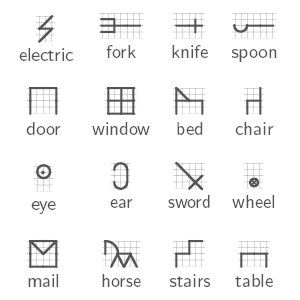
Blissymbols or Blissymbolics was conceived as an ideographic writing system called Semantography consisting of several hundred basic symbols, each representing a concept, which can be composed together to generate new symbols that represent new concepts. Blissymbols differ from most of the world’s major writing systems in that the characters do not correspond at all to the sounds of any spoken language.
Blissymbols were invented by Charles K. Bliss (1897–1985), born Karl Kasiel Blitz in the Austro-Hungarian city of Czernowitz (in what is now Ukraine), which had a mixture of different nationalities that ‘hated each other, mainly because they spoke and thought in different languages.’ Bliss graduated as a chemical engineer at the Vienna University of Technology, and joined an electronics company as a research chemist. When the German Army invaded Austria in 1938, he was sent to the concentration camps of Dachau and Buchenbald. His German wife Claire managed to get him released, and they finally became exiles in Shanghai, where Bliss had relatives.
read more »
Posted in Health, Language, World |
Leave a Comment »
December 7, 2011
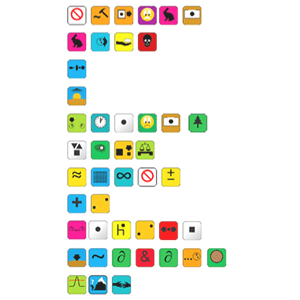
iConji is a free pictographic communication system based on an open, visual vocabulary of characters with built-in translations for most major languages. The app debuted with 1183 unique characters, known as the lexiConji (vocabulary), culled from base words used in common daily communications, word frequency lists, often-used mathematical and logical symbols, punctuation symbols, and the flags of all nations.
The process of assembling a message from iConji characters is called iConjisation. Since most characters represent an entire word or concept, rather than a single letter or character, iConji has the potential to be a more efficient communication system than SMS (texting). The usual jumble of text and confusing abbreviations can often be replaced by a short string of colorful icons that convey the identical meaning.
read more »
Posted in Language, Technology, World |
Leave a Comment »
December 1, 2011

‘Pink Box: Inside Japan’s Sex Clubs’ is a book by photojournalist Joan Sinclair, chronicling her exploration of the secret world of fuzoku (prostitution) in Japan. Sinclair was joined by contributor James Farrer, a British sociologist who attempted to ‘place[s] the images in the context of contemporary Japanese culture.’
The book was published in 2006. Sinclair, a lawyer, describes being triggered to write the book by a comment she overheard ten years earlier, when she spent a year teaching English in Japan. Sinclair describes encountering, and overcoming, difficulties researching and getting access to the clubs—usually reserved for Japanese born patrons.
Posted in Politics, Sex, World |
Leave a Comment »
December 1, 2011

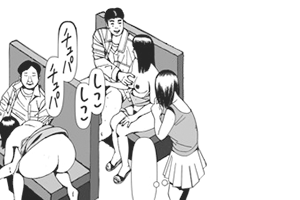
A pink salon, or pinsaro for short, is a type of brothel in Japan which specializes in oral sex. A pink salon is unusual in that the service is offered in small booths within a large open-plan room. The client is served soft drinks or alcoholic beverages by the ‘companion’ who performs fellatio on him. There may also be additional activities such as fingering the ‘companion’ and sumata (a Japanese term for a non-penetrative sex act where the sex worker rubs the client’s penis with her hands, thighs (intercrural sex), and labia majora).
Unlike the west, Japan does not have the same stigmas attached to sex work. Many young Japanese women work in pink salons throughout late high school and college as work is plentiful and pay is much better than in customer service positions. However, the work is demanding and an employee may be required to fellate over a dozen men in a single four hour shift.
Posted in Money, Sex, World |
Leave a Comment »


 The Daily Omnivore