July 19, 2011

Blue Lines is the debut album by British electronica group Massive Attack, released in 1991. It is generally considered the first trip hop album, although the term was not coined until years later.
A fusion of electronic music, hip hop, dub, ’70s soul and reggae, the album established Massive Attack as one of the most innovative British bands of the 1990s and the founder of trip hop’s Bristol Sound. The album also marked a change in electronic/dance music, ‘a shift toward a more interior, meditational sound.
read more »
Posted in Art, Technology, World |
Leave a Comment »
July 18, 2011

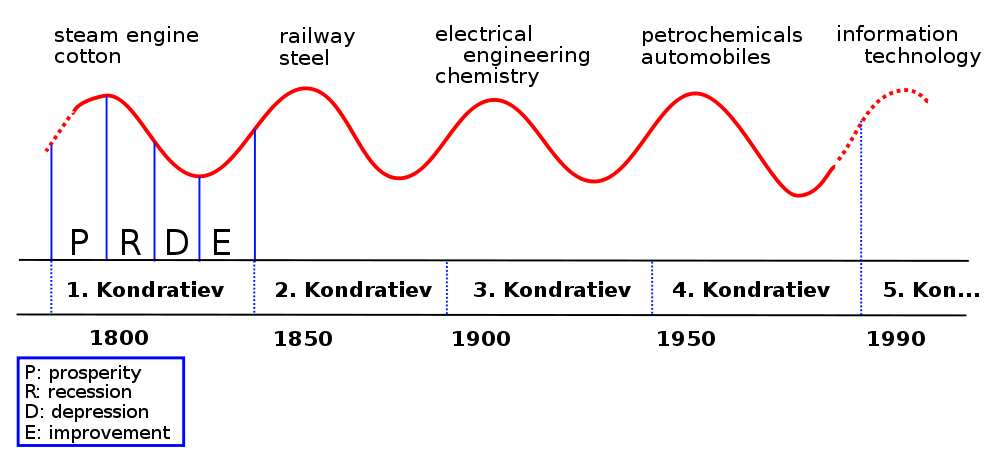
Kondratiev waves (also called supercycles, great surges, or long waves) are described as sinusoidal-like cycles in the modern capitalist world economy. Averaging fifty and ranging from approximately forty to sixty years in length, the cycles consist of alternating periods between high sectoral growth and periods of relatively slow growth. Unlike the short-term business cycle, the long wave of this theory is not accepted by current mainstream economics.
Russian economist Nikolai Kondratiev (1892 – 1938) was the first to bring these observations to international attention in his book ‘The Major Economic Cycles’ (1925). Kondratiev was a Russian economist, but his economic conclusions were disliked by the Soviet leadership and upon their release he was quickly dismissed from his post as director of the Institute for the Study of Business Activity in the Soviet Union in 1928. His conclusions were seen as a criticism of Joseph Stalin’s intentions for the Soviet economy. As a result he was sentenced to the Soviet Gulag and later received the death penalty in 1938.
read more »
Posted in Money, Technology, World |
Leave a Comment »
July 17, 2011

My Neighbor Totoro is a 1988 Japanese animated fantasy film written and directed by Hayao Miyazaki and produced by Studio Ghibli. The film follows the two young daughters of a professor and their interactions with friendly wood spirits in postwar rural Japan. The art director was Kazuo Oga, who was drawn to the film when Hayao Miyazaki showed him an original image of Totoro standing in a satoyama (foothills). Oga’s was recognized as ‘updating the traditional Japanese animist sense of a natural world that is fully, spiritually alive.’ ‘Set in a period that is both modern and nostalgic, the film creates a fantastic, yet strangely believable universe of supernatural creatures coexisting with modernity. A great part of this sense comes from Oga’s evocative backgrounds, which give each tree, hedge and twist in the road an indefinable feeling of warmth that seems ready to spring into sentient life.’ Oga’s style became a trademark style of Studio Ghibli.
As is the case with Disney’s other English dubs of Miyazaki films, the Disney version of Totoro features a star-heavy cast, including Dakota and Elle Fanning as Satsuki and Mei, and Timothy Daly as Mr. Kusakabe. ‘My Neighbor Totoro’ helped bring Japanese animation into the global spotlight, and set its writer-director Hayao Miyazaki on the road to success. The film’s central character, Totoro, is as famous among Japanese children as Winnie-the-Pooh is among British ones.
Posted in Art, World |
Leave a Comment »
July 15, 2011

Lysenkoism [li-seng-koh-iz-uhm] is used colloquially to describe the manipulation or distortion of the scientific process as a way to reach a predetermined conclusion as dictated by an ideological bias, often related to social or political objectives. The word is derived from a set of political and social campaigns in science and agriculture by the director of the Soviet Lenin All-Union Academy of Agricultural Sciences, Trofim Lysenko and his followers, which began in the late 1920s and formally ended in 1964.
In 1928, Trofim Lysenko, a previously unknown plant scientist, claimed to have developed an agricultural technique, termed vernalization, which tripled or quadrupled crop yield by exposing wheat seed to high humidity and low temperature. While cold and moisture exposure are a normal part of the life cycle of fall-seeded winter cereals, the vernalization technique claimed to enhance yields by increasing the intensity of exposure, in some cases planting soaked seeds directly into the snow cover of frozen fields. In reality, the technique was neither new (it had been known since 1854, and was extensively studied during the previous twenty years), nor did it produce the yields he promised.
read more »
Posted in Politics, Science, World |
1 Comment »
July 12, 2011

Garry Kasparov (b. 1963) is a Russian chess grandmaster, a former World Chess Champion, writer, political activist, and one of the greatest chess players of all time. Kasparov became the youngest ever undisputed World Chess Champion in 1985 at the age of 22. He held the official FIDE world title until 1993, when a dispute with FIDE led him to set up a rival organization, the Professional Chess Association. He continued to hold the ‘Classical’ World Chess Championship until his defeat by Vladimir Kramnik in 2000. He is also widely known for being the first world chess champion to lose a match to a computer under standard time controls, when he lost to IBM’s Deep Blue in 1997.
After his retirement from chess in 2005, Kasparov turned to politics and created the United Civil Front, a social movement whose main goal is to ‘work to preserve electoral democracy in Russia.’ He has vowed to ‘restore democracy’ to Russia by ousting Vladimir Putin, of whom he is an outspoken critic.
read more »
Posted in Games, Politics, World |
Leave a Comment »
July 12, 2011

Kaoru Betto (b. 1920) was a former Nippon Professional Baseball player. After playing for the Ōsaka Tigers for two years, Betto played for the Mainichi Orions from 1950 to 1957. In his first season with the Orions, Betto won the NPB’s first Pacific League MVP Award and helped lead the team to victory in the first Japan Series.
Actor Jeff Bridges can be seen wearing a Kaoru Betto shirt in several of his films.
Posted in Games, World |
Leave a Comment »
July 11, 2011

The Tamagotchi [tom-uh-gotchee] is a handheld digital pet, created in Japan by Akihiro Yokoi of WiZ and Aki Maita of Bandai. It was first sold by Bandai in 1996 in Japan. As of 2010, over 76 million Tamagotchis have been sold world-wide. Most Tamagotchis are housed in a small egg-shaped computer with an interface usually consisting of three buttons, although the number of buttons may vary for different variations. According to Bandai, the name is a portmanteau combining the Japanese word ‘tamago,’ which means ‘egg,’ and the English word ‘watch.’
Upon removing the tag of a Tamagotchi unit, an egg will appear on the screen. After setting the Tamagotchi unit’s clock, the Tamagotchi will hatch, after which the player will be told of its gender and will be given the opportunity to give it a name. From then on, the player is given the task of raising the Tamagotchi to good health throughout its life and attending to its needs, such as feeding it, playing games to make it happy, and keep it at a healthy weight, cleaning up its excrement, punishing or praising the Tamagotchi based on its actions, returning it to proper health with medicine if it gets sick, and shutting off the lights when it goes to bed.
read more »
Posted in Games, Technology, World |
Leave a Comment »
July 11, 2011

A MiniDisc (MD) is a magneto-optical disc-based data storage device initially intended for storage of up to 74 minutes and, later, 80 minutes, of digitized audio. In the form of Hi-MD, it has also developed into a general-purpose storage medium. MiniDisc was released in 1992, first in Japan, and then in Europe and the U.S. The music format was originally based exclusively on ATRAC audio data compression, but the option of linear PCM recording was later introduced to attain audio quality comparable to that of a compact disc.
Sony’s MiniDisc was one of two rival digital systems introduced in 1992, that were both targeted as a replacement for the Philips analog cassette audio tape system: the other was Digital Compact Cassette (DCC), created by Philips and Matsushita. Sony had originally intended for Digital Audio Tape (DAT) to be the dominant home digital audio recording format, replacing the analog cassette. Unfortunately, due to technical delays, DAT was not launched until 1989, and by then, the U.S. dollar had fallen so far in relation to the yen, the introductory DAT machine Sony had intended to market for about $400 in the late 1980s now had to retail for $800 or even $1000 to break even, putting it out of reach for most users. Relegating DAT for pro use, Sony immediately set to work to come up with a simpler, more economical digital home format.
read more »
Posted in Money, Technology, World |
Leave a Comment »
July 11, 2011

The Chinese typewriter was invented and patented by Dr. Lin Yutang in 1946. One of Lin’s intentions was to help modernize China. The typewriter was called ‘MingKwai’ (‘clear and quick’). Lin had a prototype machine custom built by the Carl E. Krum Company, a small engineering-design consulting firm with an office in New York City. That multilingual typewriter was the size of a conventional office typewriter of the 1940s. The typefaces fit on a drum. A ‘magic eye’ was mounted in the center of the keyboard which magnifies and allows the typist to review a selected character. Character selection is accomplished by first pressing two keys to choose a desired character, which is arranged according to a system Lin devised for his dictionary of the Chinese language. The selected Chinese character appeared in the magic eye for preview, the typist then pressed a ‘master’ key, similar to today’s computer function key.
The typewriter could create 90,000 distinct characters using either one or two of six character-containing rollers, which in combination has 7000 full characters and 1,400 character radicals or partial characters. The inspired aspect of the typewriter was the system Lin devised for a Chinese alphabet. It had thirty geometric shapes or strokes (somewhat analogous to the elements of a glyph). These became ‘letters’ by which to alphabetize Chinese characters. He broke tradition with the long-standing system of radicals and stroke order writing and categorizing of Chinese characters, inventing a new way of seeing and categorizing. The typewriter was not produced commercially. According Lin’s daughter, the day she was to demonstrate the machine to executives of the Remington Typewriter Company, they could not make it work. Although they did get the machine fixed for a press conference the next day, it was to no avail.
Posted in Language, Technology, World |
Leave a Comment »
July 11, 2011

Hot pot, less commonly Chinese fondue or steamboat, refers to several East Asian varieties of stew, consisting of a simmering metal pot of stock at the center of the dining table. While the hot pot is kept simmering, ingredients are placed into the pot and are cooked at the table. Typical hot pot dishes include thinly sliced meat, leafy vegetables, mushrooms, wontons, egg dumplings, and seafood. The cooked food is usually eaten with a dipping sauce. In many areas, hot pot meals are often eaten in the winter.
The Chinese hot pot boasts a history of more than 1,000 years. While often called ‘Mongolian hot pot,’ it is unclear if the dish actually originates in Mongolia, though Mongolian warriors had been known to cook with their helmets, which they used to boil food. Hot pot cooking spread to northern China during the Tang Dynasty (618 – 906). Today in many modern homes, particularly in the big cities, the traditional coal-heated steamboat or hot pot has been replaced by electric, gas or induction cooker versions.
read more »
Posted in Food, World |
Leave a Comment »
July 8, 2011

Jean-Yves Prieur (b.1964), aka Kid Loco is a French electronic musician, DJ, remixer and producer. His style has been compared to Air and Dimitri from Paris. His best-known album is ‘A Grand Love Story’ (1997), and he has also compiled and mixed a DJ mix album for the ‘Another Late Night’ series on Azuli Records.
He has worked with Jarvis Cocker (of Pulp), with Italian band The Transistors (Maurizio Mansueti and Luca Cirillo) and Glasgow bands A Band Called Quinn and Mogwai, and produced the album ‘Too Late To Die Young’ by the British group, Departure Lounge.
Posted in Art, World |
Leave a Comment »
July 5, 2011

Granny Takes a Trip was a boutique opened in 1966 in Chelsea, London. The shop remained open until the mid-70s and has been called the ‘first psychedelic boutique in the ‘Swinging London’ in the 1960s.” It was also the name of a Purple Gang song of the 1960s named after the store and banned by the BBC.
The boutique was the brainchild of two young Londoners, Nigel Waymouth and Sheila Cohen, who were looking for an outlet for Cohen’s ever-increasing collection of antique clothes. By the spring of 1966 the shop had achieved worldwide renown. They paved the way for many of the designer boutiques that followed, such as Mr. Freedom, Alkasura, Let It Rock, and later the more ambitious enterprises of Malcolm McLaren and Vivienne Westwood and Paul Smith.
read more »
Posted in Art, Money, World |
Leave a Comment »




 The Daily Omnivore