May 1, 2013
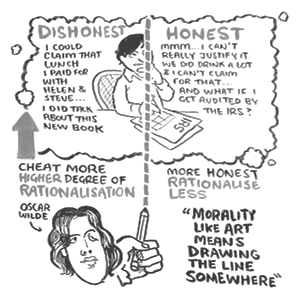
In psychology and logic, rationalization (also known as making excuses) is an unconscious defense mechanism in which perceived controversial behaviors or feelings are logically justified and explained in a rational or logical manner in order to avoid any true explanation, and are made consciously tolerable – or even admirable and superior – by plausible means.
Rationalization encourages irrational or unacceptable behavior, motives, or feelings and often involves ad hoc hypothesizing. This process ranges from fully conscious (e.g. to present an external defense against ridicule from others) to mostly subconscious (e.g. to create a block against internal feelings of guilt). Continue reading →
Posted in Health |
Leave a Comment »
May 1, 2013

An intuition pump is a thought experiment structured to elicit intuitive answers about a problem. The term was coined by Daniel Dennett. In ‘Consciousness Explained,’ he uses the term pejoratively to describe John Searle’s ‘Chinese room’ thought experiment, characterizing it as designed to elicit intuitive but incorrect answers by formulating the description in such a way that important implications of the experiment would be difficult to imagine and tend to be ignored.
Searle’s experiment supposes that there is a program that gives a computer the ability to carry on an intelligent conversation in written Chinese. If the program is given to someone who speaks only English to execute the instructions of the program by hand, then in theory, the English speaker would also be able to carry on a conversation in written Chinese. However, the English speaker would not be able to understand the conversation.
Continue reading →
Posted in Language, Philosophy, Science |
Leave a Comment »
May 1, 2013
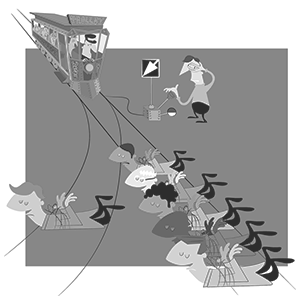
The trolley problem is a thought experiment in ethics, first introduced by British philosopher Philippa Foot in 1967, but also extensively analyzed by philosophers Judith Jarvis Thomson, Peter Unger, and Frances Kamm as recently as 1996. Outside of the domain of traditional philosophical discussion, the trolley problem has been a significant feature in the fields of cognitive science and, more recently, of neuroethics. It has also been a topic on various TV shows dealing with human psychology.
The general form of the problem is this: Person A can take an action which would benefit many people, but in doing so, person B would be unfairly harmed. Under what circumstances would it be morally just for Person A to violate Person B’s rights in order to benefit the group?
Continue reading →
Posted in Death, Health, Philosophy |
2 Comments »
April 30, 2013

Cultural imperialism is defined as the cultural aspects of imperialism. Imperialism, here, is referring to the creation and maintenance of unequal relationships between civilizations favoring the more powerful civilization. Therefore, it can be defined as the practice of promoting and imposing a culture, usually of politically powerful nations over less potent societies. It is the cultural hegemony of those industrialized or economically influential countries, which determine general cultural values and standardize civilizations throughout the world.
Many scholars employ the term, especially those in the fields of history, cultural studies, and postcolonial theory. It is usually used in a pejorative sense, often in conjunction with a call to reject such influence. Cultural imperialism can take various forms, such as an attitude, a formal policy, military action, so long as it reinforces cultural hegemony.
Continue reading →
Posted in Philosophy, Politics, World |
3 Comments »
April 30, 2013

Disneyfication is a term which describes the transformation of something, usually society at large, to resemble The Walt Disney Company’s theme parks.
The latter term appears in Sharon Zukin’s book, ‘The Cultures of Cities’ (1996), and was popularized by Alan Bryman (Professor of Organizational and Social Research at the University of Leicester) in a 2004 book, ‘The Disneyization of Society.’ Disneyfication of urban space is explored in sociologist Jeff Ferrell’s ‘Tearing Down the Streets: Adventures in Urban Anarchy.’ Continue reading →
Posted in Money, World |
Leave a Comment »
April 30, 2013

McDonaldization is a term used by sociologist George Ritzer in his book ‘The McDonaldization of Society’ (1993). He explains it occurs when a culture possesses the characteristics of a fast-food restaurant.
McDonaldization is a reconceptualization of rationalization (moving from an ad-hoc system into one that is based on a set of published rules). Where German political economist Max Weber used the model of the bureaucracy to represent the direction of this change in society, Ritzer sees the fast-food restaurant as having become a more representative contemporary paradigm.
Continue reading →
Posted in Food, Money, World |
2 Comments »
April 30, 2013

Outside the United States, Americanization is a term for the influence the United States has on the culture of other countries, such as their popular culture, cuisine, technology, business practices, or political techniques.
The term has been used since at least 1907. Within the US, it refers to the process of acculturation by immigrants or annexed populations (e.g. the Californios) to American customs and values.
Continue reading →
Posted in Money, Politics, World |
Leave a Comment »
April 30, 2013

Narconon is a Scientology front group that offers purported drug rehabilitation treatment and anti-drug lectures. Both programs promote the ideology of L. Ron Hubbard. Narconon is headquartered in Hollywood and operates several dozen residential centers worldwide, chiefly in the United States and Western Europe. The rehab program has been described as ‘medically unsafe,’ ‘quackery,’ and ‘medical fraud,’ while academic and medical experts have dismissed the educational program as containing ‘factual errors in basic concepts such as physical and mental effects, addiction and even spelling.’
In turn, Narconon has claimed that mainstream medicine is biased against it, and that ‘people who endorse so-called controlled drug use cannot be trusted to review a program advocating totally drug-free living.’ Narconon has said that criticism of its program is ‘bigoted,’ and that its critics are ‘in favor of drug abuse … they are either using drugs or selling drugs,’ while Scientology head David Miscavige attributes criticism to Scientology’s ‘war’ with ‘the mental health field.’
Continue reading →
Posted in Drugs, Philosophy, Politics |
Leave a Comment »
April 29, 2013

The Red Delicious is a clone of apple cultigen, now comprising more than 50 cultivars, that was recognized in Madison County, Iowa in 1880. As new cultivars with improved color and earlier harvestability have replaced the original cultivar in commercial orchards, the taste and texture of the harvested commodity have deteriorated, and many customers have begun to reject the Red Delicious at markets.
Apple expert, Roger Yepsen notes some of the Red’s less desirable qualities: ‘The skin is thick and bitter and has to be chewed vigorously… this apple ranks close to the bottom when cooked… sold year round, so shop with skepticism. Delicious retains its cheerful good looks long after its flavor has departed.’
Continue reading →
Posted in Food, Money, Science |
Leave a Comment »
April 29, 2013

An angry white male (AWM) is a pejorative reference to someone with what is typically known as a traditional conservative viewpoint, especially in the context of U.S. politics, characterized by opposition to racial quotas, political correctness, affirmative action, and other liberal policies.
The movies ‘Joe,’ ‘Falling Down,’ and Clint Eastwood’s performances in both the ‘Dirty Harry’ series and ‘Gran Torino’ have been described as definitive explorations of the angry white male. The protagonist of ‘Falling Down,’ a former defense worker who descends into a spiral of increasing rage and violence, was widely reported upon as a representative of the stereotype.
Posted in Language, Politics |
Leave a Comment »
April 29, 2013

First World privilege, similar to white privilege and male privilege, is the unearned advantages accrued by an individual by virtue of being a national of a First World country.
The concept is important for those considering advantages gained, due to institutional beliefs, prejudice and legal barriers, because of one’s nationality rather than one’s race or sex. Countries included in the first world class include Australia, Britain, Canada, New Zealand, United States, Japan and Western Europe. Continue reading →
Posted in Money, Politics, World |
Leave a Comment »
April 29, 2013

Reverse discrimination is discrimination against members of a dominant or majority group or in favor of members of a minority or historically disadvantaged group. Groups may be defined in terms of race, gender, ethnicity, or other factors.
This discrimination may seek to redress social inequalities where minority groups have been denied access to the same privileges of the majority group. In such cases it is intended to remove discrimination that minority groups may already face. Reverse discrimination may also be used to highlight the discrimination inherent in affirmative action programs. Continue reading →
Posted in Money, Politics, Sex |
Leave a Comment »



