February 18, 2013

‘Private Guns, Public Health‘ is a 2004 non-fiction book by David Hemenway, an economist who has served as Professor of Health Policy at the Harvard School of Public Health as well as the Director of Harvard’s Injury Control Research Center. He argues that the widespread ownership of firearms in private hands in the U.S. promotes the spread of the ‘disease’ of gun violence, and he takes a collective interpretation of the Second Amendment while stating that increased regulations are absolutely necessary in the purposes of public safety. Hemenway makes the central case that ‘more guns in a community lead to more homicide.’
Hemenway interprets the issues of gun violence and gun politics in the U.S. through a public health lens, which he believes ’emphasizes prevention rather than fault-finding, blame, or revenge.’ He writes that he is not ‘anti-gun’ or ‘anti-gun owner’ any more than people who advocate for consumer safety measures in cars are ‘anti-cars.’ He sums the goal of the book up as ‘injury prevention.’ Continue reading →
Posted in Health, Language, Politics |
Leave a Comment »
February 18, 2013

‘More Guns, Less Crime‘ is a book by economist John Lott that says violent crime rates go down when states permit the concealed carry of guns. He presents the results of his statistical analysis of crime data for every county in the United States during 29 years from 1977 to 2005. The book examines city, county and state level data from the entire United States and measures the impact of 11 different types of gun control laws on crime rates. The book expands on an earlier study published in 1997 by Lott and his co-author David Mustard in ‘The Journal of Legal Studies.’
Lott also examines the effects of gun control laws, including the Brady Law. His conclusion is that ‘shall issue’ laws, which allow citizens to carry concealed weapons, steadily decrease violent crime. He explains that this result makes sense because criminals are deterred by the risk of attacking an armed victim. As more citizens arm themselves, the danger to criminals increases. Lott also examines the effects of training requirements on crime rate and accident rate. He finds that training requirements have very little effect on both crime rates and accident rates. Continue reading →
Posted in Language, Politics |
Leave a Comment »
February 18, 2013
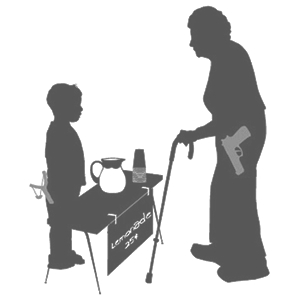
Concealed carry, or CCW (carrying a concealed weapon), refers to the practice of carrying a handgun or other weapon in public in a concealed manner, either on one’s person or in proximity. Concealed carry is legal in most areas of the United States. A handful of states and jurisdictions restrict or ban CCW, but all states except Illinois make provision for legal concealed carry via a permit or license, or via constitutional carry (CCW authorized by a State constitution).
Most states have ‘shall-issue’ statutes; that is, if a person meets the requirements to obtain a permit, the state must issue one. Some states, including California, New Jersey, New York, and Massachusetts have ‘may-issue’ statutes; these states may (or may not) issue permits to carry if a person meets the requirements to obtain one. States with may-issue statutes typically do not issue permits unless the applicant provides a documented need for a concealed weapon, such as for retired police officers, judges, and federal agents. Continue reading →
Posted in Death, Politics |
Leave a Comment »
February 18, 2013

Gun control is any law, policy, practice, or proposal designed to restrict or limit the possession, production, importation, shipment, sale, and/or use of guns or other firearms by private citizens among others. Gun control laws and policy vary greatly around the world. Some countries, such as the United Kingdom and Austrailia, have very strict limits on gun possession while others, such as the United States, have relatively modest limits. In some countries, the topic remains a source of intense debate with proponents generally arguing the dangers of widespread gun ownership, and opponents generally arguing individual rights of self-protection as well as individual liberties in general.
High rates of gun mortality and injury are often cited as a primary impetus for gun control policies. There is general agreement that gun violence is a serious public health and economic concern. Yet, society remains deeply divided over whether more restrictive gun control policies would save lives and prevent injuries. Scholars agree the rate of gun violence in the United States is disproportionately high relative to other wealthy countries. Nevertheless, strong disagreement remains among academics on the question of whether a causal relationship between gun availability and violence exists, and which, if any, gun controls would effectively stem the violence.
Continue reading →
Posted in Death, Politics, War |
2 Comments »
February 17, 2013
Coolness is an admired aesthetic of attitude, behavior, comportment, appearance and style, influenced by and a product of the Zeitgeist (‘spirit of the age’). Because of the varied and changing connotations of cool, as well its subjective nature, the word has no single meaning.
It has associations of composure and self-control and often is used as an expression of approval. Although commonly regarded as slang, it is widely used among disparate social groups, and has endured in usage for generations. Because there is no single concept of cool, one of its essential characteristics is mutability—what is considered cool changes over time and varies among cultures and generations. Continue reading →
Posted in Language, Money, Philosophy |
Leave a Comment »
February 15, 2013

A hi-top fade is a style of haircut where hair on the sides is cut off or kept very short and hair on the top of the head is very long (in contrast, a low fade is when hair on the top is kept shorter). The hi-top has been a trend symbolizing the Golden Era of hip hop and urban contemporary music during the late 1980s and the early 1990s. The hi-top fade was common among young African Americans between 1986 to 1993 and to a lesser extent in the mid-1990s (1994-1996).
The style fell completely out of fashion by 1997, though it has slowly made a return in the public eye in the late 2000s. In the hip hop community throughout the mid-1980s, young African-Americans leaned towards Jheri curls or simple haircuts without tapers or fades of any sort. Continue reading →
Posted in Art, Humor |
Leave a Comment »
February 15, 2013

The Zeitgeist [tsahyt-gahyst] (spirit of the age or spirit of the time) is the intellectual fashion or dominant school of thought that typifies and influences the culture of a particular period in time. For example, the Zeitgeist of modernism typified and influenced architecture, art, and fashion during much of the 20th century. The German word ‘Zeitgeist’ is often attributed to the philosopher Georg Hegel, but he never actually used the word. In his works such as ‘Lectures on the Philosophy of History,’ he uses the phrase ‘der Geist seiner Zeit’ (‘the spirit of his time’)—for example, ‘no man can surpass his own time, for the spirit of his time is also his own spirit.’
Other philosophers who were associated with such ideas include Herder and Spencer and Voltaire. The concept counters the ‘Great Man theory’ popularized by Thomas Carlyle which sees history as the result of the actions of heroes and geniuses.
Continue reading →
Posted in Art, Philosophy, Politics |
Leave a Comment »
February 14, 2013

In science and philosophy, a just-so story, also called an ad hoc fallacy, is an unverifiable and unfalsifiable narrative explanation for a cultural practice, a biological trait, or behavior of humans or other animals. The pejorative nature of the expression is an implicit criticism that reminds the hearer of the essentially fictional and unprovable nature of such an explanation. Such tales are common in folklore and mythology (where they are known as ‘origin’ or ‘etiological’ myths).
Published in 1902, Rudyard Kipling’s ‘Just So Stories,’ is a collection of fictional and deliberately fanciful tales for children in which the stories pretend to explain animal characteristics, such as the origin of the spots on the leopard. Continue reading →
Posted in Philosophy, Science |
Leave a Comment »
February 14, 2013

‘The Rebel Sell: Why the culture can’t be jammed’ (published in the US as ‘Nation of Rebels: Why Counterculture Became Consumer Culture’) is a non-fiction book written by University of Toronto philosopher Joseph Heath and Canadian journalist Andrew Potter in 2004. Their central claim is that counter-cultural movements have failed, and that they all share a common fatal error in the way they understand society; thus counter-culture is not a threat to ‘the system.’
Following their claim that conformity isn’t something perpetuated by mainstream media, Potter and Heath identify other sources of conformity using work from Hobbes, Rousseau, and Freud. They describe conformity as often the byproduct of simple market preferences or, alternatively, as an attempt to resolve a collective action problem. For instance, they claim that school uniforms curb the fashion ‘arms race’ created between students when no restrictions are in place, and that they are not intended merely to stamp out individualism, as many counter-cultural figures have suggested. Continue reading →
Posted in Language, Money, Politics |
Leave a Comment »
February 13, 2013

Chet Helms (1942 – 2005), often called the father of San Francisco’s 1967 ‘Summer of Love,’ was a music promoter and a cultural figure in San Francisco during its hippie period in the late Sixties. Helms was the founder and manager of Big Brother and the Holding Company and recruited Janis Joplin as its lead singer.
He was a producer and organizer, helping to stage free concerts and other cultural events at Golden Gate Park, the backdrop of San Francisco’s Summer of Love in 1967, as well as at other venues, including the Avalon Ballroom. He was the first producer of psychedelic light-show concerts at the Fillmore and the Avalon Ballroom and was instrumental in helping to develop bands that had the distinctive San Francisco Sound.
Continue reading →
Posted in Art, Money |
Leave a Comment »
February 13, 2013
A head shop is a retail outlet specializing in drug paraphernalia, as well as counterculture art, magazines, music, clothing, and home decor.
Products available in these outlets typically include pipes; pipe screens; bongs (often called water pipes in countries with drug paraphernalia laws); roach clips; vaporizers; rolling papers; rolling machines; scales or balances; blacklight-responsive posters; incense; cigarette lighters; legal drugs such as whipped-cream chargers (which contain nitrous oxide) and Salvia divinorum (illegal in some countries and US states); and products such as the Whizzinator claiming to give false negative results for drug urinalysis tests. Continue reading →
Posted in Drugs, Money |
Leave a Comment »
February 13, 2013

A breastaurant is a restaurant that has sexual undertones, most commonly in the form of large-breasted, skimpily dressed waitresses and barmaids. The term dates from at least the early 1990s and has since been applied to other restaurants that offer similar services, such as Tilted Kilt (dubbed ‘Hooters goes to Scotland’), Mugs N Jugs, Twin Peaks, Bikinis Sports Bar and Grill, Heart Attack Grill, and the much older Hooters.
The restaurants often offer specific themes, both in decoration and menu, and the operators of the restaurants hope that customers will come just for the food, or that for the customer the sexual nature is secondary to the good food. The restaurants offer numerous perks for customers, including alcohol and flirty servers.
Posted in Food, Money, Sex |
Leave a Comment »



