January 21, 2013


Guerrilla filmmaking refers to a form of independent filmmaking characterized by low budgets, skeleton crews, and simple props using whatever is available. Often scenes are shot quickly in real locations without any warning, and without obtaining permission from the owners of the locations.
Guerrilla filmmaking is usually done by independent filmmakers because they don’t have the budget to get permits, rent out locations, or build expensive sets. Larger and more ‘mainstream’ film studios tend to avoid guerrilla filmmaking tactics because of the risk of being sued, fined or having their reputation damaged due to negative PR exposure. Continue reading →
Posted in Art, Money |
Leave a Comment »
January 21, 2013

Escape From Tomorrow is a 2013 American fantasy-horror film. It is the debut film of writer-director Randy Moore, and stars Roy Abramsohn as a man having increasingly disturbing experiences and visions during the last day of a family vacation to the Walt Disney World theme park. After its premiere at the 2013 Sundance Film Festival, it became one of the most popular films there.
The film gained national media attention because Moore and his cast and crew made most of it on location at both Disney World and Disneyland without the consent or apparently even the awareness of The Walt Disney Company, which owns and operates both parks and has a reputation for being fiercely protective of its intellectual property. They used guerilla filmmaking techniques such as keeping their scripts on their iPhones to avoid attracting attention, and shooting on handheld video cameras similar to those used by the park’s many visitors. After principal photography was complete, Moore was so determined to keep the project a secret from Disney that he edited it in South Korea, and Sundance similarly declined to discuss the film in detail before it was shown.
Posted in Art, Money |
Leave a Comment »
January 21, 2013

The concept known as rational irrationality was popularized by economist Bryan Caplan in 2001 to reconcile the widespread existence of irrational behavior (particularly in the realms of religion and politics) with the assumption of rationality made by mainstream economics and game theory. The theory, along with its implications for democracy, was expanded upon by Caplan in his book ‘The Myth of the Rational Voter.’
The original purpose of the concept was to explain how (allegedly) detrimental policies could be implemented in a democracy, and unlike conventional public choice theory, Caplan posited that bad policies were selected by voters themselves. The theory has also been embraced by the ethical intuitionist philosopher Michael Huemer as an explanation for irrationality in politics. The theory has also been applied to explain religious belief.
Continue reading →
Posted in Money, Philosophy, Politics |
Leave a Comment »
January 19, 2013

Stuff You Should Know, often abbreviated as SYSK, is a free podcast published by Discovery Communications via its HowStuffWorks website and hosted by Josh Clark and Chuck Bryant, both writers at HowStuffWorks. Clark has been a mainstay on the podcast since it began in 2008. The podcast, released every Tuesday and Thursday, educates listeners on a wide variety of topics, often using popular culture as a reference giving the podcast comedic value.
Episodes are normally around 30 minutes in length, although for more in-depth topics the show has run as long as an hour. Initial episodes were much shorter in duration, often less than 10 minutes. The podcast covers a variety of odd questions and topics, like ‘How Twinkies Work,’ ‘Do Zombies Exist?,’ ‘How Tickling works,’ and ‘How Albert Einstein’s Brain Worked.’ Continue reading →
Posted in Education, Humor, Language |
Leave a Comment »
January 18, 2013

The Antagonist Movement is a cultural movement formed in New York City in 2000. The group grew out of desperation and in reaction to the New York art market. The movement primarily involves visual arts, literature, film, art manifestos and graphic design. It articulates its anti-commercial politics through a rejection of the prevailing standards in the art market and focuses its efforts on creating non-commercial cultural works and venues.
Its purpose is to ridicule the meaninglessness, superficiality and artificiality of the commercial art world. Antagonist activities have included public gatherings, demonstrations, the publication of art/literary journals, the production of documentary films, a clothing line, weekly art shows, writers nights, and a public access television show. Continue reading →
Posted in Art, Money, Politics |
Leave a Comment »
January 17, 2013

White Tantrism [tan-triz-uhm] is a form of sexual alchemy which involves a man and a woman making sexual contact then transmuting their sexual energies whilst remaining still throughout the act and withdrawing without orgasm.
It is regarded by its practitioners as an essential spiritual exercise for awakening consciousness rather than purely an act of pleasure. It is currently taught by schools of modern Gnosticism. Continue reading →
Posted in Philosophy, Sex |
Leave a Comment »
January 17, 2013
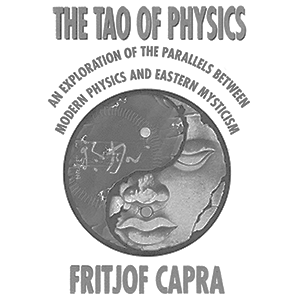
Quantum mysticism [mis-tuh-siz-uhm] is a term that has been used to refer to a set of metaphysical beliefs and associated practices that seek to relate consciousness, intelligence, or mystical world-views to the ideas of quantum mechanics and its interpretations. The term originally emerged from the founders of quantum theory in the early twentieth century as they debated the interpretations and implications of their nascent theories, which would later evolve into quantum mechanics, and later after WWII, with publications such as Schrödinger’s and Eugene Wigner’s 1961 paper.
The essential qualities of early quantum theory, and the ontological (related to the nature of being) questions that emerged from it, made a distinction between philosophical and scientific discussion difficult as quantum theory developed into a strong scientific theory. Quantum Mysticism is usually considered pseudoscience. Many of the leading Quantum physicists did however give mystical interpretations to their findings. Continue reading →
Posted in Philosophy, Science |
Leave a Comment »
January 17, 2013

The phrase ‘mind’s eye‘ refers to the human ability for visualization, i.e., for the experiencing of visual mental imagery; in other words, one’s ability to ‘see’ things with the mind. The biological foundation of the mind’s eye is not fully understood. fMRI studies have shown that the lateral geniculate nucleus (in the thalamus) and the V1 area of the visual cortex are activated during mental imagery tasks.
Harvard Medical School psychiatrist John Ratey writes: ‘The visual pathway is not a one-way street. Higher areas of the brain can also send visual input back to neurons in lower areas of the visual cortex… As humans, we have the ability to see with the mind’s eye – to have a perceptual experience in the absence of visual input. For example, PET scans have shown that when subjects, seated in a room, imagine they are at their front door starting to walk either to the left or right, activation begins in the visual association cortex, the parietal cortex, and the prefrontal cortex – all higher cognitive processing centers of the brain.’ Continue reading →
Posted in Health, Language, Philosophy |
Leave a Comment »
January 16, 2013

The utility monster is a thought experiment in the study of ethics. It was created by philosopher Robert Nozick in 1974 as a criticism of utilitarianism (which argues that the morally best action is the one that makes the most overall happiness or ‘utility’). In the thought experiment, a hypothetical being is proposed who receives as much or more utility from each additional unit of a resource he consumes as the first unit he consumes. In other words, the utility monster is not subject to diminishing marginal returns with regard to utility, but instead experiences constant marginal returns, or even increasing marginal returns.
Since ordinary people receive less utility with each additional unit consumed, if the utility monster existed, the doctrine of utilitarianism would justify the mistreatment and perhaps annihilation of everyone else, according to Nozick’s argument. In his words: ‘Utilitarian theory is embarrassed by the possibility of utility monsters who get enormously greater sums of utility from any sacrifice of others than these others lose . . . the theory seems to require that we all be sacrificed in the monster’s maw, in order to increase total utility.’ This thought experiment attempts to show that utilitarianism is not actually egalitarian, even though it appears to be at first glance. Continue reading →
Posted in Money, Philosophy |
Leave a Comment »
January 16, 2013

Common misconceptions are widely held, erroneous ideas and beliefs about notable topics which have been reported by reliable sources. Each has been discussed in published literature, as has its topic area and the facts concerning it. For example, in ancient Rome, the architectural feature called a ‘vomitorium’ was the entranceway through which crowds entered and exited a stadium, not a special room used for purging food during meals. Vomiting was not a regular part of Roman dining customs.
Also, Nero did not ‘fiddle’ during the Great Fire of Rome (violins had not yet been invented, nor was he playing the lyre). In fact, according to Roman historian Tacitus, upon hearing news of the fire, Nero rushed back to Rome to organize a relief effort, which he paid for from his own funds, and he also opened his palaces to provide shelter for the homeless, arranging for food supplies to be delivered in order to prevent starvation among the survivors. Finally, he made a new urban development plan that attempted to make it more difficult for fires to spread. Continue reading →
Posted in Education |
Leave a Comment »
January 16, 2013
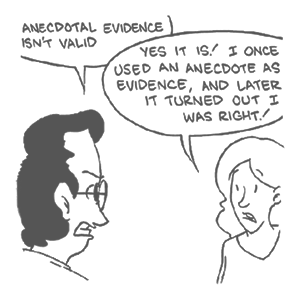
The expression anecdotal [an-ik-doht-l] evidence refers to evidence from anecdotes. Because of the small sample, there is a larger chance that it may be unreliable due to cherry-picked or otherwise non-representative samples of typical cases. Anecdotal evidence is considered dubious support of a claim; it is accepted only in lieu of more solid evidence. This is true regardless of the veracity of individual claims. The term is often used in contrast to scientific evidence, such as evidence-based medicine, which are types of formal accounts.
Some anecdotal evidence does not qualify as scientific evidence because its nature prevents it from being investigated using the scientific method. Misuse of anecdotal evidence is an informal fallacy and is sometimes referred to as the ‘person who’ fallacy (e.g.,’I know a person who…’ or ‘I know of a case where…’). Anecdotal evidence is not necessarily representative of a ‘typical’ experience; in fact, human cognitive biases such as confirmation bias mean that exceptional or confirmatory anecdotes are much more likely to be remembered. Accurate determination of whether an anecdote is ‘typical’ requires statistical evidence.
Continue reading →
Posted in Science |
1 Comment »
January 15, 2013
Dreamwork differs from classical dream interpretation in that the aim is to explore the various images and emotions that a dream presents and evokes, while not attempting to come up with a single unique dream meaning. In this way the dream remains ‘alive’ whereas if it has been assigned a specific meaning, it is ‘finished’ (i.e., over and done with). Dreamworkers take the position that a dream may have a variety of meanings depending on the levels (e.g. subjective, objective) that are being explored.
A tenet of dreamwork is that each person has his or her own dream ‘language.’ Any given place, person, object or symbol can differ in its meaning from dreamer to dreamer and also from time to time in the dreamer’s ongoing life situation. Thus someone helping a dreamer get closer to her or his dream through dreamwork adopts an attitude of ‘not knowing’ as far as possible. Continue reading →
Posted in Health, Philosophy |
1 Comment »



