November 8, 2012

The Anti Security Movement (also written as antisec and anti-sec) is a movement opposed to the computer security industry. Antisec is against full disclosure of information relating to but not limited to: software vulnerabilities, exploits, exploitation techniques, hacking tools, attacking public outlets, and distribution points of that information. The general thought behind this is that the computer security industry uses full disclosure to profit and develop scare-tactics to convince people into buying their firewalls, anti-virus software, and auditing services. As recently as 2009, attacks against security communities such as ‘Astalavista’ and ‘milw0rm,’ as well as the popular image-host ‘ImageShack,’ have given the movement worldwide media attention.
The ‘anti-security movement” as it is understood today was coined a document which was initially an index on the anti.security.is website: ‘The purpose of this movement is to encourage a new policy of anti-disclosure among the computer and network security communities. The goal is not to ultimately discourage the publication of all security-related news and developments, but rather, to stop the disclosure of all unknown or non-public exploits and vulnerabilities. In essence, this would put a stop to the publication of all private materials that could allow script kiddies from compromising systems via unknown methods.’
Posted in Money, Politics, Technology |
Leave a Comment »
November 8, 2012


A grey hat in the hacking community refers to a skilled hacker whose activities fall somewhere between white hat (lawful) and black hat (unlawful) hackers on a variety of spectra.
They usually do not hack for personal gain or have malicious intentions, but may be prepared to technically commit crimes during the course of their technological exploits in order to achieve better security. Whereas white hat hackers will tend to advise companies of security exploits quietly, grey hat hackers are prone to ‘advise the hacker community as well as the vendors and then watch the fallout.’
Continue reading →
Posted in Money, Politics, Technology |
Leave a Comment »
November 7, 2012

‘Our Dumb World‘ is a parody of the standard desk atlas created by the staff of ‘The Onion’ and published in 2007. It is The Onion’s first book of entirely original content since 1999’s ‘Our Dumb Century.’ The book, written in the satirical paper’s editorial voice, contains entries for nearly every country on Earth, including detailed maps and humorous stereotyped descriptions of regional history and customs. For example, Canada’s entry is subtitled, ‘For the United States, see pages 9 – 22.’ The sections devoted to the Northern and Southern Poles and Greenland, are touted as, ‘larger than Africa and South America combined.’
The visual style of the atlas has been compared to Dorling Kindersley’s ‘Eyewitness’ series. The book uses faux xenophobia to illustrate the cultural differences of various nations, often mocking racial stereotypes with satirical comments. In the ‘New York Times,’ William Grimes called it ‘an astoundingly offensive guide to the states of the union and the countries of the world, compiled on the premise that all countries are ridiculous and contemptible’ and found it ‘sophomoric, transgressive, and intermittently brilliant.’ Elements of the book have been transferred to an electronic format available on the paper’s website and as a layer on Google Earth.
Posted in Humor, Language, World |
Leave a Comment »
November 7, 2012
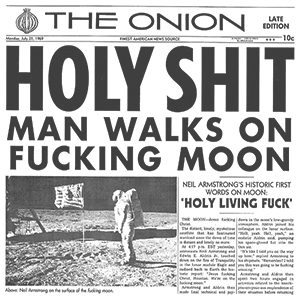
‘Our Dumb Century: The Onion Presents 100 Years of Headlines from America’s Finest News Source’ is a satirical humor book written by the staff of ‘The Onion’ and published in 1999. The chief editor of the book was Scott Dikkers, with specific sections edited by Robert D. Siegel, Maria Schneider, and John Krewson.
The book, spun off from ‘The Onion’ weekly-newspaper format of dryly satirizing current events, features mocked-up newspaper front pages from the entire 20th century, presented as though ‘The Onion’ had been continuously in print since before 1900. The publication of the book is in itself a parody of other end of the century retrospectives that had been published in 1999, notably ‘Time’ magazine and ‘The New York Times.’ Continue reading →
Posted in Humor, Language, Politics |
Leave a Comment »
November 7, 2012

The sign of the horns is a hand gesture with a variety of meanings and uses in various cultures. It is formed by extending the index and little fingers while holding the middle and ring fingers down with the thumb. When confronted with unfortunate events, or simply when these are mentioned, the sign of the horns may be given to ward off bad luck. It is a more vulgar equivalent of ‘knocking on wood.’
One can also ‘touch iron’ (‘tocca ferro’) or touch one’s nose. Males in some countries may grab their testicles, which is considered very vulgar. In Peru one says ‘contra’ (‘against’). In the Dominican Republic the expression is ‘zafa,’ said against curses. All of these gestures are meant to conjure supernatural protection. However, the sign of horns is used in Brazil, Cuba, Italy, Portugal, Spain and Uruguay to indicate a man whose wife is unfaithful. Continue reading →
Posted in Humor, Philosophy, World |
Leave a Comment »
November 7, 2012
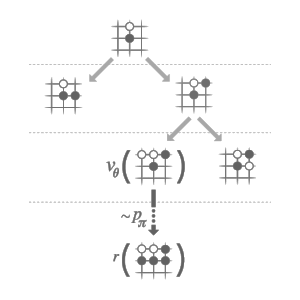
Go is a board game for two players that originated in China more than 2,500 years ago. The game is noted for being rich in strategy despite its relatively simple rules. According to chess master Edward Lasker: ‘The rules of Go are so elegant, organic, and rigorously logical that if intelligent life forms exist elsewhere in the universe, they almost certainly play Go.’
The two players alternately place black and white playing pieces, called ‘stones,’ on the vacant intersections (called ‘points’) of a grid of 19×19 lines. The object of the game is to use one’s stones to surround a larger total area of the board than the opponent. Continue reading →
Posted in Games, World |
Leave a Comment »
November 7, 2012

Scrapple [skrap-uhl], known by the Amish by the Pennsylvania Dutch name ‘pon haus,’ is a mush of pork scraps and trimmings combined with cornmeal and wheat flour, often buckwheat flour, and spices. The mush is formed into a semi-solid congealed loaf, and slices of the scrapple are then panfried to form a crust before serving.
Scraps of meat left over from butchering, not used or sold elsewhere, were made into scrapple to avoid waste. Scrapple is best known as a rural American food of the Mid-Atlantic states (Delaware, Maryland, New Jersey and Pennsylvania). It is found in supermarkets throughout the region in both fresh and frozen refrigerated cases. It is arguably the first pork food invented in America. Continue reading →
Posted in Food, World |
Leave a Comment »
November 7, 2012

Pablo Ferro (b. 1935) is a graphic designer and film titles designer. Born in Cuba, he was raised on a remote farm before emigrating to New York with his family as a teenager. Ferro taught himself animation from a book by Preston Blair.
Ferro worked on films as diverse as Stanley Kubrick’s ‘Dr. Strangelove’ to the split-screen montage of the original ‘The Thomas Crown Affair.’ He was a pioneer of quick-cut editing, multiple screen images (the first in film and television in 1963). Ferro’s visual style has influenced many in film, television, animation, commercials, novels and children’s books. Continue reading →
Posted in Art |
Leave a Comment »
November 7, 2012
Stop Making Sense (1984) is a concert movie featuring Talking Heads live on stage. Directed by Jonathan Demme, it was shot over the course of three nights at Hollywood’s Pantages Theater in December 1983, as the group was touring to promote their new album ‘Speaking in Tongues.’ The movie is notable for being the first made entirely using digital audio techniques. The band raised the budget of $1.2 million themselves.
The title comes from the lyrics of the song ‘Girlfriend Is Better’: ‘As we get older and stop making sense…’ The movie begins with the opening credits, using a style similar to Stanley Kubrick’s ‘Dr. Strangelove or: How I Learned to Stop Worrying and Love the Bomb’ (the movie trailer also makes references to ‘Dr. Strangelove’). Title designer Pablo Ferro was responsible for both title sequences.
Continue reading →
Posted in Art |
1 Comment »
November 7, 2012

Remain in Light is the fourth studio album by American New Wave band Talking Heads, released in 1980. It was recorded at locations in the Bahamas and the United States and was produced by the quartet’s long-time collaborator Brian Eno. Two singles were released from the album: ‘Once in a Lifetime’ and ‘Houses in Motion’ as well as promotional single ‘Crosseyed and Painless.’
The members of Talking Heads wanted to make an album that dispelled notions of frontman and chief lyricist David Byrne leading a back-up band. They decided to experiment with African polyrhythms and, with Eno, recorded the instrumental tracks as a series of samples and loops, a novel idea at the time. Continue reading →
Posted in Art |
Leave a Comment »
November 7, 2012


A hyperforeignism is a non-standard language form resulting from an unsuccessful attempt to apply the rules of a foreign language to a loan word (for example, the application of the rules of one language to a word borrowed from another) or, occasionally, a word believed to be a loan word.
The result reflects ‘neither the… rules of English nor those of the language from which the word in question comes.’ Continue reading →
Posted in Language, World |
Leave a Comment »
November 7, 2012

The gay lisp is a stereotypical manner of speech associated with gay males, particularly in English-speaking countries, that involves their pronunciation of sibilant consonants (fricatives, made by directing a stream of air with the tongue towards the sharp edge of the teeth, which are held close together) and sometimes others verbal features.
The phenomenon of the ‘gay lisp’ and its study are poorly understood, similar to other secondary external attributes or verbal and non-verbal mannerisms of both gay and straight people. These attributes have proven difficult to define and quantify but seem somewhat independent of other variables in the phonology of the English language, such as accent and register. Continue reading →
Posted in Language, Sex |
Leave a Comment »



