
Ectoplasm [ek-tuh-plaz-uhm] (Greek: ‘ektos,’ meaning ‘outside,’ and ‘plasma,’ meaning ‘something formed or molded’) is a term coined by French physiologist Charles Richet to denote a substance or spiritual energy ‘exteriorized’ by physical mediums (individuals who claim a spiritual connection to the dead).
Ectoplasm is said to be associated with the formation of spirits; however since World War II reports of ectoplasmic phenomena have declined and many psychical researchers doubt whether genuine cases ever existed. Ectoplasm is said to be formed by physical mediums when in a trance state. This material is excreted as a gauze-like substance from orifices on the medium’s body and spiritual entities are said to drape this substance over their nonphysical body, enabling them to interact in the physical and real universe. According to mediums, the ectoplasm can not occur in light conditions as the ectoplasmic substance would disintegrate. Continue reading
Ectoplasm
The Ascent of Money
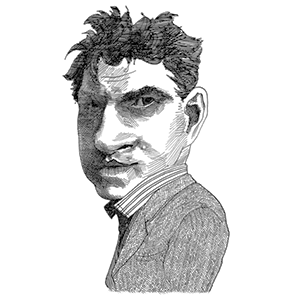
‘The Ascent of Money: A Financial History of the World’ is a 2008 book by Harvard historian Niall Ferguson’s, which was adapted into a series of documentary feature for public television in the US and UK. It examines the long history of money, credit, and banking. From Shylock’s pound of flesh to the loan sharks of Glasgow, from the ‘promises to pay’ on Babylonian clay tablets to the Medici banking system.
Professor Ferguson explains the origins of credit and debt and why credit networks are indispensable to any civilization. He also investigates human bondage. Studying the question: How did finance become the realm of the masters of the universe? Through the rise of the bond market in Renaissance Italy. With the advent of bonds, war finance was transformed and spread to north-west Europe and across the Atlantic. It was the bond market that made the Rothschilds the richest and most powerful family of the 19th century. The book also explores why stock markets produce bubbles and busts. Continue reading
Chimerica

Chimerica is a neologism and portmanteau coined in 2006 by historian Niall Ferguson and economist Moritz Schularick describing the symbiotic relationship between China and the United States, with incidental reference to the legendary chimera. In 2010, anticipating the risk of tensions between the two nations escalating into a currency war, Ferguson published a paper forecasting that Chimerica would soon unravel.
They argue that saving by the Chinese and overspending by Americans led to an incredible period of wealth creation that contributed to the global financial crisis of 2008–2009. For years, China accumulated large currency reserves and channeled them into U.S. government securities, which kept nominal and real long-term interest rates artificially low in the United States.
Cultural Impact of Star Wars

George Lucas’ six-film Star Wars saga has had a significant impact on modern American popular culture. ‘Star Wars’ references are deeply embedded in popular culture; references to the main characters and themes of Star Wars are casually made in many English-speaking countries with the assumption that others will understand the reference. Darth Vader has become an iconic villain. Phrases like ‘evil empire’ and ‘May the Force be with you’ have become part of the popular lexicon. The first ‘Star Wars film’ in 1977 was a cultural unifier, enjoyed by a wide spectrum of people.
Science fiction since the original 1977 ‘Star Wars,’ particularly in film, has often been influenced by and compared to ‘Star Wars.’ Sounds, visuals, and even the music from the films have become part of the tapestry of American society. The film also helped launch the science fiction boom of the late 1970s and early 1980s, and made science fiction films a blockbuster genre. It has also been parodied in films and short videos, such as ‘Spaceballs.’
Dark Side

The dark side of the Force is a prominent moral, philosophical, metaphorical and psychic concept in the ‘Star Wars’ universe, which George Lucas intends as a metaphor for the universal human temptation towards cruelty and inhumanity as a means of gaining ‘power,’ or advantage, in life.
The dark side is the opposite of the ‘light side’ of ‘the Force,’ a mystical energy which permeates the universe. It is used by the Sith, and forbidden among their rivals, the Jedi. By channeling intense negative emotions – such as anger, jealousy or greed – into the Force, individuals can attain powers of the Force more easily – but at a consequence. They gain lust for power, and become increasingly self-aggrandizing.
Space Diving

Like skydiving, space diving refers to the act of jumping from a plane, balloon, or spacecraft in outer space and falling to Earth’s atmosphere before parachuting to a landing. Depending on one’s definition of ‘space,’ the only historical case of a human intentionally space diving from the stratosphere is Joseph Kittinger, who jumped from a helium balloon at the height of 100,000 feet (approximately 30 kilometers).
Higher jumps from mesosphere or thermosphere have yet to be successfully performed, though Orbital Outfitters is working to create a suit that will enable safe space diving. Space diving from beyond the stratosphere has been imagined in various fictional contexts. Continue reading
Correlation does not imply Causation
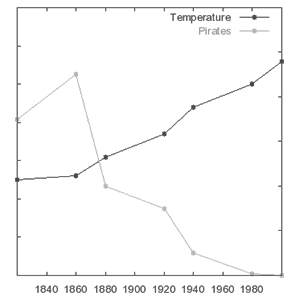
‘Correlation does not imply causation‘ is a phrase used in science and statistics to emphasize that a relationship between two variables does not automatically imply that one causes the other. The opposite belief, ‘correlation proves causation,’ is one of several questionable cause logical fallacies by which two events that occur together are claimed to have a cause-and-effect relationship.
The fallacy is also known as ‘cum hoc ergo propter hoc’ (Latin for ‘with this, therefore because of this’) and ‘false cause.’ It is a common fallacy in which it is assumed that, because two things or events occur together, one must be the cause of the other. By contrast, the fallacy, ‘post hoc ergo propter hoc,’ requires that one event occur after the other, and so may be considered a related fallacy. Continue reading
Actor–observer Asymmetry
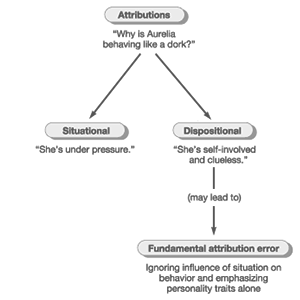
Actor-observer asymmetry (also actor-observer bias) explains the errors that one makes when forming attributions about behavior. When a person judges their own behavior, and they are the actor, they are more likely to attribute their actions to the particular situation than to a generalization about their personality. Yet when a person is attributing the behavior of another person, thus acting as the observer; they are more likely to attribute this behavior to the person’s overall disposition than as a result of situational factors.
People are more likely to see their own behavior as affected by the situation they are in, or the sequence of occurrences that have happened to them throughout their day. But, they see other people’s actions as solely a product of their overall personality, and they do not afford them the chance to explain their behavior as exclusively a result of a situational effect. Continue reading
Fundamental Attribution Error
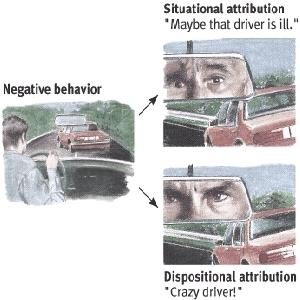
In social psychology, the fundamental attribution error describes the tendency to over-value dispositional or personality-based explanations for the observed behaviors of others while under-valuing situational explanations for those behaviors.
The fundamental attribution error is most visible when people explain the behavior of others. It does not explain interpretations of one’s own behavior—where situational factors are often taken into consideration. This discrepancy is called the actor–observer bias. As a simple example, if Alice saw Bob trip over a rock and fall, Alice might consider Bob to be clumsy or careless (dispositional). If Alice tripped over the same rock herself, she would be more likely to blame the placement of the rock (situational). Continue reading
Backmasking

Backmasking is a recording technique in which a sound or message is recorded backward on to a track that is meant to be played forward. Backmasking is a deliberate process, whereas a message found through ‘phonetic reversal’ may be unintentional. Backmasking was popularized by The Beatles who used backward instrumentation on their 1966 album ‘Revolver.’ Artists have since used backmasking for artistic, comedic and satiric effect, on both analogue and digital recordings.
The technique has also been used to censor words or phrases for ‘clean’ releases of rap songs. Backmasking has been a controversial topic in the United States since the 1980s, when allegations from Christian groups of its use for Satanic purposes were made against prominent rock musicians, leading to record-burning protests and proposed anti-backmasking legislation by state and federal governments.
Subliminal Stimuli

Subliminal stimuli (literally ‘below threshold’), contrary to ‘supraliminal stimuli’ or ‘above threshold,’ are any sensory stimuli below an individual’s threshold for conscious perception. Some research has found that subliminal messages do not produce strong or lasting changes in behavior. However, a recent review of functional magnetic resonance imaging (fMRI) studies shows that subliminal stimuli activate specific regions of the brain despite participants being unaware.
Visual stimuli may be quickly flashed before an individual can process them, or flashed and then masked, thereby interrupting the processing. Audio stimuli may be played below audible volumes, masked by other stimuli, or recorded backwards in a process called ‘backmasking.’ Continue reading
Mere-exposure Effect

The mere-exposure effect is a psychological phenomenon by which people tend to develop a preference for things merely because they are familiar with them. In social psychology, this effect is sometimes called the familiarity principle. The effect has been demonstrated with many kinds of things, including words, Chinese characters, paintings, pictures of faces, geometric figures, and sounds. In studies of interpersonal attraction, the more often a person is seen by someone, the more pleasing and likeable that person appears to be.
The earliest known research on the effect was conducted by Gustav Fechner in 1876. Edward B. Titchener also documented the effect and described the ‘glow of warmth’ felt in the presence of something that is familiar. However, Titchener’s hypothesis was thrown out once tested and results showed that the enhancement of preferences for objects did not depend on the individual’s subjective impressions of how familiar the objects were. The rejection of Titchener’s hypothesis spurred further research and the development of current theory. Continue reading


 The Daily Omnivore