July 18, 2012
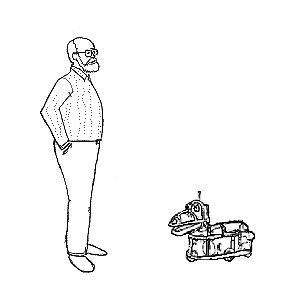
The intentional stance is a term coined by philosopher Daniel Dennett for the level of abstraction in which we view the behavior of a thing in terms of mental properties. It is part of a theory of mental content proposed by Dennett, which provides the underpinnings of his later works on free will, consciousness, folk psychology, and evolution.
‘Here is how it works: first you decide to treat the object whose behavior is to be predicted as a rational agent; then you figure out what beliefs that agent ought to have, given its place in the world and its purpose. Then you figure out what desires it ought to have, on the same considerations, and finally you predict that this rational agent will act to further its goals in the light of its beliefs. A little practical reasoning from the chosen set of beliefs and desires will in most instances yield a decision about what the agent ought to do; that is what you predict the agent will do.’
Continue reading →
Posted in Health, Philosophy, Science |
Leave a Comment »
July 18, 2012


Cradle-to-cradle design (C2C) is a biomimetic approach to the design of systems. It models human industry on nature’s processes in which materials are viewed as nutrients circulating in healthy, safe metabolisms. It suggests that industry must protect and enrich ecosystems and nature’s biological metabolism while also maintaining safe, productive technical metabolism for the high-quality use and circulation of organic and synthetic materials.
Put simply, it is a holistic economic, industrial and social framework that seeks to create systems that are not just efficient but essentially waste free. The model in its broadest sense is not limited to industrial design and manufacturing; it can be applied to many different aspects of human civilization such as urban environments, buildings, economics, and social systems. Continue reading →
Posted in Money, Technology |
Leave a Comment »
July 17, 2012
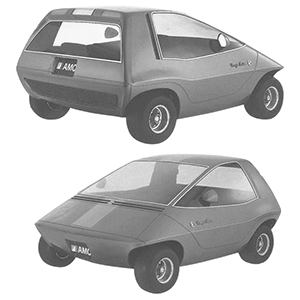
The Amitron was an electric concept car built in 1967 by American Motors Corporation (AMC) and Gulton Industries of Metuchen, New Jersey. It was a snub-snouted three-passenger urban area vehicle or city car with an overall length of only 85 inches.
Roy D. Chapin, Jr., Chairman and CEO of AMC, stated that the Amitron ‘could eliminate many problems that up to this point have made electric-type cars impractical.’ Continue reading →
Posted in Money, Technology |
Leave a Comment »
July 17, 2012
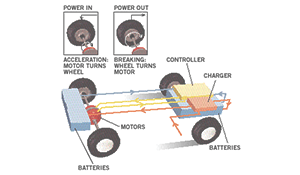

A regenerative brake is an energy recovery mechanism which slows a vehicle or object down by converting its kinetic energy into another form, which can be either used immediately or stored until needed. This contrasts with conventional braking systems, where the excess kinetic energy is converted to heat by friction in the brake linings and therefore wasted. The most common form of regenerative brake involves using an electric motor as an electric generator.
In electric railways the generated electricity is fed back into the supply system, whereas in battery electric and hybrid electric vehicles, the energy is stored in a battery or bank of capacitors for later use. Energy may also be stored mechanically via pneumatics, hydraulics, or the kinetic energy of a rotating flywheel. Continue reading →
Posted in Games, Technology |
Leave a Comment »
July 17, 2012

A flywheel is a heavy disk or wheel that is attached to a rotating shaft. Flywheels are used for storage of kinetic energy. The momentum of the flywheel causes it to not change its rotational speed easily. Because of this, flywheels help to keep the shaft rotating at the same speed. This helps when the torque applied to the shaft changes often.
Torque refers to turning or twisting force. If a force is used to begin to spin an object, or to stop an object from spinning, torque is required. Uneven torque can change the speed of rotation. Because the flywheel resists changes in speed, it decreases the effects of uneven torque. Engines which use pistons to provide power usually have uneven torque and use flywheels to fix this problem. Continue reading →
Posted in Technology |
Leave a Comment »
July 17, 2012


Abandonware are discontinued products for which no product support is available, or whose copyright ownership may be unclear for various reasons. Abandonware may be computer software or physical devices which are usually computerized in some fashion, such as personal computer games, productivity applications, utility software, or mobile phones.
Definitions of ‘abandoned’ vary; generally it refers to a product that is no longer available for legal purchase, over the age where the product creator feels an obligation to continue to support it, or where operating systems or hardware platforms have evolved to such a degree that the creator feels continued support cannot be financially justified. Software companies and manufacturers may change their names, go bankrupt, enter into mergers, or cease to exist for a variety of reasons. When this happens, product rights are usually transferred to another company that may elect not to sell or support products acquired. Continue reading →
Posted in Money, Politics, Technology |
Leave a Comment »
July 17, 2012

Sid Meier’s Alpha Centauri (SMAC) is a science fiction 4X (explore, expand, exploit, exterminate), turn-based strategy video game sequel to the ‘Civilization’ series. Sid Meier, designer of ‘Civilization,’ and Brian Reynolds, designer of ‘Civilization II,’ developed ‘Alpha Centauri’ after they left MicroProse to join the newly created developer Firaxis Games. Electronic Arts released both SMAC and its expansion, ‘Sid Meier’s Alien Crossfire’ (SMAX), in 1999. In the following year, both titles were ported to Mac and Linux.
Set in the 22nd century, the game begins as seven competing ideological factions land on the planet Chiron (‘Planet’) in the Alpha Centauri star system. As the game progresses, Planet’s growing sentience becomes a formidable obstacle to the human colonists. Alpha Centauri features improvements on Civ II’s game engine, including simultaneous multiplay, social engineering, climate, customizable units, alien native life, additional diplomatic and spy options, additional ways to win, and greater mod-ability. ‘Alien Crossfire’ introduces five new human and two non-human factions as well as additional technologies, facilities, secret projects, native life, unit abilities, and a victory condition.
Continue reading →
Posted in Games, Philosophy, Technology |
Leave a Comment »
July 17, 2012

Sid Meier’s Civilization is a turn-based strategy video game created by Sid Meier and Bruce Shelley for MicroProse in 1991. It is a standard-bearer for the 4X genre: eXplore (reveal surrounding territories), eXpand (create new settlements), eXploit (gather resources), and eXterminate (eliminate rivals). The game’s objective is to ‘Build an empire to stand the test of time.’ It begins in 4000 BCE and the players attempt to expand and develop their empires through the ages from the ancient era until modern and near-future times. The game requires a fair amount of micromanagement (although less than a simulation game such as SimCity).
Along with the larger tasks of exploration, warfare, and diplomacy, the player has to make decisions about where to build new cities, which improvements or units to build in each city, which advances in knowledge should be sought (and at what rate), and how to transform the land surrounding the cities for maximum benefit. From time to time the player’s towns may be harassed by barbarians, units with no specific nationality and no named leader. These threats only come from unclaimed land or sea, so that over time there are fewer and fewer places from which barbarians will emanate.
Continue reading →
Posted in Games, Politics, World |
Leave a Comment »
July 17, 2012

4X games are a genre of strategy video game in which players control an empire and ‘explore (reveal surrounding territories), expand (create new settlements), exploit (gather resources), and exterminate’ (eliminate rivals). The four elements often overlap with each other and vary in length depending on the game design.
For example, the ‘Space Empires’ series and ‘Galactic Civilizations II’ have lengthy expansion phases, because players must make large investments in research to explore and expand into every area. The term was first coined by video game critic Alan Emrich in his 1993 preview of ‘Master of Orion’ for ‘Computer Gaming World,’ in which he rated the game ‘XXXX’ as a pun on the rating for pornography. Continue reading →
Posted in Games, Money, Technology |
Leave a Comment »
July 17, 2012

Die Antwoord (Afrikaans: ‘The Answer’) is a South African rap-rave group whose style draws from the Zef counter-culture movement. Its lead vocalists are Ninja and Yo-Landi Vi$$er. DJ Hi-Tek is commonly referenced as a third member of the group, although the band blends reality with fantastical elements for artistic effect and they do not acknowledge whether DJ Hi-Tek is a real person or a character played by a variety of musicians and actors.
Die Antwoord lead vocalist Ninja was part of the South African hip-hop scene for many years, fronting acts such as The Original Evergreens, MaxNormal.TV, and The Constructus Corporation. Ninja told ‘Rolling Stone,’ ‘Everything I did before Die Antwoord was me experimenting, messing around and trying to find die antwoord… Everything before it was disposable. It was all throwaway.’ Continue reading →
Posted in Art, Money, World |
Leave a Comment »
July 17, 2012

Zef is a South African counter-culture movement. Die Antwoord (Afrikaans: ‘The Answer’) is a South African rap-rave group whose style draws from the movement. The word ‘zef’ stems from an Afrikaans word, which roughly translates to the English word ‘common.’ South African rapper and Die Antwoord collaborator Jack Parow, describes the movement as ‘It’s kind of like posh, but the opposite of posh.’
It differs from the Australian term ‘bogan’ (pejorative f0r those from a low-class background) and the related British term ‘chav’ in that it is mostly a positive term used to describe oneself, rather than a derogatory term for someone else. It is also not typical of the poorest classes of the society, but rather a mostly white, lower-middle class subculture, albeit one that glorifies cheap stuff. Yolandi Visser of Die Antwoord is quoted as saying, ‘It’s associated with people who soup their cars up and rock gold and shit. Zef is, you’re poor but you’re fancy. You’re poor but you’re sexy, you’ve got style.’ Continue reading →
Posted in Art, Money, World |
1 Comment »
July 16, 2012
The Slow Movement advocates a cultural shift toward slowing down life’s pace. It began with Carlo Petrini’s protest against the opening of a McDonald’s restaurant in Piazza di Spagna, Rome in 1986 that sparked the creation of the Slow Food organization. Over time, this developed into a subculture in other areas, such as Cittaslow (Slow Cities), Slow living, Slow Travel, and Slow Design. Geir Berthelsen and his creation of The World Institute of Slowness presented a vision in 1999 for an entire ‘Slow Planet.’
Norwegian philosopher Guttorm Fløistad summarizes the philosophy, stating: ‘The only thing for certain is that everything changes. The rate of change increases. If you want to hang on you better speed up. That is the message of today. It could however be useful to remind everyone that our basic needs never change. The need to be seen and appreciated! It is the need to belong. The need for nearness and care, and for a little love! This is given only through slowness in human relations. In order to master changes, we have to recover slowness, reflection and togetherness. There we will find real renewal.’
Continue reading →
Posted in Money, Philosophy, Politics |
Leave a Comment »




