July 16, 2012

Slow parenting is a parenting style in which few activities are organized for children. Instead, they are allowed to explore the world at their own pace. It is a response to concerted cultivation and the widespread trend for parents to schedule activities and classes after school; to solve problems on behalf of the children, and to buy services from commercial suppliers rather than letting nature take its course.
The philosophy, part of the ‘Slow Movement,’ makes recommendations in play, toys, access to nature, watching television, and scheduled activities. The opposing view is that such children are disadvantaged because their parents do not provide as many learning opportunities. Continue reading →
Posted in Education, Games, Philosophy |
Leave a Comment »
July 16, 2012

Concerted cultivation is a style of parenting that is marked by a parent’s attempts to foster their child’s talents by incorporating organized activities in their children’s lives.
This parenting style is commonly exhibited in middle and upper class American families, and is also characterized by consciously developing language use and ability to interact with social institutions. Many have attributed cultural benefits to this form of child-rearing due to the style’s use in higher income families, conversely affecting the social habitus (socially learned dispositions) of children raised in such a manner. Continue reading →
Posted in Education, Language, Money |
Leave a Comment »
July 16, 2012

The Price of Privilege is a non-fiction book by psychologist Madeline Levine. The book’s primary thesis is that teenagers from affluent families have more intense psychological problems than expected.
Levine maintains that children from rich families with psychological dysfunctions have been ignored because many people assume the wealthy have the resources to take care of themselves. Her findings are based on her experience as a psychologist working with children in Marin County and related clinical studies. She defines affluence as a yearly household income in the $120,000 to $160,000 range. Continue reading →
Posted in Health, Money |
Leave a Comment »
July 16, 2012

Different studies show animal prostitution exists among species such as Adélie Penguins, chimpanzees, and crab-eating macaque. Penguins use stones for building their nests. A shortage of stones led female Adélie Penguins to trade sex for stones. The female penguins, even when in a committed relationship, will exchange sexual favors with strange males for the pebbles they need to build their nests. Prostitution is also observed among chimpanzees, who trade food for sex.
The first documented case of prostitution in animals was reported in 1998 by Fiona Hunter and Lloyd Davis, who had spent five years observing the mating behavior of penguins. The study was conducted as part of an Antarctica New Zealand program on the Ross Island, approximately 800 miles from the South Pole. The female penguins observed under the study were coupled with males. The females will go outside alone to collect pebbles, but the males did not suspect their female partners. According to the observations and analysis made by Hunter, the prostitute penguins targeted single males, because if instead they picked a male penguin with a partner, the male penguin’s current partner will come in conflict with the prostitute female.
Continue reading →
Posted in Money, Science, Sex |
1 Comment »
July 16, 2012


A world’s fair (or world expo) is a large public exhibition. These exhibitions vary in character and are held in varying parts of the world. The main attractions at world’s fairs are the national pavilions, created by participating countries.
At ‘Expo 2000 Hanover,’ where countries created their own architecture, the average pavilion investment was about €13 million. Given these costs, governments are sometimes hesitant to participate, because benefits are often assumed not to outweigh the costs. Continue reading →
Posted in Politics, Technology, World |
Leave a Comment »
July 16, 2012

IMAX is a motion picture film format and a set of proprietary cinema projection standards created by a Canadian company of the same name. IMAX increases the resolution of the image by using a much larger film frame. To achieve this, 65 mm film stock passes horizontally through the cameras. Traditional cameras pass film vertically. In order to match standard film speed of 24 frames per second, three times the length of film moves through the camera.
There are 583 IMAX theaters in 48 countries (China is the second largest market after the US with roughly 25 theaters). The desire to increase the visual impact of film has a long history. In 1929, Fox introduced Fox Grandeur, the first 70 mm film format, but it ultimately lost out to 35mm film, which remains the industry standard. In the 1950s CinemaScope and VistaVision widened the image from 35 mm film, following multi-projector systems such as Cinerama. While impressive, Cinerama was difficult to install, and the seams between adjacent projected images were difficult to hide. Continue reading →
Posted in Art, Money, Technology |
Leave a Comment »
July 13, 2012
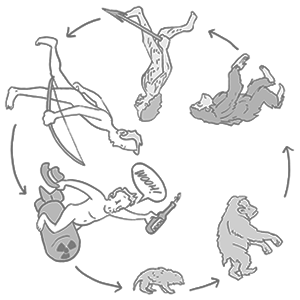
Fermi’s paradox asks why, given the age and size of the universe, we have not detected any other alien civilizations. Unless the Earth is very atypical, extraterrestrial life should be common. In an informal discussion in 1950, Italian American physicist Enrico Fermi questioned why, if a multitude of advanced extraterrestrial civilizations exists in the Milky Way galaxy, evidence such as spacecraft or probes is not seen.
Another common name for the phenomenon is silentium universi (‘the silence of the universe’). There have been attempts to resolve the paradox by locating evidence of extraterrestrial civilizations (e.g. SETI), along with proposals that such life could exist without human knowledge. Counterarguments suggest that intelligent extraterrestrial life does not exist or occurs so rarely or briefly that humans will never make contact with it. Continue reading →
Posted in Philosophy, Science, Technology |
3 Comments »
July 12, 2012
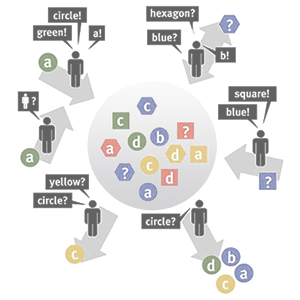
A folksonomy [fohk-son-uh-mee] is a system of classification derived from the practice and method of collaboratively creating and managing tags to annotate and categorize content; this practice is also known as collaborative tagging, social classification, social indexing, and social tagging. Folksonomy, a term coined by Thomas Vander Wal, is a portmanteau of folk and taxonomy.
Folksonomies became popular on the Web around 2004 as part of social software applications such as social bookmarking and photograph annotation. Tagging, which is one of the defining characteristics of Web 2.0 services, allows users to collectively classify and find information. Some websites include tag clouds as a way to visualize tags in a folksonomy. A good example of a social website that utilizes folksonomy is ’43 Things.’ However, tag clouds visualize only the vocabulary but not the structure of folksonomies, as do tag graphs.
Continue reading →
Posted in Language, Technology |
1 Comment »
July 12, 2012

The Dubai Fountain is a record-setting choreographed fountain system set on the 30-acre manmade Burj Khalifa Lake, at the center of the Downtown Dubai development in Dubai, United Arab Emirates.
It was designed by WET Design, the California-based company responsible for the fountains at the Bellagio Hotel Lake in Las Vegas. Illuminated by 6,600 lights and 25 colored projectors, it is 275 m (902 ft) long and shoots water 240 feet into the air accompanied by a range of classical to contemporary Arabic and world music. It was built at a cost $218 million US. The fountain was officially inaugurated in 2009 along with the official opening ceremony of the Dubai Mall.
Posted in Money, Technology, World |
Leave a Comment »
July 12, 2012

The Evolution Control Committee (The ECC) is an experimental music band based in Columbus, Ohio. The ECC was founded by Mark Gunderson (a.k.a. TradeMark G.) in 1987. It typically uses uncleared and illegal samples from various sources as a form of protest against copyright law.
The ECC also produces numerous audio experiments, such as the disfiguring of compact discs in live performance, known as ‘CDestruction,’ and has produced a few video works as well, ranging from re-edited 50’s corporate shorts to a Teddy Ruxpin reciting the works of William S. Burroughs. Other activities include culture jamming. Continue reading →
Posted in Art, Money, Politics |
Leave a Comment »
July 12, 2012

Negativland is an experimental music and sound collage band which originated in San Francisco in the late 1970s. They took their name from a Neu! song. The current core of the band consists of Mark Hosler, Richard Lyons, Don Joyce, David Wills, and Peter Conheim. Negativland has released a number of albums ranging from pure sound collage to more musical expositions. These have mostly been released on their own label, Seeland Records.
In the late 1980s and early 1990s, they produced several recordings for SST Records, most notably ‘Escape from Noise,’ ‘Helter Stupid,’ and ‘U2.’ Negativland were sued by U2’s record label, Island Records, and by SST Records, which brought them widespread publicity and notoriety.
Continue reading →
Posted in Art, Money, Politics |
Leave a Comment »
July 11, 2012

The Bran Flakes are a sound collage pop group with members in the United States and Canada who specialize in creating music from pre-existing sources. The group’s members include Otis Fodder, Mildred Pitt, Susan DeLint, and The GRDNR. Along with other bands such as Negativland and Evolution Control Committee, the Bran Flakes make extensive use of sampling, recontextualizing the samples into new works. The group scours thrift shops for obscure and quirky LPs; some of their songs also make use of recognizably famous basslines, television shows, and soundtracks from video games. The unauthorized nature of much of their output has precluded wide commercial release.
Following the 1998 release of ‘I Remember When I Break Down’ on Ovenguard Music, on which Otis Fodder was sole writer, the group’s first album as a duo (Otis Fodder and Mildred Pitt) was in 1999, with ‘Hey Won’t Somebody Come and Play’ on Ovenguard Music. 2001 saw the release of ‘I Don’t Have a Friend’ on Lomo Records. Their 2002 album ‘Bounces!’ was released on the band’s own Happi Tyme Records, and contained one of their most popular songs; ‘Good Times a Goo Goo’, which sampled extensively from Kermit the Frog and Fozzie Bear’s performance of ‘Moving Right Along’ from ‘The Muppet Movie.’ In 2008 the band signed with the label Illegal Art, known for such acts as Girl Talk and Steinski.
Posted in Art, Technology |
Leave a Comment »



