April 26, 2012

Foreign Accent Syndrome is a rare medically recognised condition which is a speech impediment that usually occurs as a resulting side effect of brain injury, such as a stroke or head trauma. As a result of the speech impediment those suffering from the Foreign Accent Syndrome pronounce their native language with an accent that to the ear of the listeners may be mistaken as foreign or dialectical.
It has many other impacts and effects, including poor memory and concentration span, as well as a feeling of loss of identity, potentially causing those affected to go through a bereavement process. Two cases have been reported of individuals with the condition as a development problem and one associated with severe migraine. Between 1941 and 2009 there have been sixty recorded cases. Continue reading →
Posted in Health, Language, World |
Leave a Comment »
April 26, 2012

Koro is a culture-specific syndrome from Southeast Asia in which the person has an overpowering belief that his penis (or other genitalia) is shrinking and will shortly disappear. Also known as shrinking penis, the syndrome is listed in the Diagnostic and Statistical Manual of Mental Disorders. In China, it is known as ‘shuk yang.’
For females, the belief focuses on the nipples retracting or shrinking. Though the syndrome is rooted in China and found mostly in Southeast Asia, rare and isolated cases of koro are found in people of non-Chinese ethnicity worldwide. Episodes of epidemics occurred in the endemic nations. In a different cultural setting, mass hysteria of genital-shrinkage have been reported in African nations. Continue reading →
Posted in Health, Sex, World |
Leave a Comment »
April 26, 2012

Clay Shirky (b. 1964) is an American writer, consultant, and teacher on the social and economic effects of Internet technologies. He has a joint appointment at NYU as a Distinguished Writer in Residence at the Arthur L. Carter Journalism Institute and Assistant Arts Professor in the New Media focused graduate Interactive Telecommunications Program (ITP). His courses address, among other things, the interrelated effects of the topology of social networks and technological networks, how our networks shape culture and vice-versa.
Shirky divides his time between consulting, teaching, and writing on the social and economic effects of Internet technologies. His consulting practice is focused on the rise of decentralized technologies such as peer-to-peer, web services, and wireless networks that provide alternatives to the wired client–server infrastructure that characterizes the World Wide Web. He is a member of the Wikimedia Foundation’s Advisory Board. In 2010, Kevin Kelly (founding executive editor of ‘Wired’ magazine) cited the phrase ‘Institutions will try to preserve the problem to which they are the solution,’ and called it the ‘Shirky Principle,’ as the phrasing reminded him of the clarity of the Peter Principle. Continue reading →
Posted in Language, Politics, Technology |
Leave a Comment »
April 26, 2012

Orbital are a British electronic dance music duo from England consisting of brothers Phil and Paul Hartnoll. Their career initially ran from 1989 until 2004, but in 2009 they announced that they would be reforming and headlining The Big Chill, (an annual festival of alternative, dance, and chill-out music, and comedy, held in the grounds of Eastnor Castle during early August) in addition to a number of other live shows in 2009.
The band’s name was taken from Greater London’s orbital motorway, the M25, which was central to the early rave scene and party network in the South East during the early days of acid house. One of the biggest names in British electronica during the 1990s, Orbital were both critically and commercially successful, and known particularly for their element of live improvisation during shows, a rarity among techno acts. They were initially influenced by early electro and punk rock.
Continue reading →
Posted in Art, Technology, World |
Leave a Comment »
April 26, 2012

Don Buchla (b. 1937) is a pioneer in the field of sound synthesizers, releasing his first units months after Robert Moog’s first synthesizers. Buchla formed his electronic music equipment company, Buchla and Associates, in 1962 in Berkeley, California. Buchla was commissioned by avant garde music composers Morton Subotnick and Ramon Sender, both of the San Francisco Tape Music Center (which studies the incorporation of electric sound production into compositional practice), to create an electronic instrument for live performance. Under a grant from the Rockefeller Foundation Buchla completed his first modular synthesizer in 1963. The result was the Buchla Series 100, which he began selling in 1966. Buchla’s synthesizers experimented in control interfaces, such as touch-sensitive plates. In 1969 the Series 100 was sold to CBS, who soon after dropped the line, not seeing the synthesizer market as a profitable area.
In 1970 the Buchla 200 series Electric Music Box was released and was manufactured until 1985. Buchla created the Buchla Series 500, the first digitally controlled analog synthesizer, in 1971. Shortly after, the Buchla Series 300 was released, which combined the Series 200 with microprocessors. The Music Easel, a small, portable, all-in-one synthesizer was released in 1972. The Buchla 400 was released in 1982, which featured a video display. In 1987 the fully MIDI enabled Buchla 700 was released. Beginning in the 1990s, Buchla began designing alternative MIDI controllers, such as the Thunder, Lightning, and Marimba Lumina. With the recent resurgence of interest in analog synthesizers Buchla has released a revamped 200 series called the 200e.
Posted in Art, Money, Technology |
Leave a Comment »
April 26, 2012

Suzanne Ciani [cha-nee] (b. 1946) is an Italian American pianist and music composer who found early success with innovative electronic music. She received classical music training at Wellesley College and obtained her M.A. in music composition in 1970 at University of California, Berkeley where she met and was influenced by the synthesizer designer, Don Buchla. She studied computer generated music with John Chowning and Max Mathews at Stanford’s Artificial Intelligence Labs in the early 1970s.
In 1974 she formed her own company, Ciani/Musica, and, using a Buchla Analog Modular Synthesizer, composed scores for television commercials for corporations such as Coca-Cola, Merrill Lynch, AT&T, and General Electric. Besides music, her specialty was reproducing sound effects on the synthesizer that recording engineers had found difficult to record properly; the sound of a bottle of Coca-Cola being opened and poured was one of Ciani’s most widely recognized works, and was used in a series of radio and television commercials in the late 1970s. Continue reading →
Posted in Art, Money, Technology |
1 Comment »
April 25, 2012

Copenhagen Distortion is a festival for club culture in the streets of Copenhagen, Denmark, and in dozens of unusual locations around city, every year during the week of the first Saturday in June. The festival’s cultural focus is on club culture, upfront dance music, street life, contemporary art (only when related to nightlife or public space), social art and Copenhagen’s new independent media (print and web).
Copenhagen Distortion is ‘a celebration of streetlife & nightlife’ orchestrating 150+ dancefloors hosted by 150+ local and international icons of streetlife and nightlife (people, shops, clubs, galleries, labels, and magazines). The characteristic Distortion atmosphere involves high-energy impulsive chaos with a strong ‘streetlife freedom’ feel. The music selection is sharp and upfront: names like Hot Chip, Simian Mobile Disco, Spank Rock, and Sebastien Tellier were booked for Distortion events before they had become underground heroes of international scope. The festival has always been a Copenhagen leader in the field of using urban space and unusual locations.
Posted in Art, World |
1 Comment »
April 24, 2012

In psychology, fluid and crystallized intelligence (abbreviated Gf and Gc, respectively) are factors of general intelligence originally identified by Raymond Cattell. Concepts of fluid and crystallized intelligence were further developed by Cattell’s disciple John L. Horn. Fluid intelligence or fluid reasoning is the capacity to think logically and solve problems in novel situations, independent of acquired knowledge. It is the ability to analyze novel problems, identify patterns and relationships that underpin these problems, and the extrapolation of these using logic.
It is necessary for all logical problem solving, especially scientific, mathematical and technical problem solving. Fluid reasoning includes inductive reasoning and deductive reasoning. Crystallized intelligence is the ability to use skills, knowledge, and experience. It should not be equated with memory or knowledge, but it does rely on accessing information from long-term memory. Crystallized intelligence is one’s lifetime or intellectual achievement, as demonstrated largely through one’s vocabulary and general knowledge. This improves somewhat with age, as experiences tend to expand one’s knowledge. Continue reading →
Posted in Education, Games, Science |
Leave a Comment »
April 24, 2012

Automated essay scoring (AES) is the use of specialized computer programs to assign grades to essays written in an educational setting. It is a method of educational assessment and an application of natural language processing. Its objective is to classify a large set of textual entities into a small number of discrete categories, corresponding to the possible grades—for example, the numbers 1 to 6. Therefore, it can be considered a problem of statistical classification.
Several factors have contributed to a growing interest in AES. Among them are cost, accountability, standards, and technology. Rising education costs have led to pressure to hold the educational system accountable for results by imposing standards. The advance of information technology promises to measure educational achievement at reduced cost. Continue reading →
Posted in Education, Language, Technology |
Leave a Comment »
April 24, 2012

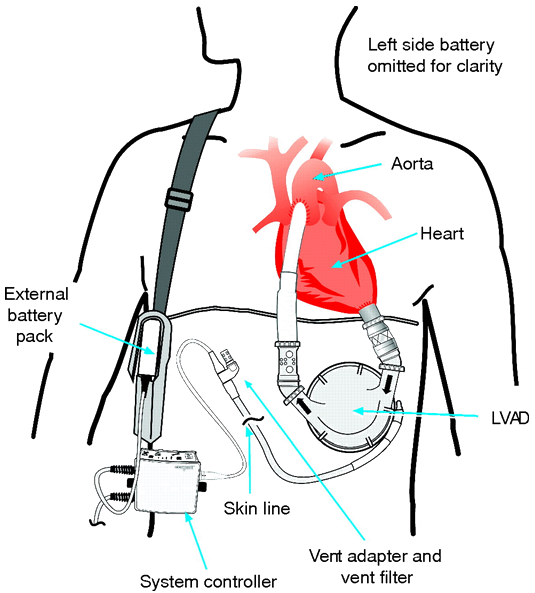
A Ventricular assist device [ven-trik-yuh-ler] (VAD) is a mechanical circulatory device that is used to partially or completely replace the function of a failing heart. Some VADs are intended for short term use, typically for patients recovering from heart attacks or heart surgery, while others are intended for long term use (months to years and in some cases for life), typically for patients suffering from congestive heart failure. VADs are designed to assist either the right (RVAD) or left (LVAD) ventricle, or both at once (BiVAD).
Which of these types is used depends primarily on the underlying heart disease and the pulmonary arterial resistance that determines the load on the right ventricle. LVADs are most commonly used, but when pulmonary arterial resistance is high, right ventricular assistance becomes necessary. Long term VADs are normally used to keep patients alive with a good quality of life while they wait for a heart transplantation (known as a ‘bridge to transplantation’). However, LVADs are sometimes used as ‘destination therapy’ (therapy when a heart transplant is not an option) and sometimes as a ‘bridge to recovery.’
Continue reading →
Posted in Health, Technology |
Leave a Comment »
April 23, 2012

The Force is a binding, metaphysical, and ubiquitous power in the fictional universe of the ‘Star Wars’ galaxy created by George Lucas. Mentioned in the first film in the series, it is integral to all subsequent incarnations of Star Wars, including the expanded universe of comic books, novels, and video games. Within the franchise, it is the object of the Jedi and Sith monastic orders. Lucas has attributed the origins of ‘The Force’ to a 1963 abstract film by Arthur Lipsett, called ’21-87,’ which sampled from many sources. One of the audio sources Lipsett sampled was a conversation between artificial intelligence pioneer Warren S. McCulloch and Roman Kroitor, a cinematographer who went on to develop IMAX.
In the face of McCulloch’s arguments that living beings are nothing but highly complex machines, Kroitor insists that there is something more: ‘Many people feel that in the contemplation of nature and in communication with other living things, they become aware of some kind of force, or something, behind this apparent mask which we see in front of us, and they call it God.’ When asked if this was the source of ‘the Force,’ Lucas confirms that his use of the term in ‘Star Wars’ was ‘an echo of that phrase in ’21-87.’ The idea behind it, however, was universal: ‘Similar phrases have been used extensively by many different people for the last 13,000 years to describe the ‘life force,” he says.
Continue reading →
Posted in Art, Philosophy |
Leave a Comment »
April 23, 2012

In traditional Chinese culture, qì [chee] is an active principle forming part of any living thing. Qi is frequently translated as life energy, lifeforce, or energy flow. Qi is the central underlying principle in traditional Chinese medicine and martial arts. The literal translation is ‘breath,’ ‘air,’ or ‘gas.’ Concepts similar to qi can be found in many cultures, for example, Prana in Vedantic philosophy, mana in Hawaiian culture, Lüng in Tibetan Buddhism, and Vital energy in Western philosophy.
Some elements of qi can be understood in the term ‘energy’ when used by writers and practitioners of various esoteric forms of spirituality and alternative medicine. Elements of the qi concept can also be found in popular culture, for example ‘The Force’ in ‘Star Wars’ Notions in the west of energeia, élan vital, or vitalism are purported to be similar.
Continue reading →
Posted in Health, Philosophy, World |
Leave a Comment »