April 23, 2012

Élan vital [ey-lahn vee-tal] was coined by French philosopher Henri Bergson in his 1907 book ‘Creative Evolution,’ in which he addresses the question of self-organization and spontaneous morphogenesis of things in an increasingly complex manner. Elan vital was translated in the English edition as ‘vital impetus,’ but is usually translated by his detractors as ‘vital force.’ It is a hypothetical explanation for evolution and development of organisms, which Bergson linked closely with consciousness.
It was believed by others that this essence (élan vital) could be harvested and embedded into an inanimate substance and activated with electricity, perhaps taking literally another of Bergson’s metaphorical descriptions, the ‘current of life.’ British biologist Julian Huxley remarked that Bergson’s élan vital is no better an explanation of life than is explaining the operation of a railway engine by its ‘élan locomotif’ (‘locomotive driving force’). The same epistemological fallacy is parodied in Molière’s ‘Le Malade imaginaire,’ where a quack ‘answers’ the question of ‘Why does opium cause sleep?’ with ‘Because of its soporific [sleep-inducing] power.’ Continue reading →
Posted in Language, Politics |
Leave a Comment »
April 23, 2012

In William Gibson’s fiction, the Sprawl is a colloquial name for the Boston-Atlanta Metropolitan Axis (BAMA), an urban sprawl environment on a massive scale, and a fictional extension of the real Northeast Megalopolis. The novels ‘Neuromancer’ (1984), ‘Count Zero’ (1986), and ‘Mona Lisa Overdrive’ (1988) (collectively known as the Sprawl trilogy) take place in this environment, as do the short stories ‘Johnny Mnemonic,’ ‘New Rose Hotel,’ ‘Burning Chrome,’ and ‘Fragments of a Hologram Rose.’
The Sprawl is a visualization of a future where virtually the entire East Coast of the United States, from Boston to Atlanta, has melded into a single mass of urban sprawl. It has been enclosed in several geodesic domes and merged into one megacity. The city has become a separate world with its own climate, no real night/day cycle, and an artificial sky that is always grey. It is said of the Sprawl that ‘the actors change but the play remains the same.’
Posted in Art, Language, Technology |
Leave a Comment »
April 23, 2012

BosWash is a name coined by futurist Herman Kahn in a 1967 essay describing a theoretical United States megalopolis extending from the metropolitan area of Boston to that of Washington, D.C. The publication also coined ‘SanSan’ for the areas on the Pacific coast of California.
The general concept for the area described by BosWash was first identified in French geographer Jean Gottmann’s 1961 book ‘Megalopolis: The Urbanized Northeastern Seaboard of the United States.’ Kahn’s essay was the product of a study commissioned in 1965 by the American Academy of Arts and Sciences. Kahn discussing urbanization, began by writing: ‘The United States in the year 2000 will probably see at least three gargantuan megalopolises. We have labeled these—only half frivolously—’Boswash,’ ‘Chipitts,’ and ‘SanSan.” Continue reading →
Posted in Politics, Science, World |
Leave a Comment »
April 23, 2012

The Blue Banana (also known as the Hot Banana, European Megalopolis or European Backbone) is a discontinuous corridor of urbanization in Western Europe, with a population of around 110 million. It stretches approximately from North West England to Milan.
The curvature of this corridor (hence the ‘banana’ in the name) takes in cities such as Leeds, Liverpool, Manchester, Birmingham, London, Amsterdam, The Hague, Rotterdam, Brussels, Antwerp, Eindhoven, the Ruhr, Düsseldorf, Cologne, Frankfurt am Main, Luxembourg, Strasbourg, Stuttgart, Munich, Zürich, Turin, Milan, Venice, and Genoa and covers one of the world’s highest concentrations of people, money and industry.
Continue reading →
Posted in Money, Politics, World |
Leave a Comment »
April 23, 2012
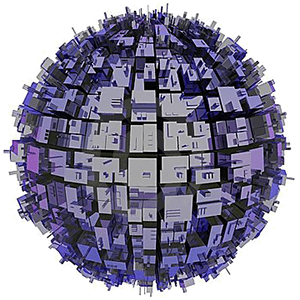
Ecumenopolis [ek-yoo-meh-nop-oh-lys] (Greek: ‘world city’) is a word invented in 1967 by the Greek city planner Constantinos Doxiadis to represent the idea that in the future urban areas and megalopolises would eventually fuse and there would be a single continuous worldwide city as a progression from the current urbanization and population growth trends.
Before the word was coined, the American religious leader Thomas Lake Harris (1823–1906) mentioned city-planets in his verses, and science fiction author Isaac Asimov uses the city-planet Trantor as the setting of some of his novels. Continue reading →
Posted in Politics, Technology, World |
Leave a Comment »
April 23, 2012
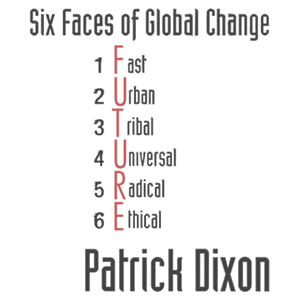
Futurewise is a book on global trends written by the futurist Patrick Dixon in 1998, with new editions in 2001, 2003, and 2007. ‘Futurewise’ contains over 500 expectations about what future life will be like, and divides future trends into six dimensions, which spell the word FUTURE: Fast (combinations of events bring new opportunities for agile leaders—and risks); Urban (demographics and lifestyle issues including megacities); Tribal (the most powerful force in the world today is tribalism—basis of culture, belonging, teams, brands); Universal (globalization at cost of local identity, risking international tensions, and the impact of the digital age); Radical (the rise of single issue activism and the death of left-right politics); and Ethical (the passions people have and personal values, including spirituality– the glue holding our future together)
A key thesis of ‘Futurewise’ is that the future is about emotion, and that emotional reactions to events are usually more important than the events themselves. Therefore a deep understanding is needed of how people are likely to feel in the future. The book also focuses on managing uncertainty. Risk management is a major challenge for all large corporations, including responding to wild cards – low probability but potentially high impact events.
Posted in Language, Politics, World |
Leave a Comment »
April 23, 2012
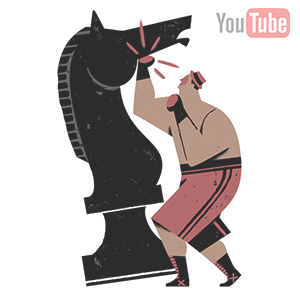
Chessboxing is a hybrid sport that combines chess with boxing in alternating rounds. The sport was invented by Dutch artist Iepe Rubingh, who was inspired by a French comic book ‘Le Froid Equateur’ by artist and filmmaker Enki Bilal. A match consists of up to eleven alternating rounds of boxing and chess. The match begins with a four-minute chess round. This is followed by three minutes of boxing, with rounds of chess and boxing alternating until the end. There is a one minute break between rounds.
Competitors may win by a knockout, achieving a checkmate, by the judges’ decision, or if their opponent’s twelve minutes of chess time is exceeded. If a competitor fails to make a move during the chess round, he is issued a warning and he must move within the next 10 seconds. Repeated warnings may result in a disqualification. The players put on headphones during the chess portion so that they do not hear any shouted assistance from the audience or the live chess commentary. If the chess game reaches a stalemate, the scores from the boxing rounds are used to determine the winner. If the boxing score is also a tie, the player with the black pieces wins.
Posted in Games, Humor |
Leave a Comment »
April 22, 2012
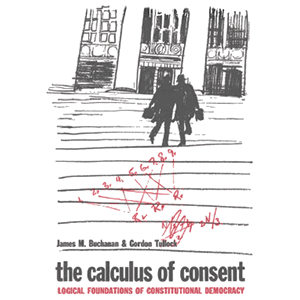
Rational ignorance occurs when the cost of educating oneself on an issue exceeds the potential benefit that the knowledge would provide. Ignorance about an issue is said to be ‘rational’ when the cost of educating oneself about the issue sufficiently to make an informed decision can outweigh any potential benefit one could reasonably expect to gain from that decision, and so it would be irrational to waste time doing so.
This has consequences for the quality of decisions made by large numbers of people, such as general elections, where the probability of any one vote changing the outcome is very small. The term is most often found in economics, particularly public choice theory, but also used in other disciplines which study rationality and choice, including philosophy (epistemology) and game theory. The term was coined by Anthony Downs in ‘An Economic Theory of Democracy’ (1957).
Continue reading →
Posted in Money, Philosophy, Politics |
1 Comment »
April 22, 2012

The Pebble E-Paper Watch, known now as the Pebble Classic, is an American smartwatch developed by Pebble Technology Corporation, and is the first generation of the Pebble watch lineup. The smartwatch was pledged from a Kickstarter campaign, proving massively successful, collecting around $10 million for development of the smartwatch.
Pebble connects to both Android and iOS phones, so they can display notifications from the phone, control music, view calendar events, and create reminders. An online app store makes the Pebble compatible with apps tailored for them from many third party sellers, for many purposes especially sports. In 2015, Pebble Technology released its second-generation Time, with a color e-paper display, microphone, and updated design.
Posted in Money, Technology |
Leave a Comment »
April 22, 2012

Liquid funk is a sub-genre of drum and bass. While it uses similar basslines and bar layouts to other styles, it contains fewer bar-oriented samples and more instrumental layers (both synthesized and natural), harmonies, and ambience, producing a calmer atmosphere directed at both home listeners and nightclub audiences. In 2000, Fabio began championing a new form of drum and bass he called ‘Liquid funk,’ with a compilation release of the same name on his Creative Source label. This was characterized by influences from disco and house music, and widespread use of vocals. Although slow to catch on at first, the style grew massively in popularity around 2003–2004, and by 2005 it was established as one of the biggest-selling subgenres in drum and bass.
Liquid funk is very similar to intelligent drum and bass, but has subtle differences. Liquid funk has stronger influences from soca, latin, disco, jazz, and funk music, while IDB creates a calmer yet more synthetic sound, using smooth synth lines and samples in place of the organic element achieved by use of real instruments.
Posted in Art |
Leave a Comment »
April 21, 2012

Noisia, stylized as NOISIΛ (‘VISION’ rotated 180°), is a Dutch electronic music trio consisting of Nik Roos, Martijn van Sonderen, and Thijs de Vlieger from The Netherlands. They produce drum and bass, dubstep, breakbeat, and house music.
For a time between 2005 and 2009, NOISIΛ also released tracks under the name ‘Drifter,’ encompassing the lighter side of Drum and Bass known as ‘Liquid Funk,’ as well as releasing a EP under the name ‘Hustle Athletics.’ They later decided to go back to releasing all their music under the name ‘NOISIΛ’ so as to not confuse the audience and to avoid being pigeonholed into different genres with different names.
Posted in Art |
Leave a Comment »
April 20, 2012


A demo (demonstration) is a non-interactive multimedia presentation made within the computer subculture known as the demoscene. Demogroups create demos to demonstrate their abilities in programming, music, drawing, and 3D modeling.
The key difference between a classical animation and a demo is that the display of a demo is computed in real time, making computing power considerations the biggest challenge. Demos are mostly composed of 3D animations mixed with 2D effects and full screen effects. Continue reading →
Posted in Art, Games, Technology |
Leave a Comment »



