April 16, 2012

The Bling Ring, sometimes called the ‘Hollywood Hills Burglar Bunch,’ were a group, mostly of teenagers based in and around Calabasas, California, who burglarized the homes of several celebrities in 2008 – 2009. In total, their activities resulted in the theft of about $3 million in cash and belongings, most of it from Paris Hilton, whom they robbed several times. However, over 50 homes were reportedly targeted for potential burglary.
The alleged ringleader of the group, Rachel Lee is the daughter of divorced Korean immigrants. Both parents own successful businesses. Lee lived in Calabasas with her mother, who owns a franchise of Kumon, a tutoring company. Her father is based in Las Vegas. Lee and her older sister Candace had a privileged upbringing, and she drove an Audi A4 to school, where she was named ‘Best Dressed’ in the 2007 yearbook. A year after graduation, she was fined and put on probation for a petty theft incident in which she and a friend, Diana Tamayo, stole $85 of merchandise from a Sephora cosmetics store. Continue reading →
Posted in Money |
Leave a Comment »
April 14, 2012

Chironomia is the art of using gesticulations or hand gestures to good effect in traditional rhetoric or oratory. Effective use of the hands, with or without the use of the voice, is a practice of great antiquity, which was developed and systematized by the Greeks and the Romans. Various gestures had conventionalized meanings which were commonly understood, either within certain class or professional groups, or broadly among dramatic and oratorical audiences.
Gilbert Austin was a well-known author on chironomia, in the preface to his book on the subject, Austin writes: ‘…it is a fact, that we do not possess from the ancients, nor yet from the labors of our own countrymen, any sufficiently detailed and precise precepts for the fifth division of the art of rhetoric, namely rhetorical delivery, called by the ancients ‘actio’ and ‘pronuntiatio.” Continue reading →
Posted in Language, Philosophy, Science |
Leave a Comment »
April 13, 2012
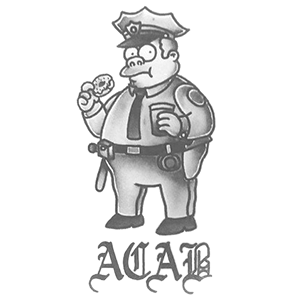
A.C.A.B. stands for ‘All Cop[per]s Are Bastards.’ Dating from at least the 1940s, and used as a slogan during the UK miners’ strike, A.C.A.B. is an abbreviation often integrated into prison tattoos in the United Kingdom, it is most commonly rendered with one letter between the knuckle and first joint of each finger, alternatively sometimes seen as symbolic small dots across each knuckle.
The British Oi! punk band, the 4-Skins, popularized the acronym in their 1980s song of the same name. It is currently in common usage as a phrase and tattoo amongst some ultras ( a type of sports fans renowned for their fanatical and elaborate displays of ‘support’) groups in Europe, particularly in Eastern Europe where most groups are more akin to hooligans than ultras.
Posted in Language, Politics, World |
Leave a Comment »
April 13, 2012
HWDP [ha-voo-de-pe] is a frequently used acronym of a Polish vulgar phrase ‘chuj w dupę policji,’ meaning literally ‘a dick up the police’s ass.’ It can be best compared to the English-language phrase ACAB (‘All Cops Are Bastards’), known in western English-language countries, painted on walls by aggressive football fans already in the 1960s. It is also commonly used as a tattoo among some of the Latino prisoners in the United States of America, who claim it stands for ‘Always Carry A Bible,’ when asked about it by the authorities. Another English counterpart of this Polish vulgar phrase is FTP, an acronym of the phrase ‘fuck the police.’
This vulgar slogan, often written on walls, is used by a part of the youth as a form of provocation against the police, but also one of its ‘trademarks.’ Writing of the HWDP characters, visible from far, is a de facto form of aggressive vandalism, which reasonably lowers the value of the flats near the marked objects. The habit of using the HWDP slogan is particularly popular amongst aggressive football fans, called pseudokibice, of the beginning of the 21st century. It is a specific expression of protest against the authorities and the entire surrounding system, although it isn’t an ideological rebellion, but instead, a characteristic sign of the additude to the surrounding reality.
Posted in Language, Politics, World |
Leave a Comment »
April 13, 2012

Sager Midern Computer, Inc., is an American OEM (original equipment manufacturer) computer manufacturer specializing in laptop computers. Sager laptops are manufactured by Clevo which are also sold under many other brand names. Sager is the biggest Clevo retailer. In addition to selling physical hardware, Sager also offers support and repair services for all Clevo based Laptops. This service is offered even if the laptop was not ordered through Sager, although in that case the user must pay in full for all services provided.
The company was founded in 1985 by Shung Song Yuan in City of Industry, California. While ‘A-brands’ such as Dell, Toshiba, IBM, or HP are manufactured on a contract basis where so-called contract manufacturers assemble laptop computers as specified by the brand, Sager instead purchases finished and generic chassis designed and built by Original Design Manufacturers or ODMs (such as Clevo). Sager then assembles the laptop with parts chosen by the final customer, puts its logo on the chassis and sells them under the brand Sager. Sager then provides support to these computers.
Posted in Games, Money, Technology |
Leave a Comment »
April 13, 2012

Clevo is a Taiwanese OEM/ODM (original equipment and design manufacturer) computer manufacturer which exclusively produces laptop computers. They manufacture and sell complete laptops under their own brand; they also sell laptop chassis to other OEMs who build laptops on the chassis, often customized for each customer.
Companies which rebrand Clevo chassis or have in the past include Sager, iBuypower, and OriginPC. Alienware also used to sell rebranded Clevo notebooks, although it is unclear whether they still do.
Posted in Money, Technology, World |
Leave a Comment »
April 13, 2012

Miso [mee-soh] is a traditional Japanese seasoning produced by fermenting rice, barley and/or soybeans, with salt and the fungus kōjikin, the most typical miso being made with soy. The result is a thick paste used for sauces and spreads, pickling vegetables or meats, and mixing with dashi soup stock to serve as miso soup called ‘misoshiru,’ a Japanese culinary staple. High in protein and rich in vitamins and minerals, miso played an important nutritional role in feudal Japan.
Miso is still very widely used in Japan, both in traditional and modern cooking, and has been gaining world-wide interest. Miso is typically salty, but its flavor and aroma depend on various factors in the ingredients and fermentation process. There is a very wide variety of miso available. Different varieties of miso have been described as salty, sweet, earthy, fruity, and savory. The traditional Chinese analogue of miso is known as dòujiàng.
Continue reading →
Posted in Food, Health, World |
1 Comment »
April 13, 2012

Mole [moh-ley] (from the Aztec word for ‘sauce’) is the generic name for a number of sauces used in Mexican cuisine, as well as for dishes based on these sauces. Outside of Mexico, it often refers to a specific sauce which is known in Spanish by the more specific name ‘mole poblano.’ In contemporary Mexico, the term is used for a number of sauces, some quite dissimilar to one another, including black, red, yellow, colorado, green, almendrado, and pipián. The sauce is most popular in the central and southern regions of the country, but eaten nationwide, particularly during celebrations.
In Mexico, to say ‘to go to a mole’ (‘ir a un mole’) means to go to a wedding. Three states in Mexico claim to be the origin of mole, Puebla, Oaxaca, and Tlaxcala. The states with the best known moles are Puebla and Oaxaca, but other regions in Mexico also make various types of mole sauces. Moles come in various flavors and ingredients, with chili peppers as the common factor. A classic mole poblano is a dark red or brown sauce served over meat. Mole has a strong flavor, especially the dark ones, and is considered to be an acquired taste for most. This has spawned another saying, ‘en su mero mole,’ which means something like ‘one’s cup of tea.’ Continue reading →
Posted in Food, Money, World |
1 Comment »
April 13, 2012
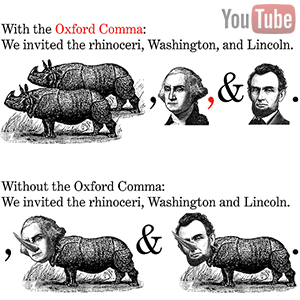
The serial comma (also known as the Oxford comma or Harvard comma) is the comma used immediately before a coordinating conjunction (usually ‘and’ or ‘or’) preceding the final item in a list of three or more items.
For example, a list of three countries can be punctuated as either ‘Portugal, Spain, and France’ (with the serial comma) or as ‘Portugal, Spain and France’ (without the serial comma).
Continue reading →
Posted in Education, Language, World |
1 Comment »
April 12, 2012


A calligram [kal-uh-gram] is a poem, phrase, or word in which the typeface, calligraphy, or handwriting is arranged in a way that creates a visual image. The image created by the words expresses visually what the word, or words, say. In a poem, it manifests visually the theme presented by the text of the poem.
Guillaume Apollinaire was a famous calligram writer and author of a book of poems called ‘Calligrammes.’ His poem written in the form of the Eiffel Tower is an example of a calligram.
Posted in Art, Language |
Leave a Comment »
April 12, 2012

Eye music (often referred to in English by its exact German translation ‘Augenmusik’) describes graphical features of scores that when performed are unnoticeable by the listener. A clear definition of eye music is elusive, for the border between eye music, word painting, and representations of melody and form depends on the relationships of composer, performer, and listener. Word painting (also known as tone painting or text painting) is writing music that reflects the literal meaning of a song (r.g. ascending scales would accompany lyrics about going up; slow, dark music would accompany lyrics about death).
To a person well-versed in the style of Baroque music, word painting is, as intended, noticed. But someone unused to Baroque musical style may not appreciate that musical effect – to them they are merely notes and lyrics. In this case, word painting is no longer the issue. For them, the ‘leaps’ of written notes are unhearable, but are visible only to the composer or performer: a definition of eye music.
Continue reading →
Posted in Art, Language |
Leave a Comment »
April 12, 2012
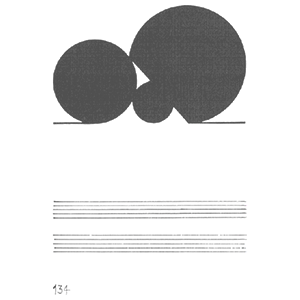
Graphic notation is the representation of music through the use of visual symbols outside the realm of traditional music notation. Graphic notation evolved in the 1950s, and it is often used in combination with traditional music notation. Composers often rely on graphic notation in experimental music, where standard musical notation can be ineffective. A common aspect of graphic notation is the use of symbols to convey information to the performer about the way the piece is to be performed. These symbols first began to appear in the works of avant-garde composers such as Morton Feldman, Karlheinz Stockhausen, and Krzysztof Penderecki, as well as the works of experimental composers such as John Cage and Earle Brown during the 1950s and 60s. In the late 1970s, the Brazilian composer Emanuel Dimas de Melo Pimenta started producing graphic notation in four dimensions, inside virtual reality.
After working as Stockhausen’s assistant, Cornelius Cardew began work on a massive graphic score, which he titled ‘Treatise.’ The piece consists of 193 pages of highly abstract scores. The score itself is almost its own separate work of art. In 2008, Theresa Sauer edited a compendium featuring graphic scores by composers from over fifty countries, demonstrating how widespread the practice has become. Notable graphic scores(in which the music is represented using symbols and illustrations) include: Hans-Christoph Steiner’s score for ‘Solitude,’ created using the Pure Data programming language. Altered Notation can be seen in George Crumb’s work, where he uses traditional notation but presents the music on the page in a graphic or nontraditional manner such as spirals or circles.
Posted in Art, Language |
Leave a Comment »