August 15, 2020

Karen is a pejorative term used in the United States and other English-speaking countries for a person perceived as entitled or demanding beyond the scope of what is appropriate or necessary. A common stereotype is that of a white woman who uses her privilege to demand her own way at the expense of others.
Depictions also include demanding to ‘speak to the manager,’ anti-vaccination beliefs, being racist, or sporting a particular bob cut hairstyle. As of 2020, the term was increasingly being used as a general-purpose term of disapproval for middle-aged white women. Continue reading →
Posted in Language, Politics |
1 Comment »
August 13, 2020
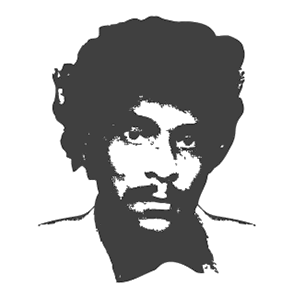
Robert Beck, born Robert Lee Maupin, (1918 – 1992), better known as Iceberg Slim, was an American pimp who subsequently became an influential author among a primarily African-American readership.
Scottish author Irvine Welsh said ‘Iceberg Slim did for the pimp what Jean Genet did for the homosexual and thief and William Burroughs did for the junkie: he articulated the thoughts and feelings of someone who had been there. The big difference is that they were white.’ Continue reading →
Posted in Language, Money, Sex |
Leave a Comment »
August 11, 2020
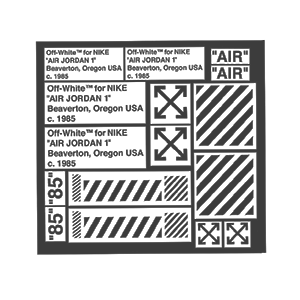
Off-White (stylized as OFF-WHITE c/o VIRGIL ABLOH) is an Italian luxury fashion label founded by American designer Virgil Abloh. The label has collaborated with Nike, Levi, Jimmy Choo, IKEA and Évian. In 2019, José Neves, owner of Farfetch, an online luxury fashion retail platform, purchased New Guards Group, the parent organization of Off-White for US$675 million.
The company was first founded as ‘PYREX VISION’ by Virgil Abloh in the Italian city of Milan in 2012. The name was abandoned after coming under criticism for printing ‘PYREX 23’ on the classic Ralph Lauren rugby flannel silhouette, and reselling them for a premium $550 price tag. Abloh then rebranded the company as Off-White, which he describes as ‘the grey area between black and white as the color off-white’ to the fashion world.
Continue reading →
Posted in Art, Money |
Leave a Comment »
August 6, 2020
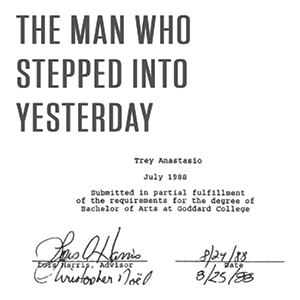
Gamehendge is the fictional setting for a number of songs by the rock band Phish. Most of the songs can be traced back to ‘The Man Who Stepped Into Yesterday’ (or TMWSIY), the senior project of guitarist and primary vocalist Trey Anastasio, written while he attended Goddard College in 1987.
The recording of TMWSIY has been heavily circulated among fans and is considered by some to be an unreleased Phish album. Outside of the songs from TMWSIY, there are numerous other songs set in the fictional universe of Gamehendge. Continue reading →
Posted in Art, Humor |
Leave a Comment »
August 2, 2020

Dead Birds is a 1963 American documentary film by American anthropologist Robert Gardner (1925-2014) about the ritual warfare cycle of the Dugum Dani tribe in New Guinea. The film presents footage of battles between the Willihiman-Wallalua clan and the Wittaia clan with scenes of the funeral of a small boy killed by a raiding party, the women’s work that goes on while battles continue, and the wait for enemy to appear.
The film’s theme is the encounter that all people must have with death, as told in a Dugum Dani myth of the origins of death that bookends the film. The film uses a nonlinear narrative structure of parallel or braided narrative that traces three individuals through a season of three deaths and one near-death as relayed by an expository voiceover that describes scenes and the thoughts of the film’s protagonists. Continue reading →
Posted in Death, Science, War, World |
Leave a Comment »
July 22, 2020

An art car is a vehicle that has had its appearance modified as an act of personal artistic expression. Art cars are often driven and owned by their creators, who are sometimes referred to as ‘Cartists.’
Most car artists are ordinary people with no artistic training. Artists are largely self-taught and self funded, though some mainstream trained artists have also worked in the art car medium. Artists like Roy Lichtenstein, Andy Warhol and others have designed BMW Art Cars, a project introduced by French racecar driver and auctioneer Hervé Poulain In 1975, and their work has been reflected in racing cars like the BMW V12 LMR. Continue reading →
Posted in Art, Technology |
1 Comment »
July 20, 2020

Low-background steel is any steel produced prior to the detonation of the first nuclear bombs in the 1940s and 1950s. With the Trinity test and the nuclear bombings of Hiroshima and Nagasaki in 1945, and then subsequent nuclear weapons testing during the early years of the Cold War, background radiation levels increased across the world.
Modern steel is contaminated with radionuclides because its production uses atmospheric air. Low-background steel is so-called because it does not suffer from such nuclear contamination. This steel is used in devices that require the highest sensitivity for detecting radionuclides. The primary source of low-background steel is sunken ships that were constructed before the Trinity test, most famously the scuttled German World War I warships in Scapa Flow. Continue reading →
Posted in Technology, War |
1 Comment »
July 7, 2020
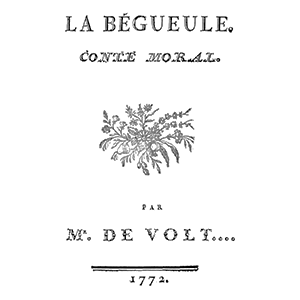
Perfect is the enemy of good is an aphorism which is commonly attributed to French philosopher Voltaire, who quoted a similar Italian proverb in his ‘Dictionnaire philosophique’ in 1770. It subsequently appeared in his moral poem ‘La Bégueule.’ Aristotle, Confucius, and other classical philosophers propounded the principle of the ‘golden mean,’ which counsels against extremism in general.
The ‘Pareto principle,’ or 80–20 rule, explains this numerically. For example, it commonly takes 20% of the full time to complete 80% of a task, while to complete the last 20% of a task takes 80% of the effort. Achieving absolute perfection may be impossible and so, as increasing effort results in diminishing returns. Robert Watson-Watt, who developed Britain’s first radar detectors, propounded a ‘cult of the imperfect,’ which he stated as ‘Give them the third best to go on with; the second best comes too late, the best never comes.’
Posted in Language, Philosophy |
Leave a Comment »
July 1, 2020

Chief Wahoo was the primary logo of the Ohio-based Major League Baseball (MLB) franchise the Cleveland Indians. As part of the larger Native American mascot controversy, it drew criticism from many people including Native Americans, social scientists, and religious and educational groups, but remains popular among many fans of the team. MLB commissioner Rob Manfred and Indians’ owner Paul Dolan announced that Chief Wahoo would no longer appear on uniforms or stadium signs following the end of the 2018 season. The team’s primary logo is now a block ‘C.’
The logo was last worn by the Indians in a loss to the Houston Astros on October 8 in the 2018 American League Division Series. News outlets noted the irony of the logo’s final appearance being on Indigenous Peoples’ Day/Columbus Day. Continue reading →
Posted in Games, Politics |
Leave a Comment »
June 29, 2020
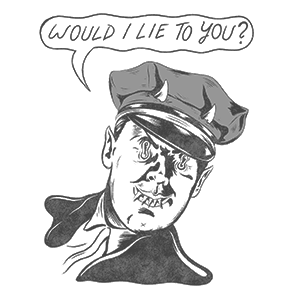
Police perjury (or testilying in U.S. police slang) is the act of a police officer giving false testimony. It is typically used in a criminal trial to ‘make the case’ against a defendant believed by the police to be guilty when irregularities during the suspect’s arrest or search threaten to result in acquittal.
It also can be extended further to encompass substantive misstatements of fact for the purpose of convicting those whom the police believe to be guilty, procedural misstatements to ‘justify’ a search and seizure, or even to include statements to frame an innocent citizen. Continue reading →
Posted in Politics |
1 Comment »
June 26, 2020

Bōsōzoku (literally ‘running-out-of-control (as of a vehicle) tribe’) is a Japanese youth subculture associated with customized motorcycles. The first appearance of these types of biker gangs was in the 1950s. Popularity climbed throughout the 1980s and 1990s, peaking at an estimated 42,510 members in 1982. Their numbers dropped dramatically in the 2000s with a reported number of under 7,297 members in 2012.
Bōsōzoku are known to modify their motorcycles in peculiar and showy ways, which are called ‘Kaizōsha’ (‘Modified Vehicles’). The general style of bōsōzoku bike modification appears to combine elements of an American chopper bike and a British café racer. Examples of modifications that are taken from these styles are raised handle bars like those on a chopper or over-sized fairings like those found on café racers (though bōsōzoku usually fit them much higher on the bike than their original position, and angled upwards at the front). Continue reading →
Posted in World |
1 Comment »
June 25, 2020

The boogaloo movement, adherents to which are often referred to as ‘boogaloo boys’ or ‘boogaloo bois,’ is a loosely organized American far-right extremist movement. Participants generally identify as a libertarian citizen-militia and say they are preparing for, or seek to incite, the ‘boogaloo,’ a second American Civil War that will overthrow the United States government.
While use of the term has been found on the fringe imageboard website 4chan since 2012, it did not come to widespread attention until late 2019. Adherents use the term (including variations, so as to avoid social media crackdowns) to refer to violent uprisings against the federal government or left-wing political opponents, often anticipated to follow government confiscation of firearms. Continue reading →
Posted in Politics, War |
Leave a Comment »



