March 5, 2012

A viral video is one that becomes popular through the process of Internet sharing, typically through video sharing websites, social media and email. Viral videos often contain humorous content and include televised comedy sketches, such as The Lonely Island’s ‘Lazy Sunday’ and ‘Dick in a Box,’ amateur video clips like ‘Star Wars Kid,’ the ‘Numa Numa’ videos, ‘The Evolution of Dance,’ and ‘Chocolate Rain,’ and web-only productions such as ‘I Got a Crush… on Obama.’ Some eyewitness events have also been caught on video and have ‘gone viral’ such as the ‘Battle at Kruger.’
The proliferation of camera phones and inexpensive video editing and publishing tools credited with fueling phenomena. These consumer-shot videos are typically non-commercial, intended for viewing by friends or family. A video becoming viral is often unexpected, and an accident, and therefore a video cannot be called viral purely in the creator’s intention at the time of recording. Continue reading →
Posted in Humor, Money, Technology |
Leave a Comment »
March 5, 2012
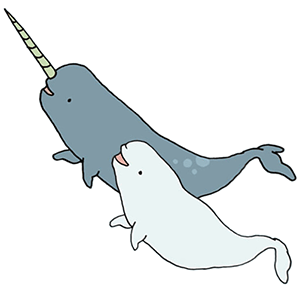
The Narwhal is a rarely seen Arctic whale known for the very long tooth that males have. The tusk’s function is uncertain, perhaps used as a formidable jousting weapon in courtship and dominance rivalry, in getting food, and/or for channeling and amplifying sonar pulses (which they emit), however the tusk is not used in hunting. Long ago, narwhal sightings probably reinforced (or started) the unicorn legends. At times, people found the horn of a dead narwhal washed up on shore and thought that they had found the horn of a unicorn. Narwhal can dive up to 1,500 meters; this makes them one of the deepest diving sea mammals.
Narwhals live in the icy waters of the Arctic seas. They do not go far away from ice and migrate in the summer closer to land where they can sometimes be seen in the estuaries, deep fjords, and bays of Greenland and Northern Canada. These groups can be as big as 10 or even as big as 100 sometimes. But when Winter comes around again, they move back to the icy waters, where they breath from small holes in the ice. Narwhals eat cod, shrimp and squid, and are hunted by polar bears and killer whales. The native Inuit people who are sometimes called the Eskimos, are allow to hunt the Narwhals for food.
Posted in Science |
Leave a Comment »
March 5, 2012

Active camouflage is camouflage which adapts to the actual surroundings of an object such as an animal or military vehicle. It is used in several groups of animals including cephalopods (e.g. squid, octopus) and flatfish in the sea, and reptiles on land (e.g. chameleon). Some sea creatures can counterilluminate (emit light to match the background) because in the sea, light comes down from the surface, so animals tend to appear dark when seen from below. Bioluminescence and color change also have other functions in animals including attracting prey and signalling mates.
In military usage, counterillumination camouflage was first investigated during the WWII for marine use. Current research aims at achieving crypsis (avoidance of detection) using cameras to sense the visible background, and panels or coatings which can vary their appearance. Military active camouflage has its origins in the diffused lighting camouflage tested on Canadian Navy corvettes during WWII. Later, a US Air Force program placed low-intensity blue lights on aircraft as counterillumination camouflage. As night skies are not pitch black, a 100 percent black-colored aircraft might be rendered visible.
Posted in Science, Technology, War |
1 Comment »
March 5, 2012
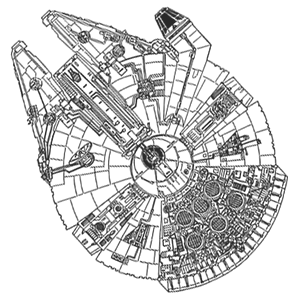
Kitbashing is a practice whereby a new scale model is created by taking pieces out of commercial kits. These pieces may be added to a custom project or to another kit. For professional modelmakers, kitbashing is popular to create concept models for detailing movie special effects. Professionals often kitbash to build prototype parts which are then recreated with lightweight materials. Although it has a long history, kitbashing came to the attention of a wider public via the fine modelwork seen in TV series such as ‘Thunderbirds’ and the films ‘2001: A Space Odyssey’ and ‘Star Wars.’ Many of the spaceship models created for these programs incorporated details from tank, speedboat and car kits. Another example is the Tumbler from the 2005 film ‘Batman Begins.’
An important aspect of kitbashing in model railroading is the reconfiguration of structure kits, most often to fit the geometry of a specific space. Walls can be shortened or lengthened, and/or corner angles changed to fit a given location on the layout. Another application is to use the wall parts to create a ‘flat,’ or shallow relief model to be displayed against the backdrop. For example, since it isn’t needed in this case, the rear wall can be abutted to the front to double the length of the building; usually, but not exclusively, done with industrial structures. Plain sheet styrene or other material is typically added to the rear to strengthen the resulting model.
Posted in Art, Games, Money |
Leave a Comment »
March 5, 2012
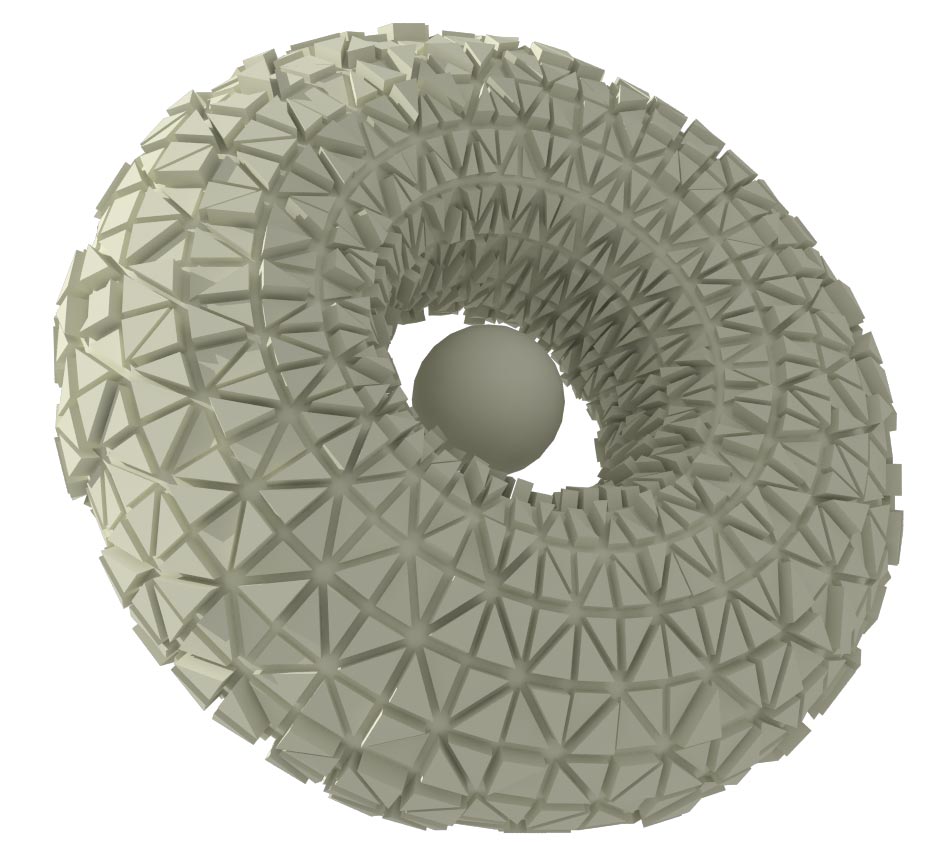
A greeble or nurnie is a small piece of detailing added to break up the surface of an object to add visual interest to a surface or object, particularly in movie special effects. They serve no real purpose other than to add complexity to the object, and cause the flow of the eye over the surface of the object to be interrupted, usually giving the impression of increased size. It is essentially the small detailed technical part of a larger object. The detail can be made from geometric primitives, including cylinders, cubes, and rectangles, combined to create intricate, but meaningless, surface detail.
Greebles are commonly found on models or drawings of fictional spacecraft in science fiction. The earliest recorded use of the term ‘greeble’ found to date was by those working on the special effects for ‘Star Wars’ — the group who would later become Industrial Light and Magic. They also described this design method as ‘guts on the outside.’ Ron Thornton is widely believed to have coined the term ‘nurnies’ referring to CGI technical detail that his company Foundation Imaging produced for the ‘Babylon 5’ series.
Continue reading →
Posted in Art, Language, Technology |
Leave a Comment »
March 5, 2012
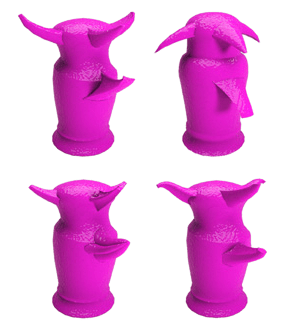
The Greebles refers to a category of novel objects used as stimuli in psychological studies of object and face recognition, created by Scott Yu at Yale University. They were named by the psychologist Robert Abelson. The greebles were created for Isabel Gauthier’s dissertation work at Yale, so as to share constraints with faces: they have a small number of parts in a common configuration.
This makes it difficult to distinguish any individual object on the basis of the presence of a feature, and this is thought to encourage the use of all features and the relationships between them. In other words, greebles, just like faces, can be processed configurally. Yu’s originals (both the symmetrical and asymmetrical sets) can be obtained from Michael Tarr.[1] Greebles appear in over 25 scientific articles.
Posted in Health, Science, Technology |
Leave a Comment »
March 5, 2012

PJ B Hancock and C Foster investigate the double face illusion, where the eyes and mouth are duplicated. On an identification task for briefly (80ms) presented faces, there are strong individual differences: doubling has little effect for the majority, but inhibits recognition for about a quarter of participants. A second experiment shows that some participants are unable to detect face doubling at this speed, while others are 100% correct at 50 ms.
Unlike the Thatcher illusion, a doubled face is still obvious when inverted, but it is less unsettling to look at and a third study found that participants were about 35 ms faster to decide that a face has been doubled when it is inverted. A final experiment tested visual search for normal and doubled faces; neither pops out from the other and the search time per item is again about 35 ms longer for double faces.
Posted in Science |
Leave a Comment »
March 4, 2012
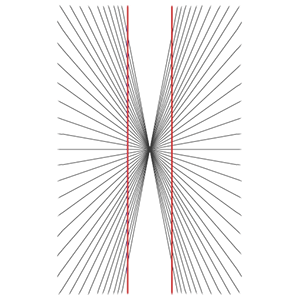
Researcher Mark Changizi of Rensselaer Polytechnic Institute in New York has a more imaginative take on optical illusions, saying that they are due to a neural lag which most humans experience while awake. When light hits the retina, about one-tenth of a second goes by before the brain translates the signal into a visual perception of the world. Scientists have known of the lag, yet they have debated how humans compensate, with some proposing that our motor system somehow modifies our movements to offset the delay.
Changizi asserts that the human visual system has evolved to compensate for neural delays by generating images of what will occur one-tenth of a second into the future. This foresight enables humans to react to events in the present, enabling humans to perform reflexive acts like catching a fly ball and to maneuver smoothly through a crowd. Illusions occur when our brains attempt to perceive the future, and those perceptions don’t match reality. Continue reading →
Posted in Science |
Leave a Comment »
March 3, 2012

In fiction, an antihero is generally considered to be a protagonist whose character is contrary to that of the archetypal hero, yet typically retains many heroic qualities. Some consider the word’s meaning to be sufficiently broad as to additionally encompass an antagonist who, in contrast to the archetypal villain, elicits considerable sympathy or admiration.
The antihero has evolved over time, changing as society’s conceptions of the hero changed, from the Elizabethan times of Faust and William Shakespeare’s Falstaff, to the darker-themed Victorian literature of the 19th century, such as John Gay’s ‘The Beggar’s Opera’ or as a timid, passive, indecisive man that contrasts sharply with other Greek heroes to Philip Meadows Taylor’s ‘Confessions of a Thug.’ The Byronic hero also sets a literary precedent for the modern concept of antiheroism. Continue reading →
Posted in Art |
Leave a Comment »
March 2, 2012


Corinthian leather is a term coined by the advertising agency Bozell to describe the upholstery used in certain Chrysler luxury vehicles beginning in 1974. Although the term suggests that the product has a relationship to or origination from Corinth, Greece, there is no relationship; the term is a marketing concept. Some sources say it was a blend of leather and vinyl (seat surfaces were leather and seat sides were vinyl), while other sources say it was simply a trade name for American produced leather, much of which was produced at a plant outside Newark, New Jersey.
The term was first used during the marketing campaign of the 1974 Chrysler Imperial, but the it is usually associated with the marketing campaign for the 1975 Chrysler Cordoba and that campaign’s celebrity spokesperson, Ricardo Montalban, who described the car’s seats as being covered with ‘soft Corinthian leather.’
Posted in Humor, Money, World |
Leave a Comment »
March 1, 2012
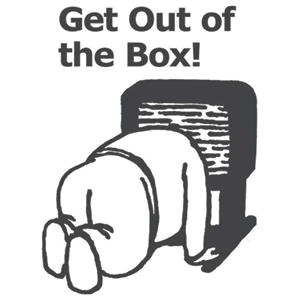
White Dot is an anti-television organization based in the UK. It encourages people to not watch television, and also to switch off televisions in cafés and pubs with devices such as the TV-B-Gone. It also organizes what it calls zocalo (a Mexican term for a town square) events where people are requested to turn off their televisions, go outside and talk to their neighbors.
The organization is named after the white dot that appeared in the middle of old CRT television screens when switched off—as the capacitors discharged, the cathode ray would continue to emit electrons although no longer being controlled horizontally or vertically.
Posted in Politics, Technology, World |
1 Comment »
March 1, 2012
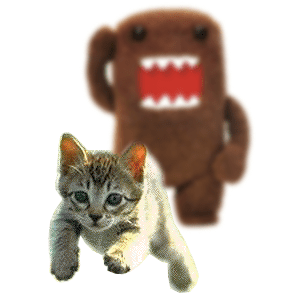
‘Every time you masturbate… God kills a kitten‘ is the caption of an image created by a member of the website Fark.com in 2002. The image features a kitten (subsequently referred to as ‘Cliché Kitty’) being chased by two Domos (a Japanese TV mascot), and has the tagline ‘Please, think of the kittens.’ This phony PSA is quite out of character with Domo’s image in Japan.
The phrase originally appeared as the headline ‘Fact: Every Time You Masturbate, God Kills a Kitten. How Many More Have to Die?’ with a kitten photo on the cover of ‘The Gonzo,’ a satirical publication produced by students at Georgetown University, in 1996.
Posted in Humor, Sex |
Leave a Comment »