February 29, 2012

The Edelweiss Pirates (Edelweißpiraten) were a loose group of youth culture in Nazi Germany. They emerged in western Germany out of the German Youth Movement of the late 1930s in response to the strict regimentation of the Hitler Youth.
Similar in many ways to the Leipzig Meuten (anti-Nazi, pro-communist gangs of young adults in Germany), they consisted of young people, mainly between the ages of 14 and 17, who had evaded the Hitler Youth by leaving school (which was allowed at 14.) and were also young enough to avoid military conscription, which was only compulsory from the age of 17 onward.
Continue reading →
Posted in Politics, War, World |
Leave a Comment »
February 29, 2012

The Raspberry Pi (or RasPi) is a $35 single-board computer developed in the UK by the Raspberry Pi Foundation which aims to ‘promote the study of computer science and related topics, especially at school level, and to put the fun back into learning computing.’ The design is based around a Broadcom BCM2835 system on a chip (SoC), which includes a 700 MHz ARM CPU, VideoCore IV GPU, and 256 Megabytes of RAM. The design does not include a built-in hard disk or solid-state drive, instead relying on an SD card for booting and long-term storage.
The foundation has released one model (Model B) initially, and a second model (Model A) will be released sometime later. Model A will have one USB port and no Ethernet controller, and will cost $25, while Model B contains two USB ports and a 10/100 Ethernet controller and costs $35. Though the Model A doesn’t have an RJ45 Ethernet port, it can connect to a network by using a user-supplied USB Ethernet or Wi-Fi adapter. As is typical of modern computers, generic USB keyboards and mice are compatible with the Raspberry Pi. The system will use a Linux kernel-based operating systems.
Posted in Money, Technology, World |
Leave a Comment »
February 29, 2012

Ecofont is a TrueType font developed by SPRANQ in the Netherlands. The font uses tiny circles placed in the characters to cut down on ink costs. It claims to cut down the amount of ink usage by approximately 15 percent.
In a 2010 test, Ecofont Vera Sans saved 20% more ink when compared to Bitstream Vera Sans. However, both sans-serif fonts used more ink than most typical serif fonts. Therefore Ecofont developed software to save ink when using any typeface, including serif fonts.
Posted in Money, Technology |
Leave a Comment »
February 29, 2012

Wim Delvoye (b. 1965) is a Belgian neo-conceptual artist known for his inventive and often shocking projects. Much of his work is focused on the body. He repeatedly links the attractive with the repulsive, creating work that holds within it inherent contradictions. He has an eclectic oeuvre, exposing his interest in a range of themes, from bodily function, to the Catholic Church, and numerous subjects in between.
Though Delvoye started tattooing pig skins taken from slaughterhouses in the United States in 1992, he began to tattoo live pigs in 1997. He ultimately moved the operation to an Art Farm in China in 2004 where restrictions regarding animal welfare were less strict. The pigs have been inked with a diverse array of designs, including the trivial, such as skulls and crosses, to Louis Vuitton designs, to designs dictated by the pig’s anatomy. Delvoye described the process of tattooing a live pig, ‘we sedate it, shave it and apply Vaseline to its skin.’ As another manifestation of contradiction in Delvoye’s art, he owns a pig farm though he is a practicing vegetarian.
Posted in Art, Humor |
Leave a Comment »
February 29, 2012

The Dougie is a hip-hop dance generally performed by moving one’s body in a shimmy style and passing a hand through or near the hair on one’s own head.
There is no defined way to perform the Dougie, and each individual performs with his or her own variation. The dance first originated in Dallas, where it took its name from similar moves performed by 1980s rapper Doug E. Fresh.
Posted in Art |
1 Comment »
February 29, 2012

Xenophilia [zen-uh-fil-ee-uh] means an affection for unknown objects or peoples. It is the opposite of xenophobia. Xenophilia is a theme found in science fiction, primarily the space opera sub-genre, in which one explores the consequences of love and sexual intercourse between humans and extraterrestrials, particularly humanoid ones. A satirical example is ‘XXXenophile,’ an X-rated comic book written by Phil Foglio. A more somber example is the relationship of Sarek and Amanda Grayson (Spock’s parents) in ‘Star Trek.’
The 1970 film ‘Watermelon Man’ centers in part around a white man trying to have sex with a white woman he works with. His efforts fail until he is magically turned into an African American, at which point she is more than willing to sleep with him. It is only the following day that the protagonist realizes, to his horror, that the woman is a xenophile and only had sex with him because of his race; she had no interest in him as a person. George Washington, in his 1796 Farewell Address, described the influence of xenophilia in politics, which he saw as negative: ‘Such an attachment of a small or weak towards a great and powerful nation dooms the former to be the satellite of the latter.’
Posted in Language, Sex, World |
Leave a Comment »
February 28, 2012

Mel Ramos (b. 1935) is a U.S. figurative painter, whose work incorporates elements of realist and abstract art. Born in Sacramento, California, he gained his greatest popularity in association with the Pop Art movement of the 1960s. The classification of Ramos within any particular school of art is disputed.
Some critical observers of the ‘art scene’ classify him as a pop artist. However, others believe identification of Ramos’ work within the Pop movement of the 1960s implies a satirical or parodic bent which does not reflect the broader context of his paintings, and instead defend his ‘parodies’ as respectful, affectionate tributes, a celebration of images with personal meaning.
Posted in Art, Money, Sex |
Leave a Comment »
February 28, 2012

The Dark Knight Returns is a four-issue comic book limited series written and drawn by Frank Miller, originally published by DC Comics in 1986, which tells the story of a 56-year-old Bruce Wayne who comes out of retirement to fight crime, only to face opposition from the Gotham City police force and the US government.
The series is set in a dystopian near-future. A year is never specified, though it has been a full decade since the last reported sighting of Batman, the current American President appears to be Ronald Reagan or someone using his image, and the Cold War is still ongoing. Virtually all superheroes, with the exception of Superman, have been forced into retirement or otherwise driven away by a distrusting populace. Bruce Wayne has voluntarily retired from crime fighting following the death (under unspecified circumstances) of Jason Todd, the second Robin. In the absence of superheroes, criminals run amok, and a gang called the Mutants terrorizes Gotham City.
Posted in Art |
Leave a Comment »
February 28, 2012

Competitive eating is a sport in which participants compete against each other to consume large quantities of food in a short time period. Contests are typically less than 15 minutes in length, with the person consuming the most food being declared the winner. Competitive eating is most popular in the United States and Japan, where organized professional eating contests often offer $10,000 or more in prize money. Competitive eaters are sometimes known as ‘gurgitators,’ a word used by those close to the sport and an assumed opposite of regurgitation.
The chief criticism of competitive eating is the message the gluttonous sport sends in an age of rising obesity levels among Americans and the example it sets for today’s youth. Others contend that competitive eating is an example of Western gluttony at a time when others around the world are starving. Gastroparesis, also known as stomach paralysis, is also a concern among those who routinely stretch their stomachs beyond capacity. The condition may lead to the stomach’s inability to contract and lose its ability to empty itself.
Continue reading →
Posted in Food, Games, Health |
Leave a Comment »
February 28, 2012

Cognitive inertia refers the tendency for beliefs or sets of beliefs to endure once formed. In particular, it describes the human inclination to rely on familiar assumptions and exhibit a reluctance and/or inability to revise them, even when supporting evidence no longer exists. The term is employed in the managerial and organizational sciences to describe the commonly observed phenomenon whereby managers fail to update and revise their understanding of a situation when that situation changes, a phenomenon that acts as a psychological barrier to organizational change.
However, not all instances of cognitive inertia result in negative outcomes. It is a key component of love, trust, and friendship. For instance, if evidence showed that a friend was dishonest, the cognitive inertia of the friendship would demand much more evidence to form an opinion than that required to form an opinion of a stranger.
Posted in Money, Science |
1 Comment »
February 28, 2012
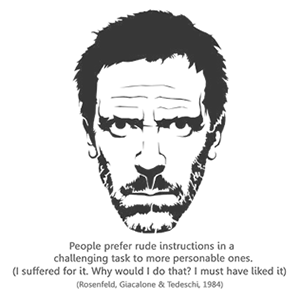
Effort Justification refers to the tendency to attribute greater value to outcomes that one put effort into achieving. It is an idea in social psychology stemming from psychologist Leon Festinger’s theory of ‘Cognitive Dissonance,’ which explains changes in people’s attitudes or beliefs as the result of an attempt to reduce a dissonance (discrepancy) between contradicting ideas or cognitions. In the case of effort justification, there is a dissonance between the amount of effort exerted into achieving a goal or completing a task (high effort – high ‘cost’) and the subjective reward for that effort (lower than was expected for such an effort). By adjusting and increasing one’s attitude or subjective value of the goal, this dissonance is resolved.
This theory is clearly implicated in the effect of rites of passage and hazing rituals on group solidarity and loyalty. The hazing rituals, prevalent in military units, sports teams and Academic fraternities and sororities, often include demanding and/or humiliating tasks which lead (according to dissonance theory) the new member to increase the subjective value of the group. This contributes to his/her loyalty and to the solidarity of the entire group.
Posted in Health, Science |
Leave a Comment »
February 28, 2012
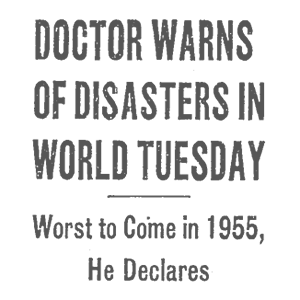
When Prophecy Fails is a 1956 classic book in social psychology by Leon Festinger, Henry Riecken, and Stanley Schachter about a UFO religion that believes the end of the world is at hand. Festinger’s theory of cognitive dissonance (holding conflicting thoughts or feelings at the same time causes distress) can account for the psychological consequences of disconfirmed expectations.
Festinger and his associates read an interesting item in their local newspaper headlined ‘Prophecy from planet Clarion call to city: flee that flood.’ A housewife given the name ‘Marian Keech’ (real name Dorothy Martin, later known as Sister Thedra), had mysteriously been given messages in her house in the form of ‘automatic writing’ from alien beings. These messages revealed that the world would end in a great flood before dawn on December 21, 1954. Continue reading →
Posted in Health, Language, Philosophy |
1 Comment »