February 25, 2012
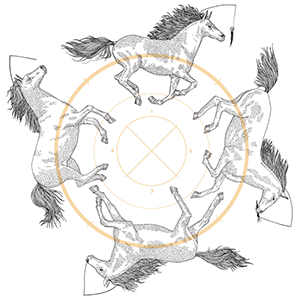
The hedonic treadmill is the supposed tendency of humans to quickly return to a relatively stable level of happiness despite major positive or negative events or life changes. According to this theory, as a person makes more money, expectations and desires rise in tandem, which results in no permanent gain in happiness. Brickman and Campbell coined the term in their essay ‘Hedonic Relativism and Planning the Good Society’ (1971). During the late ’90s, the concept was modified by Michael Eysenck, a British psychology researcher, to become the current ‘hedonic treadmill theory’ which compares the pursuit of happiness to a person on a treadmill, who has to keep working just to stay in the same place. The general idea of the ‘Hedonic (or Happiness) Set Point’ has gained interest throughout the field of positive psychology.
Research supports a three-factor model, where our level of happiness is 50% determined by genetics, 10% determined by outside circumstances, and 40% determined by intentional activities. That last factor, of intentional activities, is the focus of positive psychology, especially because not all activities are equally effective at helping one to reach the higher end of their happiness range. One study concluded that life goals along with personality characteristics are important determinants of one’s subjective well-being. Life goals that enrich one’s relationships and social resources, such as altruistic and family oriented goals, increase their level of subjective well-being. On the other hand, materialistic life goals, such as monetary achievement, have a negative effect on people’s overall subjective well-being.
Posted in Health, Science |
1 Comment »
February 25, 2012

Moneybomb is a neologism coined in 2007 to describe a grassroots fundraising effort over a brief fixed time period, usually to support a candidate for election by dramatically increasing, concentrating, and publicizing fundraising activity during a specific hour or day. The term was first applied to a supporter-led fundraiser on behalf of presidential candidate Ron Paul.
The effort combines traditional and Internet-based fundraising appeals focusing especially on viral advertising through online vehicles such as YouTube, Facebook, and online forums. In the case of lesser-known candidates it is also intended to generate significant free mass media coverage the candidate would otherwise not receive. The term has also been used as a verb and apparently arose from analogy with the neologism ‘googlebomb,’ a method of search engine optimization.
Posted in Money, Politics, Technology |
Leave a Comment »
February 25, 2012
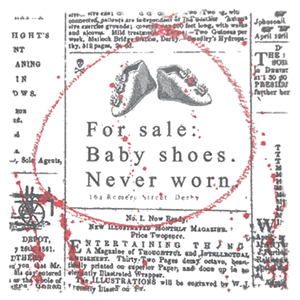
Flash fiction is a style of fictional literature or fiction of extreme brevity.
There is no widely accepted definition of the length of the category. Some self-described markets for flash fiction impose caps as low as three hundred words, while others consider stories as long as a thousand words to be flash fiction. In one particular format, established by Steve Moss, Editor of the New Times, the requirement is 55 words; no more and no fewer. Another, unspecified but frequently held, requirement is that the title may be no more than seven words. Continue reading →
Posted in Art, Language |
Leave a Comment »
February 24, 2012

Negative space, in art, is the space around and between the subject(s) of an image. Negative space may be most evident when the space around a subject, and not the subject itself, forms an interesting or artistically relevant shape, and such space is occasionally used to artistic effect as the ‘real’ subject of an image. The use of negative space is a key element of artistic composition. The Japanese word ‘ma’ is sometimes used for this concept, for example in garden design. In a two-tone, black-and-white image, a subject is normally depicted in black and the space around it is left blank (white), thereby forming a silhouette of the subject.
However, reversing the tones so that the space around the subject is printed black and the subject itself is left blank causes the negative space to be apparent as it forms shapes around the subject, called ‘figure-ground reversal.’ One tool used by art teachers in explaining positive and negative space is an exercise where students copy from an upside-down drawing or photograph. Because the picture is upside-down, they don’t readily recognize the objects in the picture. They are able to give equal attention to the positive and negative shapes. The result is often a much more accurate drawing.
Posted in Art |
Leave a Comment »
February 24, 2012
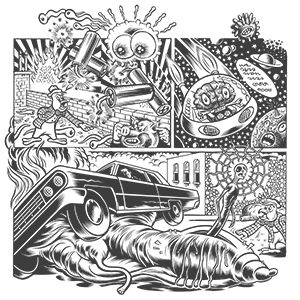
In visual art, ‘horror vacui‘ [vak-yew-ee] (Latin: ‘fear of empty space,’ which might be represented by white spots; cenophobia in Greek, is the filling of the entire surface of an artwork with detail. The term is associated with the Italian critic and scholar Mario Praz, who used it to describe the suffocating atmosphere and clutter of interior design in the Victorian age. Older, and more artistically successful examples can be seen in illuminated manuscripts such as the ‘Book of Kells.’ Moving east, this feeling of meticulously filling empty spaces permeates Arabesque Islamic art from ancient times to the present. Another example comes from ancient Greece during the Geometric Age (1100 – 900 BCE), when horror vacui was considered a stylistic element of all art. The mature work of the French Renaissance engraver Jean Duvet consistently exhibits horror vacui.
Some examples of horror vacui in art come from, or are influenced by, the mentally unstable and inmates of psychiatric hospitals, such as Richard Dadd in the 19th century, and many modern examples fall under the category of Outsider Art. Horror vacui may have also had an impact, consciously or unconsciously, on graphic design by artists like David Carson or Vaughan Oliver, and in the underground comix movement in the work of S. Clay Wilson, Robert Crumb, Robert Williams, and on later comic artists such as Mark Beyer. The paintings of Williams, Faris Badwan, Joe Coleman and Todd Schorr are further examples of horror vacui in the modern Lowbrow art movement. The entheogen-inspired visionary art of certain indigenous peoples, such as the Huichol yarn paintings and the ayahuasca-inspired art of Pablo Amaringo, often exhibits this style, as does the psychedelic art movement of the 1960s counterculture.
Posted in Art, Language |
Leave a Comment »
February 24, 2012
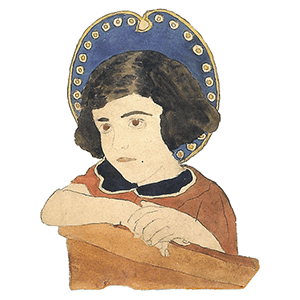
The term outsider art was coined by art critic Roger Cardinal in 1972 as an English synonym for ‘art brut’ (French: ‘raw art’), a label created by French artist Jean Dubuffet to describe art created outside the boundaries of official culture; Dubuffet focused particularly on art by insane-asylum inmates.
While Dubuffet’s term is quite specific, the English term ‘outsider art’ is often applied more broadly, to include certain self-taught or Naïve art makers who were never institutionalized. Typically, those labeled as outsider artists have little or no contact with the mainstream art world or art institutions. In many cases, their work is discovered only after their deaths. Often, outsider art illustrates extreme mental states, unconventional ideas, or elaborate fantasy worlds.
Continue reading →
Posted in Art, Health |
Leave a Comment »
February 24, 2012
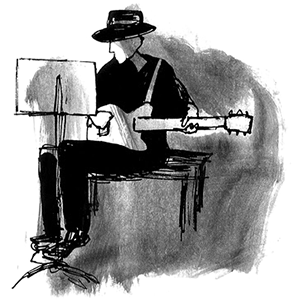
Outsider music, a term coined by music historian Irwin Chusid in the mid-1990s, are songs and compositions by musicians who are not part of the commercial music industry who write songs that ignore standard musical or lyrical conventions, either because they have no formal training or because they disagree with formal rules. This type of music, which often lacks typical structure and is emotionally stark, has few outlets; performers or recordings are often promoted by word of mouth or through fan chat sites, usually among communities of music collectors and music connoisseurs.
Outsider musicians usually have much ‘greater individual control over the final creative’ product either because of a low budget or because of their ‘inability or unwillingness to cooperate’ with modifications by a record label or producer. While a small number of outsider musicians became notable, such as Florence Foster Jenkins, an American soprano, the majority of outsider artists do not attain mainstream popularity.
Continue reading →
Posted in Art, Language, Money |
1 Comment »
February 23, 2012

Free speech zones (also known as ‘First Amendment Zones’) are areas set aside in public places for political activists to exercise their right of free speech in the US. The First Amendment states that ‘Congress shall make no law… abridging… the right of the people peaceably to assemble, and to petition the Government for a redress of grievances.’ The existence of free speech zones is based on court decisions stipulating that the government may regulate the time, place, and manner—but not content—of expression.
The stated purpose is to protect the safety of those attending the political gathering, or for the safety of the protesters themselves. Critics, however, suggest that such zones are ‘Orwellian,’ and that authorities use them in a heavy-handed manner to censor protesters by putting them literally out of sight of the mass media, hence the public, as well as visiting dignitaries. Civil libertarians claim that such areas are used as a form of censorship and public relations management to conceal the existence of popular opposition from the mass public and elected officials.
Posted in Language, Politics, World |
Leave a Comment »
February 23, 2012

Poseur is a pejorative term which describes a person who copies the dress, speech, and mannerisms of a subculture without understanding the values or philosophy of the group they are mimicking. A poseur habitually pretends to be something they are not (an insincere person), or tries to impress others by behaving in an affected way (a pretentious person).
While the term is most associated with the 1970s- and 1980s-era punk and hardcore subculture, English use originates in the late 19th century. The English term is a loanword from French, where it refers to people who ‘affect an attitude or pose.’ One could say ‘poseur’ is merely the English word ‘poser’ in French garb and thus could itself be considered an affectation.
Continue reading →
Posted in Art, Language |
Leave a Comment »
February 23, 2012

Gravitropism [gra-vitre-pizm] is a turning or growth movement by a plant or fungus in response to gravity.
Charles Darwin was one of the first to scientifically document that roots show positive gravitropism and stems show negative gravitropism. That is, roots grow in the direction of gravitational pull (i.e., downward) and stems grow in the opposite direction (i.e., upwards).
Posted in Language, Science |
Leave a Comment »
February 23, 2012
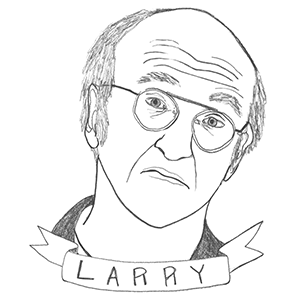
Jewish humor is self-deprecating, crude, and often anecdotal humor originating in Eastern Europe, which took root in the United States over the last hundred years. Beginning with vaudeville, and continuing through radio, stand-up comedy, film, and television, a disproportionately high percentage of American and Russian comedians have been Jewish.
Jewish humor is rooted in several traditions. The first is the intellectual and legal methods of the Talmud, which uses elaborate arguments and situations often seen as so absurd as to be humorous in order to tease out the meaning of religious law. There is an egalitarian tradition among the Jewish communities of Eastern Europe in which the powerful were often mocked subtly, rather than attacked overtly—as Saul Bellow once put it, ‘oppressed people tend to be witty.’ Jesters known as badchens used to poke fun at prominent members of the community during weddings, creating a good-natured tradition of humor as a levelling device. Continue reading →
Posted in Humor, Philosophy, Politics |
1 Comment »
February 22, 2012
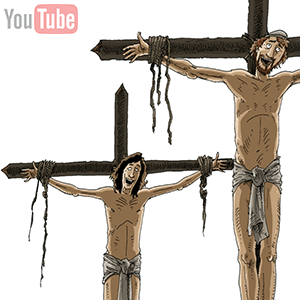
Gallows humor is a type of humor that still manages to be funny in the face of, and in response to, a hopeless situation. It arises from stressful, traumatic, or life-threatening situations, often in circumstances such that death is perceived as impending and unavoidable. The genre developed in Central Europe, and then moved to the US as part of Jewish humor. Gallows humor is offered by the person affected by the dramatic situation, an aspect that is missing in the derivative called black comedy. It is rendered with the German expression ‘Galgenhumor,’ and is comparable to the French ‘rire jaune’ (‘sickly smile’), and the Belgian Dutch ‘groen lachen’ (‘laugh desperately’). Italian comedian Daniele Luttazzi discussed gallows humor focusing on the particular type of laughter that it arouses, and said that grotesque satire, as opposed to ironic satire, is the one that most often arouses this kind of laughter.
In the Weimar era Kabaretts, this genre was particularly common; Karl Valentin and Karl Kraus were the major masters of it. Sigmund Freud in his 1927 essay ‘Humour (Der Humor)’ puts forth the following theory of the gallows humor: ‘The ego refuses to be distressed by the provocations of reality, to let itself be compelled to suffer. It insists that it cannot be affected by the traumas of the external world; it shows, in fact, that such traumas are no more than occasions for it to gain pleasure.’ Gallows humor has the social effect of strengthening the morale of the oppressed and undermines the morale of the oppressors. ‘To be able to laugh at evil and error means we have surmounted them.’
Posted in Death, Humor, Language |
Leave a Comment »


 The Daily Omnivore