February 24, 2012
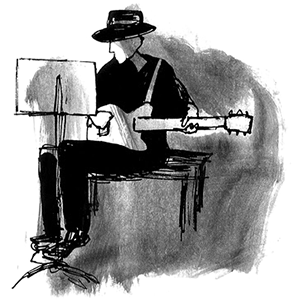
Outsider music, a term coined by music historian Irwin Chusid in the mid-1990s, are songs and compositions by musicians who are not part of the commercial music industry who write songs that ignore standard musical or lyrical conventions, either because they have no formal training or because they disagree with formal rules. This type of music, which often lacks typical structure and is emotionally stark, has few outlets; performers or recordings are often promoted by word of mouth or through fan chat sites, usually among communities of music collectors and music connoisseurs.
Outsider musicians usually have much ‘greater individual control over the final creative’ product either because of a low budget or because of their ‘inability or unwillingness to cooperate’ with modifications by a record label or producer. While a small number of outsider musicians became notable, such as Florence Foster Jenkins, an American soprano, the majority of outsider artists do not attain mainstream popularity.
Continue reading →
Posted in Art, Language, Money |
1 Comment »
February 23, 2012

Free speech zones (also known as ‘First Amendment Zones’) are areas set aside in public places for political activists to exercise their right of free speech in the US. The First Amendment states that ‘Congress shall make no law… abridging… the right of the people peaceably to assemble, and to petition the Government for a redress of grievances.’ The existence of free speech zones is based on court decisions stipulating that the government may regulate the time, place, and manner—but not content—of expression.
The stated purpose is to protect the safety of those attending the political gathering, or for the safety of the protesters themselves. Critics, however, suggest that such zones are ‘Orwellian,’ and that authorities use them in a heavy-handed manner to censor protesters by putting them literally out of sight of the mass media, hence the public, as well as visiting dignitaries. Civil libertarians claim that such areas are used as a form of censorship and public relations management to conceal the existence of popular opposition from the mass public and elected officials.
Posted in Language, Politics, World |
Leave a Comment »
February 23, 2012

Poseur is a pejorative term which describes a person who copies the dress, speech, and mannerisms of a subculture without understanding the values or philosophy of the group they are mimicking. A poseur habitually pretends to be something they are not (an insincere person), or tries to impress others by behaving in an affected way (a pretentious person).
While the term is most associated with the 1970s- and 1980s-era punk and hardcore subculture, English use originates in the late 19th century. The English term is a loanword from French, where it refers to people who ‘affect an attitude or pose.’ One could say ‘poseur’ is merely the English word ‘poser’ in French garb and thus could itself be considered an affectation.
Continue reading →
Posted in Art, Language |
Leave a Comment »
February 23, 2012

Gravitropism [gra-vitre-pizm] is a turning or growth movement by a plant or fungus in response to gravity.
Charles Darwin was one of the first to scientifically document that roots show positive gravitropism and stems show negative gravitropism. That is, roots grow in the direction of gravitational pull (i.e., downward) and stems grow in the opposite direction (i.e., upwards).
Posted in Language, Science |
Leave a Comment »
February 23, 2012
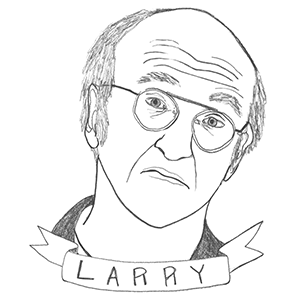
Jewish humor is self-deprecating, crude, and often anecdotal humor originating in Eastern Europe, which took root in the United States over the last hundred years. Beginning with vaudeville, and continuing through radio, stand-up comedy, film, and television, a disproportionately high percentage of American and Russian comedians have been Jewish.
Jewish humor is rooted in several traditions. The first is the intellectual and legal methods of the Talmud, which uses elaborate arguments and situations often seen as so absurd as to be humorous in order to tease out the meaning of religious law. There is an egalitarian tradition among the Jewish communities of Eastern Europe in which the powerful were often mocked subtly, rather than attacked overtly—as Saul Bellow once put it, ‘oppressed people tend to be witty.’ Jesters known as badchens used to poke fun at prominent members of the community during weddings, creating a good-natured tradition of humor as a levelling device. Continue reading →
Posted in Humor, Philosophy, Politics |
1 Comment »
February 22, 2012
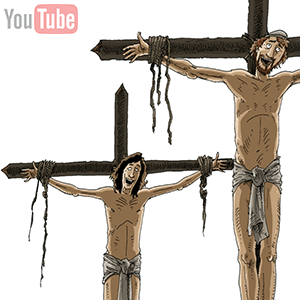
Gallows humor is a type of humor that still manages to be funny in the face of, and in response to, a hopeless situation. It arises from stressful, traumatic, or life-threatening situations, often in circumstances such that death is perceived as impending and unavoidable. The genre developed in Central Europe, and then moved to the US as part of Jewish humor. Gallows humor is offered by the person affected by the dramatic situation, an aspect that is missing in the derivative called black comedy. It is rendered with the German expression ‘Galgenhumor,’ and is comparable to the French ‘rire jaune’ (‘sickly smile’), and the Belgian Dutch ‘groen lachen’ (‘laugh desperately’). Italian comedian Daniele Luttazzi discussed gallows humor focusing on the particular type of laughter that it arouses, and said that grotesque satire, as opposed to ironic satire, is the one that most often arouses this kind of laughter.
In the Weimar era Kabaretts, this genre was particularly common; Karl Valentin and Karl Kraus were the major masters of it. Sigmund Freud in his 1927 essay ‘Humour (Der Humor)’ puts forth the following theory of the gallows humor: ‘The ego refuses to be distressed by the provocations of reality, to let itself be compelled to suffer. It insists that it cannot be affected by the traumas of the external world; it shows, in fact, that such traumas are no more than occasions for it to gain pleasure.’ Gallows humor has the social effect of strengthening the morale of the oppressed and undermines the morale of the oppressors. ‘To be able to laugh at evil and error means we have surmounted them.’
Posted in Death, Humor, Language |
Leave a Comment »
February 22, 2012

Blue comedy is comedy that is off-color, risqué, indecent or profane, largely about sex. It often contains profanity and/or sexual imagery that may shock and offend some audience members. ‘Working blue’ refers to the act of performing this type of material. A ‘blue comedian’ or ‘blue comic’ is a comedian who usually performs blue, or is known mainly for his or her blue material. Blue comedians often find it difficult to succeed in mainstream media.
Many comedians who are normally family-friendly might choose to work blue when off-camera or in an adult-oriented environment; Bob Saget exemplifies this dichotomy. A recording survives of one Masquers roast from the 1950s with Jack Benny, George Jessel, George Burns, and Art Linkletter all using highly risque material and, in some cases, obscenities. In the 1970s, CBS aired the ground-breaking sitcom ‘All in the Family,’ based on the British series ‘Till Death Us Do Part,’ which featured a ‘lovable’ bigot, Archie Bunker. The character’s dialogue usually contained racial prejudices and ethnic slurs, as well as derogatory comments against Jews, gays and women’s rights, but in a guise of blue humor against his own bigotry.
Posted in Humor, Politics, Sex |
1 Comment »
February 22, 2012
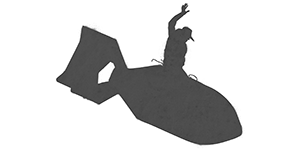

A black comedy is a comic work that employs black humor or gallows humor. The definition of black humor is problematic; it has been argued that it corresponds to the earlier concept of gallows humor (humor that still manages to be funny in the face of, and in response to, a hopeless situation); and that, as humor has been defined since Freud as a comedic act that anesthetizes an emotion, all humor is ‘black humor.’ The term ‘black humor’ (from the French ‘humour noir’) was coined by the Surrealist theoretician André Breton in 1935, to designate a sub-genre of comedy and satire in which laughter arises from cynicism and skepticism, often relying on topics such as death.
In black humor, topics and events that are usually regarded as taboo, specifically those related to death, are treated in an unusually humorous or satirical manner while retaining their seriousness; the intent of black comedy, therefore, is often for the audience to experience both laughter and discomfort, sometimes simultaneously.
Continue reading →
Posted in Humor, Language, War |
Leave a Comment »
February 22, 2012
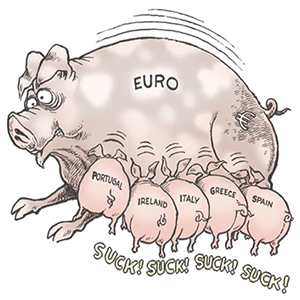
PIGS is a pejorative acronym used to refer to the economies of Portugal, Italy, Greece and Spain which are facing a financial crisis.
Since 2008, the term has included Ireland, either in place of Italy or with an additional I. Some news organizations have limited or banned use of the term because of criticism regarding perceived offensive connotations. The term has been used since at least the mid-1990s as an epithet.
Posted in Money, Politics, World |
1 Comment »
February 21, 2012

Everybody Draw Mohammed Day was an event held on 20 May 2010 in support of free speech and freedom of artistic expression of those threatened by violence for drawing representations of the Islamic Prophet Muhammad. It began as a protest against censorship of an American television show, ‘South Park,’ ‘201’ by its distributor, Comedy Central, in response to death threats against some of those responsible for two segments broadcast in April. Observance of the day began with a drawing posted on the Internet on April 20, 2010, accompanied by text suggesting that ‘everybody’ create a drawing representing Muhammad, on May 20, 2010, as a protest against efforts to limit freedom of speech. U.S. cartoonist Molly Norris of Seattle created the artwork. Depictions of Muhammad are explicitly forbidden by a few hadiths (sayings of and about Muhammad), though not by the Qur’an.
South Park episodes ‘200’ and ‘201,’ broadcast in April 2010, featured a character in a bear costume, who various other characters stated was Muhammad. The ‘South Park’ episode sparked statements from the extremist website Revolution Muslim, which posted a picture of the partially decapitated body of the Dutch filmmaker, Theo van Gogh, with a statement declaring that Parker and Stone could meet a similar fate. Comedy Central self-censored the episode when it was broadcast by removing the word ‘Muhammad’ and a speech about intimidation and fear from the episode.
Posted in Humor, Philosophy, Politics |
1 Comment »
February 21, 2012
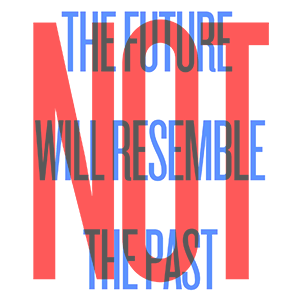
The Beginning of Infinity is a popular science book by physicist David Deutsch that was published in 2011. Deutsch views the enlightenment of the 18th century as near the beginning of an infinite sequence of purposeful knowledge creation. Knowledge here consists of information with good explanatory function that is resistant to falsifiability. Any real process physically possible is able to be performed provided the knowledge to do so has been acquired.
The enlightenment set up the conditions for knowledge creation which disrupted the static societies that previously existed. These conditions are the valuing of creativity and the free and open debate that exposed ideas to criticism to reveal those good explanatory ideas that naturally resist being falsified due to their having basis in reality. Deutsch points to previous moments in history, such as Renaissance Florence and Plato’s Academy in Golden age Athens, where this process almost got underway before succumbing to their static societies’ resistance to change. Continue reading →
Posted in Language, Science, Technology |
1 Comment »
February 21, 2012
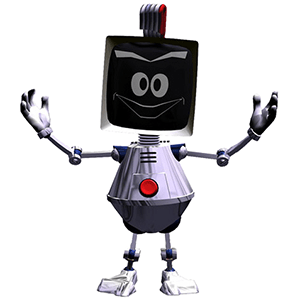
The Turing test is a test to see if a computer can trick a person into believing that the computer is a person too. Alan Turing thought that if a human could not tell the difference between another human and the computer, then that computer must be as intelligent as a human. No one has made a computer that can pass the Turing test. A chatterbot called Elbot came close in 2008. The test was introduced by Alan Turing in his 1950 paper ‘Computing Machinery and Intelligence,’ which opens with the words: ‘I propose to consider the question, ‘Can machines think?” Since ‘thinking’ is difficult to define, Turing chooses to ‘replace the question by another, which is closely related to it and is expressed in relatively unambiguous words’:
‘Are there imaginable digital computers which would do well in the imitation game?’ (a party game in which a man and a woman go into separate rooms and guests try to tell them apart by writing a series of questions and reading the typewritten answers sent back; both the man and the woman aim to convince the guests that they are the other). This question, Turing believed, is one that can actually be answered. In the remainder of the paper, he argued against all the major objections to the proposition that ‘machines can think.’ In the years since 1950, the test has proven to be both highly influential and widely criticized, and it is an essential concept in the philosophy of artificial intelligence.
Continue reading →
Posted in Games, Language, Technology |
Leave a Comment »



