February 26, 2012
The Monroe Institute (TMI) is a nonprofit education and research organization devoted to the exploration of human consciousness, based in Virginia. TMI, which claims a policy of no dogma or bias with respect to belief system, religion, political or social stance, was founded by Robert Monroe after he experienced an ‘out of body experience,’ now also commonly referred to as OBEs. Activities includes teaching various techniques, based on audio-guidance processes, in order to expand consciousness and explore areas of consciousness not normally available in the waking state.
Controlled studies of the Institute’s technology suggest that it is effective as an analgesic supplement and can reduce hospital discharge times. The Institute has an affiliated professional membership, and also publishes scientific papers on a subset of its own studies of altered states of consciousness. In its in-house laboratory, these states or focus levels are typically induced by delivering Hemi-Sync signals to subjects performing relaxation procedures inside a shielded, sense-depriving isolation tank. Progression through states is detected and monitored by measurement of peripheral skin temperature, galvanic skin response and DC skin potential voltage.
Posted in Health, Technology |
Leave a Comment »
February 25, 2012
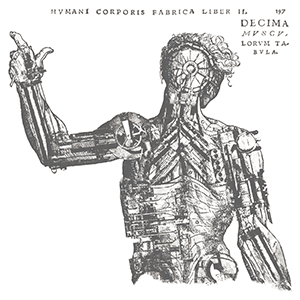
‘One-Dimensional Man: Studies in the Ideology of Advanced Industrial Society’ is a 1964 book by philosopher Herbert Marcuse. The work offers a wide-ranging critique of both contemporary capitalism and the society in the Soviet Union, documenting the parallel rise of new forms of social repression in both these societies, as well as the decline of revolutionary potential in the West.
Marcuse argues that ‘advanced industrial society’ created false needs, which integrated individuals into the existing system of production and consumption via mass media, advertising, industrial management, and contemporary modes of thought.
Continue reading →
Posted in Language, Money, Politics |
Leave a Comment »
February 25, 2012
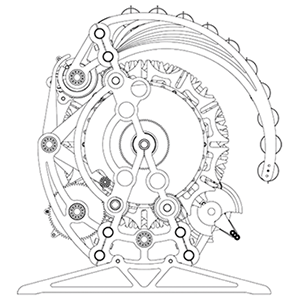
The Clock of the Long Now is a proposed mechanical clock designed to keep time for 10,000 years. The project to build it is part of the Long Now Foundation, a private organization that seeks to become the seed of a very long-term cultural institution. The project was conceived by American inventor Danny Hillis in 1986: ‘I want to build a clock that ticks once a year. The century hand advances once every one hundred years, and the cuckoo comes out on the millennium.I want the cuckoo to come out every millennium for the next 10,000 years.’
The first prototype of the clock began working on December 31, 1999, just in time to display the transition to the year 2000. At midnight on New Year’s Eve, the date indicator changed from 01999 to 02000, and the chime struck twice. That prototype, approximately two meters tall, is currently on display at the Science Museum in London. The first full-scale clock’s manufacture and site construction is being funded by Jeff Bezos, who has donated $42 million, and is located on his Texas land.
Continue reading →
Posted in Money, Technology |
Leave a Comment »
February 25, 2012

Heroin chic was a look popularized in mid-1990s fashion and characterized by pale skin, dark circles underneath the eyes, and angular bone structure. This waifish, drug-addicted look was the basis of the 1993 advertising campaign of Calvin Klein featuring Kate Moss photographed by Vincent Gallo.
Emaciated features and androgyny were a reaction to ‘healthy’ and vibrant look of models such as Cindy Crawford, Claudia Schiffer, and Heidi Klum. A 1996 article in ‘The Los Angeles Times’ charged that the fashion industry had ‘a nihilistic vision of beauty’ that was reflective of drug addiction. Continue reading →
Posted in Art, Drugs, Money |
Leave a Comment »
February 25, 2012

Radical chic is a term coined by journalist Tom Wolfe in his 1970 essay ‘Radical Chic: That Party at Lenny’s,’ to describe the adoption and promotion of radical political causes by celebrities, socialites, and high society. The concept has been described as ‘an exercise in double-tracking one’s public image: on the one hand, defining oneself through committed allegiance to a radical cause, but on the other, vitally, demonstrating this allegiance because it is the fashionable, au courant way to be seen in moneyed, name-conscious Society.’
Unlike dedicated activists, revolutionaries, or dissenters, those who engage in radical chic remain frivolous political agitators. They are ideologically invested in their cause of choice only so far as it advances their social standing. ‘Terrorist chic’ is a modern expression with similar connotations. This derivative, however, de-emphasizes the class satire of Wolfe’s original term, instead accentuating concerns over the semiotics of radicalism (such as the aestheticization of violence).
Continue reading →
Posted in Money, Politics |
Leave a Comment »
February 25, 2012

A monofin is a type of swimfin typically used in finswimming and free-diving. It consists of a single surface attached to footpockets for both of the free-diver’s feet. Monofins were introduced in 1972, by a Ukrainian finswimming club, and have been used for finswimming competitions since, allowing monofin swimmers to reach speeds of 12km/h. Monofins can be made of glass fiber or carbon fiber. The diver’s muscle power, swimming style, and the type of aquatic activity the monofin is used for determines the choice of size, stiffness, and materials.
To differentiate between the use of monofins and conventional fins, the latter are sometimes referred to as stereo fins or bi-fins. The monofin swimmer extends arms forward, locking hands together, locking the head between the biceps. The undulating movement starts in the shoulders, with maximum amplitude towards the hips, the legs almost don’t bend to transfer the movement to the monofin. This technique is called the dolphin kick.
Posted in Games, Technology |
Leave a Comment »
February 25, 2012

The hedonic treadmill is the supposed tendency of humans to quickly return to a relatively stable level of happiness despite major positive or negative events or life changes. According to this theory, as a person makes more money, expectations and desires rise in tandem, which results in no permanent gain in happiness. Brickman and Campbell coined the term in their essay ‘Hedonic Relativism and Planning the Good Society’ (1971). During the late ’90s, the concept was modified by Michael Eysenck, a British psychology researcher, to become the current ‘hedonic treadmill theory’ which compares the pursuit of happiness to a person on a treadmill, who has to keep working just to stay in the same place. The general idea of the ‘Hedonic (or Happiness) Set Point’ has gained interest throughout the field of positive psychology.
Research supports a three-factor model, where our level of happiness is 50% determined by genetics, 10% determined by outside circumstances, and 40% determined by intentional activities. That last factor, of intentional activities, is the focus of positive psychology, especially because not all activities are equally effective at helping one to reach the higher end of their happiness range. One study concluded that life goals along with personality characteristics are important determinants of one’s subjective well-being. Life goals that enrich one’s relationships and social resources, such as altruistic and family oriented goals, increase their level of subjective well-being. On the other hand, materialistic life goals, such as monetary achievement, have a negative effect on people’s overall subjective well-being.
Posted in Health, Science |
1 Comment »
February 25, 2012

Moneybomb is a neologism coined in 2007 to describe a grassroots fundraising effort over a brief fixed time period, usually to support a candidate for election by dramatically increasing, concentrating, and publicizing fundraising activity during a specific hour or day. The term was first applied to a supporter-led fundraiser on behalf of presidential candidate Ron Paul.
The effort combines traditional and Internet-based fundraising appeals focusing especially on viral advertising through online vehicles such as YouTube, Facebook, and online forums. In the case of lesser-known candidates it is also intended to generate significant free mass media coverage the candidate would otherwise not receive. The term has also been used as a verb and apparently arose from analogy with the neologism ‘googlebomb,’ a method of search engine optimization.
Posted in Money, Politics, Technology |
Leave a Comment »
February 25, 2012

Flash fiction is a style of fictional literature or fiction of extreme brevity.
There is no widely accepted definition of the length of the category. Some self-described markets for flash fiction impose caps as low as three hundred words, while others consider stories as long as a thousand words to be flash fiction. In one particular format, established by Steve Moss, Editor of the New Times, the requirement is 55 words; no more and no fewer. Another, unspecified but frequently held, requirement is that the title may be no more than seven words. Continue reading →
Posted in Art, Language |
Leave a Comment »
February 24, 2012

Negative space, in art, is the space around and between the subject(s) of an image. Negative space may be most evident when the space around a subject, and not the subject itself, forms an interesting or artistically relevant shape, and such space is occasionally used to artistic effect as the ‘real’ subject of an image. The use of negative space is a key element of artistic composition. The Japanese word ‘ma’ is sometimes used for this concept, for example in garden design. In a two-tone, black-and-white image, a subject is normally depicted in black and the space around it is left blank (white), thereby forming a silhouette of the subject.
However, reversing the tones so that the space around the subject is printed black and the subject itself is left blank causes the negative space to be apparent as it forms shapes around the subject, called ‘figure-ground reversal.’ One tool used by art teachers in explaining positive and negative space is an exercise where students copy from an upside-down drawing or photograph. Because the picture is upside-down, they don’t readily recognize the objects in the picture. They are able to give equal attention to the positive and negative shapes. The result is often a much more accurate drawing.
Posted in Art |
Leave a Comment »
February 24, 2012
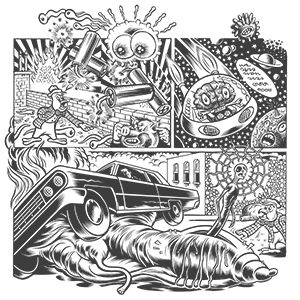
In visual art, ‘horror vacui‘ [vak-yew-ee] (Latin: ‘fear of empty space,’ which might be represented by white spots; cenophobia in Greek, is the filling of the entire surface of an artwork with detail. The term is associated with the Italian critic and scholar Mario Praz, who used it to describe the suffocating atmosphere and clutter of interior design in the Victorian age. Older, and more artistically successful examples can be seen in illuminated manuscripts such as the ‘Book of Kells.’ Moving east, this feeling of meticulously filling empty spaces permeates Arabesque Islamic art from ancient times to the present. Another example comes from ancient Greece during the Geometric Age (1100 – 900 BCE), when horror vacui was considered a stylistic element of all art. The mature work of the French Renaissance engraver Jean Duvet consistently exhibits horror vacui.
Some examples of horror vacui in art come from, or are influenced by, the mentally unstable and inmates of psychiatric hospitals, such as Richard Dadd in the 19th century, and many modern examples fall under the category of Outsider Art. Horror vacui may have also had an impact, consciously or unconsciously, on graphic design by artists like David Carson or Vaughan Oliver, and in the underground comix movement in the work of S. Clay Wilson, Robert Crumb, Robert Williams, and on later comic artists such as Mark Beyer. The paintings of Williams, Faris Badwan, Joe Coleman and Todd Schorr are further examples of horror vacui in the modern Lowbrow art movement. The entheogen-inspired visionary art of certain indigenous peoples, such as the Huichol yarn paintings and the ayahuasca-inspired art of Pablo Amaringo, often exhibits this style, as does the psychedelic art movement of the 1960s counterculture.
Posted in Art, Language |
Leave a Comment »
February 24, 2012

The term outsider art was coined by art critic Roger Cardinal in 1972 as an English synonym for ‘art brut’ (French: ‘raw art’), a label created by French artist Jean Dubuffet to describe art created outside the boundaries of official culture; Dubuffet focused particularly on art by insane-asylum inmates.
While Dubuffet’s term is quite specific, the English term ‘outsider art’ is often applied more broadly, to include certain self-taught or Naïve art makers who were never institutionalized. Typically, those labeled as outsider artists have little or no contact with the mainstream art world or art institutions. In many cases, their work is discovered only after their deaths. Often, outsider art illustrates extreme mental states, unconventional ideas, or elaborate fantasy worlds.
Continue reading →
Posted in Art, Health |
Leave a Comment »



