February 15, 2012
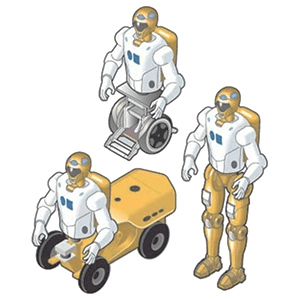
Robonaut is a humanoid robotic development project conducted by the Dextrous Robotics Laboratory at NASA’s Johnson Space Center (JSC) in Houston. Robonaut differs from other current space-faring robots (such as robotic arms, cranes and exploration rovers), which are designed to move large objects; Robonaut’s tasks require more dexterity. The core idea behind the Robonaut series is to have a humanoid machine work alongside astronauts. Its form factor and dexterity are designed such that Robonaut can use space tools and work in similar environments suited to astronauts.
The latest Robonaut version, R2, the first US-built robot on the ISS, delivered by the Space Shuttle in 2011, is a robotic torso designed to assist with crew EVA’s. However, Robonaut 2 does not have adequate protection needed to exist outside the space station and enhancements and modifications would be required to allow it to move around the station’s interior.
Continue reading →
Posted in Money, Technology |
Leave a Comment »
February 15, 2012

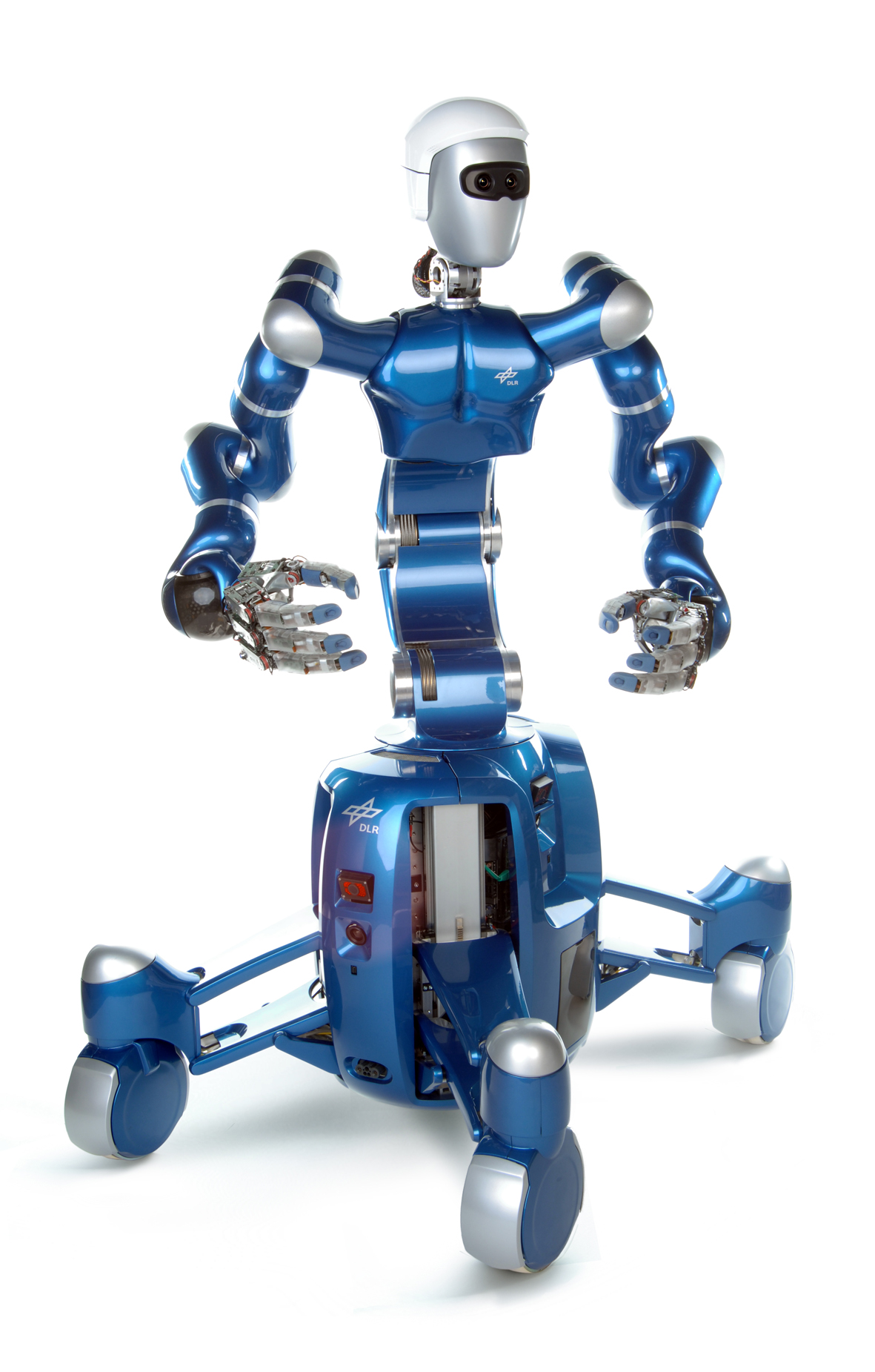
Justin is a humanoid robot developed by the German Aerospace Center (DLR) controlable through telepresence. Justin will be mounted on its own satellite and will be able to maneuver in orbit and fix other satellites.
The European Space Agency (ESA) plans to have astronauts aboard the International Space Station teleoperate Justin while he is on Earth.
Posted in Technology, World |
Leave a Comment »
February 15, 2012

Juan Francisco Casas (b. 1976) is a Spanish artist who paints large size oil canvases and blue ballpen drawings where he reproduces images he takes with his camera.
In 2010 he participated, along with artists such as Edward Hopper, Édouard Manet, Chuck Close, and Andreas Gursky, in the impressive display ‘Realismus. Das Abenteuer der Wirklichkeit’ (‘Realism The Adventure of Reality’) in the Kunsthalle der Hypo-Kulturstiftung Museum, Munich. He lives and works in Paris and Madrid.
Posted in Art |
Leave a Comment »
February 15, 2012

The concept of Cool Japan, along with that of ‘Gross National Cool,’ was coined in 2002 as an expression of Japan’s emergent status as a cultural superpower. Gaining broad exposure in the media and academia, the brand of ‘Cool Japan’ has been adopted by the Japanese government as well as trade bodies seeking to exploit the commercial capital of the country’s culture industry. It has been described as a form of soft power, ‘the ability to indirectly influence behaviour or interests through cultural or ideological means.’
In a 2002 article in ‘Foreign Policy’ entitled ‘Japan’s Gross National Cool,’ Douglas McGray wrote of Japan ‘reinventing superpower’ as its cultural influence expanded internationally despite the economic and political problems of the ‘lost decade.’ Surveying youth culture and the role of manga, anime, fashion, film, consumer electronics, architecture, cuisine, J-pop, and phenomena of cuteness such as Hello Kitty, McGray highlighted Japan’s considerable soft power, posing the question of what message the country might project. He also argued that Japan’s recession may even have boosted its national cool, due to the partial discrediting of erstwhile rigid social hierarchies and big-business career paths.
Posted in Art, Money, World |
Leave a Comment »
February 15, 2012

The Lost Decade is the time after the Japanese asset price bubble’s collapse within the Japanese economy, which occurred gradually rather than catastrophically. The term originally referred to the years 1991 to 2000, but recently the decade from 2001 to 2010 is also sometimes included, so that the whole period of the 1990s and 2000s is referred to as the Lost Decades or the Lost Years.
The strong economic growth of the 1980s ended abruptly at the start of the 1990s. In the late 1980s, abnormalities within the Japanese economic system had fueled a massive wave of speculation by Japanese companies, banks and securities companies. A combination of exceptionally high land values and exceptionally low interest rates briefly led to a position in which credit was both easily available and extremely cheap. This led to massive borrowing, the proceeds of which were invested mostly in domestic and foreign stocks and securities. Continue reading →
Posted in Money, Politics, World |
1 Comment »
February 14, 2012

Human Flesh Search (HFS) is a primarily Chinese internet phenomenon of massive researching using Internet media such as blogs and forums. It has generally been stigmatized as being for the purpose of identifying and exposing individuals to public humiliation, usually out of Chinese nationalistic sentiment, or conversely, to break the Internet censorship in China.
More recent analyses, however, have shown that it is also used for a number of other reasons, including exposing government corruption, identifying hit and run drivers, and outing scientific fraud, as well as for more entertainment related items such as identifying people seen in pictures. The system is based on massive human collaboration. The name refers both to the use of knowledge contributed by human beings through social networking, as well as the fact that the searches are usually dedicated to finding the identity of a human being who has committed some sort of offense or social breach online. People conducting such research are commonly referred to collectively as ‘Human Flesh Search Engines.’ Continue reading →
Posted in Politics, Technology, World |
Leave a Comment »
February 14, 2012

On the Internet, nobody knows you’re a dog‘ is an adage which began as the caption of a cartoon by Peter Steiner published by ‘The New Yorker’ in 1993. Steiner, a cartoonist and contributor to ‘The New Yorker’ since 1979, said the cartoon initially did not get a lot of attention, but later took on a life of its own, and that he felt similar to the person who created the ‘smiley face.’ In fact, Steiner was not that interested in the Internet when he drew the cartoon, and although he did have an online account, he recalled attaching no ‘profound’ meaning to the cartoon; it was just something he drew in the manner of a ‘make-up-a-caption’ cartoon.
In response to the comic’s popularity, he stated, ‘I can’t quite fathom that it’s that widely known and recognized.’ The cartoon marks a notable moment in Internet history. Once the exclusive domain of government engineers and academics, the Internet was now a subject of discussion in general interest magazines like ‘The New Yorker.’ Lotus 1-2-3 founder and early Internet activist Mitch Kapor commented in a ‘Time’ magazine article in 1993 that ‘the true sign that popular interest has reached critical mass came this summer when the ‘New Yorker printed a cartoon showing two computer-savvy canines.’
Continue reading →
Posted in Humor, Politics, Technology |
1 Comment »
February 14, 2012
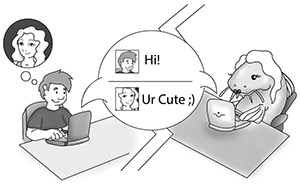

A sockpuppet is an online identity used for purposes of deception. The term—a reference to the manipulation of a simple hand puppet made from a sock—originally referred to a false identity assumed by a member of an internet community who spoke to, or about himself while pretending to be another person.
The term now includes other uses of misleading online identities, such as those created to praise, defend or support a third party or organization. A significant difference between the use of a pseudonym and the creation of a sockpuppet is that the sockpuppet poses as an independent third-party unaffiliated with the puppeteer. Continue reading →
Posted in Language, Money, Technology |
2 Comments »
February 14, 2012

A shill, plant or stooge helps someone without disclosing that he or she has a close relationship with that person or organization. Shill typically refers to someone who purposely gives onlookers the impression that he or she is an enthusiastic independent customer of a seller that he or she is secretly working for. The person or group that hires the shill is using crowd psychology, to encourage other onlookers or audience members to make a purchase.
Shills are often employed by confidence artists. Plant and stooge more commonly refer to any person who is secretly in league with another person or organization while pretending to be neutral or actually a part of the organization he or she is planted in, such as a magician’s audience, a political party, or an intelligence organization (double agent). Continue reading →
Posted in Language, Money, Politics |
Leave a Comment »
February 13, 2012
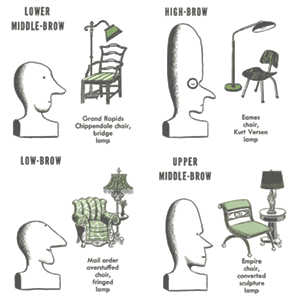
The term middlebrow describes both a certain type of easily accessible art, often literature, as well as the population that uses art to acquire culture and class that is usually unattainable. First used by the British satire magazine ‘Punch’ in 1925, middlebrow is derived as the intermediary between highbrow and lowbrow, terms derived from phrenology.
Middlebrow has famously gained notoriety from derisive attacks by Dwight Macdonald, Virginia Woolf, and to a certain extent, Russell Lynes. It has been classified as a forced and ineffective attempt at cultural and intellectual achievement, as well as characterizing literature that emphasizes emotional and sentimental connections rather than literary quality and innovation.
Continue reading →
Posted in Art, Language |
Leave a Comment »
February 13, 2012

Popular culture studies is the academic discipline studying popular culture from a critical theory perspective. It is generally considered as a combination of communication studies and cultural studies. Following the work of the Frankfurt School, popular culture has come to be taken more seriously as a terrain of academic inquiry and has also helped to change the outlooks of more established disciplines.
Conceptual barriers between so-called high and low culture have broken down, accompanying an explosion in scholarly interest in popular culture, which encompasses such diverse media as comic books, television, and the Internet. Reevaluation of mass culture in the 1970s and 1980s has revealed significant problems with the traditional view of mass culture as degraded and elite culture as uplifting. Divisions between high and low culture have been increasingly seen as political distinctions rather than defensible aesthetic or intellectual ones.
Continue reading →
Posted in Education, Money, Politics |
Leave a Comment »
February 13, 2012
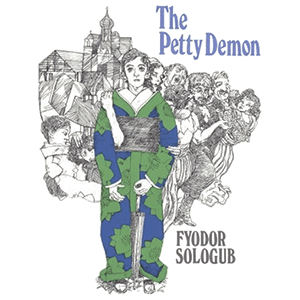
Poshlost is a Russian word that has been defined as ‘petty evil or self-satisfied vulgarity,’ however there is no single English translation.
At more length, ‘Poshlost’ is the Russian version of banality, with a characteristic national flavoring of metaphysics and high morality, and a peculiar conjunction of the sexual and the spiritual. This one word encompasses triviality, vulgarity, sexual promiscuity, and a lack of spirituality. The war against poshlost’ was a cultural obsession of the Russian and Soviet intelligentsia from the 1860s to 1960s.’
Continue reading →
Posted in Language, Sex, World |
Leave a Comment »