February 9, 2012

Dietrich Varez (b. 1939) is an iconoclastic printmaker-painter. His work is among the most widely-recognized of any artist in Hawaii. A long-time resident of the Big Island, he is known primarily for scenes of Hawaiian mythology and of traditional Hawaiian life and stylized designs from nature. The studio where Varez works and lives is in a rural forested area near the small town of Volcano, Hawaii a few miles from the entrance to Hawaii Volcanoes National Park.
He built the house himself after many years of living in tents or cabins on the land or in the Park. For most of his life there, he and his family have lived a self-sufficient pioneering life. They capture rainwater for their needs, and had no electricity for thirty years. The road to his home has been described as ‘barely passable.’ Varez and his wife rarely leave their homestead, virtually never travelling off-island.
Continue reading →
Posted in Art, Money |
Leave a Comment »
February 8, 2012
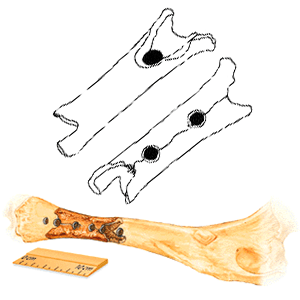
Prehistoric music (previously called primitive music) is a term in the history of music for all music produced in preliterate cultures (prehistory), beginning somewhere in very late geological history. Prehistoric music is followed by ancient music in different parts of the world, but still exists in isolated areas.
Prehistoric music thus technically includes all of the world’s music that has existed before the advent of any currently-extant historical sources concerning that music, for example, traditional Native American music of preliterate tribes and Australian Aboriginal music. However, it is more common to refer to the ‘prehistoric’ music which still survives as folk, indigenous or traditional music. Prehistoric music is studied alongside other periods within Music Archaeology.
Continue reading →
Posted in Art, Science, Technology |
Leave a Comment »
February 8, 2012

The pregap on a Red Book audio CD is the portion of the audio track that precedes ‘index 01’ for a given track in the table of contents (TOC). The pregap (‘index 00’) is typically two seconds long and usually, but not always, contains silence. Popular uses for having the pregap contain audio are live CDs, track interludes, and hidden songs in the pregap of the first track. On certain CDs, such as ‘Think Tank’ by Blur, the pregap contains a hidden track. The track is truly hidden in the sense that most conventional standalone players and software CD players will not see it. Such hidden tracks can be played by playing the first song and ‘rewinding’ (more accurately, seeking in reverse) until the actual start of the whole CD audio track. Not all CD drives can properly extract such hidden tracks. Some drives will report errors when reading these tracks, and some will seem to extract them properly, but the extracted file will contain only silence.
The pregap was used to hide computer data, tricking computers into detecting a data track whereas conventional CD players would continue to see the CD as an audio CD. This method was quickly made obsolete in late 1996 when an update to Windows 95 made the pregap track inaccessible. It is unclear whether or not this change in Microsoft Windows’ behavior was intentional: for instance, it may have been intended to steer developers away from the pregap method and encourage what became the Blue Book specification ‘CD Extra’ format.
Posted in Art, Money, Technology |
Leave a Comment »
February 8, 2012
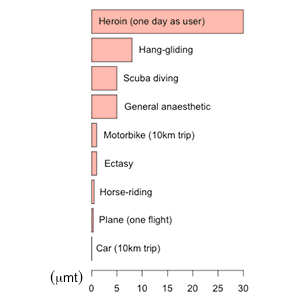
A micromort is a unit of risk measuring a one-in-a-million probability of death (from micro- and mortality). Micromorts can be used to measure riskiness of various day-to-day activities. A microprobability is a one-in-a million chance of some event; thus a micromort is the microprobability of death. The micromort concept was introduced by Ronald A. Howard who pioneered the modern practice of decision analysis.
An application of micromorts is measuring the value that humans place on risk: for example, one can consider the amount of money one would have to pay a person to get him or her to accept a one-in-a-million chance of death (or conversely the amount that someone might be willing to pay to avoid a one-in-a-million chance of death).
Continue reading →
Posted in Death, Health, Money |
2 Comments »
February 8, 2012

‘Manifold Destiny‘ is a 2006 article in ‘The New Yorker’ written by Sylvia Nasar (known for her biography of John Forbes Nash, ‘A Beautiful Mind’) and David Gruber. It gives a detailed account (including interviews with many mathematicians) of some of the circumstances surrounding the proof of the Poincaré conjecture, one of the most important accomplishments of 20th and 21st century mathematics, and traces the attempts by three teams of mathematicians to verify the proof given by Grigori Perelman.
Subtitled ‘A legendary problem and the battle over who solved it,’ the article concentrates on the human drama of the story, especially the discussion on who contributed how much to the proof of the Poincaré conjecture. Interwoven with the article is an interview with the reclusive mathematician Grigori Perelman, whom the authors tracked down to the St. Petersburg apartment he shares with his mother. The article describes Perelman’s disillusionment and withdrawal from the mathematical community and paints an unflattering portrait of the 1982 Fields Medalist, Shing-Tung Yau.
Continue reading →
Posted in Language, Science |
1 Comment »
February 8, 2012

Grigori Perelman (b. 1966) is a Russian mathematician who has made landmark contributions to geometry and topology (the study of geometric deformation). In 1992, Perelman proved the soul conjecture. In 2002, he proved Thurston’s geometrization conjecture. This consequently solved in the affirmative the Poincaré conjecture, posed in 1904, which before its solution was viewed as one of the most important and difficult open problems in topology.
In 2006, Perelman was awarded the Fields Medal, but declined to accept the award or to appear at the congress, stating: ‘I’m not interested in money or fame, I don’t want to be on display like an animal in a zoo.’ In 2010, it was announced that he had met the criteria to receive the first Clay Millennium Prize for resolution of the Poincaré conjecture. He turned down the prize ($1 million), saying that he considers his contribution to proving the Poincaré conjecture to be no greater than that of U.S. mathematician Richard Hamilton. Continue reading →
Posted in Education, Money, Science |
Leave a Comment »
February 7, 2012

New Historicism is a school of literary theory that developed in the 1980s, primarily through the work of the critic Stephen Greenblatt, and gained widespread influence in the 1990s. The goal of the theory is to understand information by its historical context, and to understand cultural and intellectual history through literature. Michel Foucault based his approach both on his theory of the limits of collective cultural knowledge and on his technique of examining a broad array of documents in order to understand a particular time. New Historicism is claimed to be a more neutral approach to historical events, and to be sensitive towards different cultures.
‘Sub-literary’ texts and uninspired non-literary texts all came to be read as documents of historical discourse, side-by-side with the ‘great works of literature.’ A typical focus of New Historicist critics, led by Stephen Orgel, has been on understanding Shakespeare less as an autonomous great author in the modern sense than as a clue to the conjunction of the world of Renaissance theater—a collaborative and largely anonymous free-for-all—and the complex social politics of the time. In this sense, Shakespeare’s plays are seen as inseparable from the context in which he wrote.
Continue reading →
Posted in Language, Philosophy, Politics |
1 Comment »
February 7, 2012
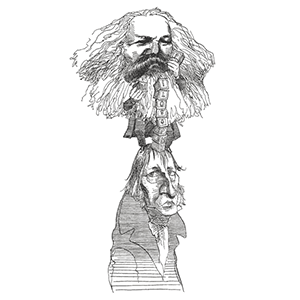
Historicism is doctrine that emphasizes the importance of history. It is a mode of thinking that assigns a central and basic significance to a specific context, such as historical period, geographical place and local culture. As such it is in contrast to individualist theories of knowledge such as empiricism and rationalism, which often discount the role of traditions. Historicism therefore tends to be hermeneutical (investigative of interpretations), because it places great importance on cautious, rigorous and contextualized interpretation of information and/or relativist (in support of the theory that knowledge is always relative to limitations of the mind), because it rejects notions of universal, fundamental and immutable interpretations.
The term has developed different and divergent, though loosely related, meanings. Elements of historicism appear in the writings of Italian philosopher G. B. Vico and French essayist Michel de Montaigne, and became fully developed with the dialectic of G. W. F. Hegel, influential in 19th-century Europe. The writings of Karl Marx, influenced by Hegel, also contain historicism. The term is also associated with the empirical social sciences and the work of Franz Boas. Historicism may be contrasted with reductionist theories, which suppose that all developments can be explained by fundamental principles (such as in economic determinism), or theories that posit historical changes as result of random chance. The theological use of the word denotes the interpretation of biblical prophecy as being related to church history. Post-structuralism uses the term New Historicism, which has some connections to both anthropology and Hegelianism.
Posted in Philosophy, Politics, Science |
1 Comment »
February 7, 2012

Butterflies are characterized by their scale-covered wings. These scales are pigmented with melanins that give them blacks and browns. Other colors like blues, greens, reds and iridescence are usually created not by pigments but the microstructure of the scales.
This structural coloration is the result of coherent scattering of light by the photonic crystal nature of the scales. The scales cling somewhat loosely to the wing and come off easily without harming the butterfly.
Posted in Science |
Leave a Comment »
February 7, 2012

The phrase snake oil is as a derogatory term used to describe quackery, the promotion of fraudulent or unproven medical practices. The expression is also applied metaphorically to any product with questionable and/or unverifiable quality or benefit. By extension, the term ‘snake oil salesman’ may be applied to someone who sells fraudulent goods, or who is a fraud himself.
The phrase originates with a topical preparation made from the Chinese Water Snake. Chinese laborers on railroad gangs involved in building the First Transcontinental Railroad first gave snake oil to Europeans with joint pain. When rubbed on the skin at the painful site, snake oil was claimed to bring relief. This claim was ridiculed by rival medicine salesmen, and in time, snake oil became a generic name for many compounds marketed as panaceas or miraculous remedies whose ingredients were usually secret, unidentified, or mis-characterized and mostly inert or ineffective. Continue reading →
Posted in Drugs, Health, Politics |
Leave a Comment »
February 7, 2012

Bile bears or battery bears are Asiatic black bears kept in captivity in China and Vietnam to harvest bile, a digestive juice produced by the liver and stored in the gall bladder. When extracted, the bile is a valuable commodity for sale as an ingredient in traditional Chinese medicine (TCM).
The bears are also known as moon bears because of the cream-colored crescent moon shape on their chest. The Asiatic black bear, the one most commonly used on bear farms, is listed as vulnerable on the World Conservation Union’s (IUCN’s) Red List of Threatened Animals.
Continue reading →
Posted in Health, Politics, World |
Leave a Comment »
February 7, 2012

A bible for screenwriters is a reference document used for information on a story’s characters, settings and other elements. Show bibles are commonly used in television series; new writers and freelancers are often referred to it when writing scripts for the show to ensure continuity with previous episodes; they’re also used by individual writers for books and movies to keep track of details.
However, according to writer and producer Jane Espenson, ‘Show bibles … just aren’t as important as you might think to the daily life of the [writing] staff. The truth is that once you’re living inside a show, you’re swimming as fast as you can from one island to the next, and there is neither the time nor the need to record decisions that have been made (these are in the scripts), or that are in the process of being made (these are in the notes taken in the room as the writers work).’ Continue reading →
Posted in Art, Language, Money |
Leave a Comment »