January 24, 2012

A bait car, also called a decoy car, is a vehicle used by law enforcement agencies to capture car thieves. The vehicles are modified, with features including GPS tracking and audio/video surveillance technology, and can be remotely monitored and controlled. A ‘kill switch’ may be installed in the vehicle allowing police to remotely disable the engine and lock all doors from the inside, preventing escape.
The bait car, often filled with valuable items to draw attention to it, is parked in a high auto-theft area. In some cases, the vehicle may be simply left unlocked with the keys in the ignition. When the car is stolen, officers are immediately alerted, and can monitor the vehicle and send commands to control it such as disabling the engine, locking the doors or honking the horn. Live audio/video streaming devices may be installed allowing law enforcement personnel to determine how many suspects are in the car, what they are planning and if they are armed.
Posted in Money, Politics, Technology |
Leave a Comment »
January 24, 2012

GAMAGO is a company that was started in 2001 by Greg Long and Chris Edmundson. The pair began silkscreening t-shirts with artwork from their friends in Long’s San Francisco garage. They wanted to help promote the San Francisco art scene and distract from their day jobs. Shortly after starting, one of Long’s friends, artist Tim Biskup joined them, and printed shirts with Biskup’s Gama-Goon character.
The three of them together took the basement hobby and turned it into a company. In 2006, Tim Biskup ceased his creative involvement with the company. In 2006, GAMAGO shifted their focus from apparel to gifts for the home and kitchen. 2009 saw the release of The Flipper, a guitar shaped spatula. The success of The Flipper.
Posted in Art, Money |
Leave a Comment »
January 24, 2012

Tim Biskup (b. 1967) is an American artist generally considered to be a part of the group that has been dubbed ‘lowbrow’ or pop surrealism. His free-spirited style recalls 1950s storybook illustration, with bright colors and whimsical shapes unrestricted by the black outlining typically used in character design.
He works with playful and vibrant psychedelic imagery in the pop-design genre that emerged in the late 20th century through such diverse media as silkscreening, textile production, and rotocast vinyl. He is also a significant contributor to the ‘GAMA-GO’ clothing line. However, Tim has stated on his website that he has ceased involvement with the company. Tim works closely with ex wife Seonna Hong, with whom he has a daughter named Tigerlily.
Posted in Art |
Leave a Comment »
January 24, 2012


Everyday carry (EDC) refers to a small collection of tools, equipment and supplies that are carried on a daily basis. The term EDC also refers to the philosophy or spirit of ‘preparedness’ that goes along with the selection and carrying of these items. Implicit in the term is the sense that an EDC is an individual’s personal selection of equipment, arrived at after deliberation, rather than a standardized kit.
EDC items normally fit in a pocket, or small pack, or be attached to clothing. Emphasis is placed on the usefulness, accessibility and reliability of these items. As an example, the core elements of a typical EDC might include a folding pocket knife, a flashlight and a multi-tool. These items are often collected into a pack or organizer. Continue reading →
Posted in Money, Technology |
2 Comments »
January 24, 2012

Survivalism is a movement devoted to preparing for possible disruptions in social or political order, on scales ranging from local to international. Survivalists often have emergency medical and self-defence training, stockpile food and water, prepare for self-sufficiency, and build structures that will help them survive or ‘disappear’ (e.g. a survival retreat or underground shelter).
Anticipated disruptions include the following: clusters of natural disasters, patterns of apocalyptic planetary crises, or Earth Changes (in the form of tornadoes, hurricanes, earthquakes, blizzards, severe thunderstorms); disaster caused by the activities of humankind (chemical spills, release of radioactive materials, nuclear or conventional war, oppressive governments); societal collapse caused by the shortage or unavailability of resources such as electricity, fuel, food, or water; financial disruption or economic collapse (caused by monetary manipulation, hyperinflation, deflation, or depression); and global pandemic.
Continue reading →
Posted in Money, Philosophy, War |
Leave a Comment »
January 24, 2012


The American Preppers Network (APN) is a non-profit corporation and part of a growing international movement of survivalists who call themselves ‘preppers.’ The social network is organized by state and regional blogs and forums. The members are volunteer contributors who are dedicated to providing free information on survival, preparedness, self-sufficiency and sustainability. The individuals involved in the prepper network prefer to be called preppers instead of survivalists because they are regular people with normal lifestyles and jobs who prepare for a variety of reasons whether natural or man-made.
The network of blogs is based on the concept originally created by Riverwalker of the ‘Stealth Survival’ blog, who founded the first Preppers Network. The organization has also formed alliances with independent affiliates such as ‘Pioneer Living Survival Magazine,’ a homesteading and survival skills website for a range of survivalist, from those who just want to store extra food in case of a power cut, to people who want to embrace the ‘off the grid’ lifestyle of America’s western pioneers.
Posted in Money, Politics |
Leave a Comment »
January 24, 2012

James Surowiecki [soor-oh-wik-ee] (b. 1967) is an American journalist. He is a staff writer at ‘The New Yorker,’ where he writes a regular column on business and finance. He was born in Connecticut but grew up in Puerto Rico. He moved back to Connecticut for high school. In 1988 he graduated from the University of North Carolina. He pursued Ph.D. studies in American History on a Mellon Fellowship at Yale University before becoming a financial journalist. He currently lives in Brooklyn and is married to ‘Slate’ culture editor Meghan O’Rourke. He got his start on the Internet when he was hired from graduate school by ‘Motley Fool’ co-founder David Gardner.
In 2002, Surowiecki edited an anthology, ‘Best Business Crime Writing of the Year,’ a collection of articles from different business news sources that chronicle the fall from grace of various CEOs. In 2004, he published ‘The Wisdom of Crowds,’ in which he argued that in some circumstances, large groups exhibit more intelligence than smaller, more elite groups, and that collective intelligence shapes business, economies, societies and nations.
Posted in Language, Money |
Leave a Comment »
January 24, 2012

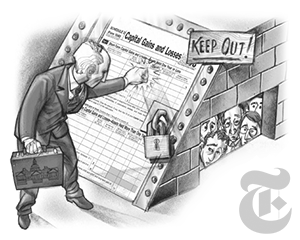
In North America, a tax shelter is generally defined as any method that recovers more than $1 in tax for every $1 spent, within 4 years. Some tax shelters are questionable or even illegal such as offshore companies that exploit differing tax rates and legislation. Others are part of financing arrangements; by paying unreasonably high interest rates to a related party, one may severely reduce the income of an investment (or even create a loss), but create a massive capital gain when one withdraws the investment. The tax benefit derives from the fact that capital gains are taxed at a lower rate than the normal investment income such as interest or dividend.
The offense of these questionable tax shelters are usually that transactions were not reported at fair market value or the interest rate was too high or too low. In general, if the purpose of a transaction is to lower tax liabilities but otherwise have no economic value, and especially when arranged between related parties, such transactions are often viewed as unethical. Continue reading →
Posted in Money, Politics |
Leave a Comment »
January 24, 2012


Private equity, in finance, is an asset class (investment strategy) consisting of equity securities (stocks) in operating companies that are not publicly traded on a stock exchange. A private equity investment will generally be made by a private equity firm (which specialize in just private equity), a venture capital firm (which invests in start-up companies), or an angel investor (an affluent individual who provides capital for start-ups). Each of these categories of investor has its own set of goals, preferences and investment strategies; each however providing working capital to a target company to nurture expansion, new product development, or restructuring of the company’s operations, management, or ownership.
Among the most common investment strategies in private equity are: leveraged buyouts, venture capital, growth capital, distressed investments, and mezzanine capital. In a typical leveraged buyout transaction, a private equity firm buys majority control of an existing or mature firm. This is distinct from a venture capital or growth capital investment, in which the investors (typically venture capital firms or angel investors) invest in young or emerging companies, and rarely obtain majority control.
Posted in Money, Politics |
Leave a Comment »
January 21, 2012

Bernie Sanders (b. 1941) is the junior United States Senator from Vermont. He previously represented Vermont’s at-large district in the United States House of Representatives. Sanders also served as mayor of Burlington, Vermont. Sanders is a self-described democratic socialist, and has praised European social democracy (though he has also criticized its contemporary ‘Third Way,’ center-left departure).
He is the first person elected to the U.S. Senate to identify as a socialist. Sanders caucuses with the Democratic Party and is counted as a Democrat for the purposes of committee assignments, but because he does not belong to a formal political party, he appears as an independent on the ballot. He has also been the only independent member of the House during much of his service there.
Continue reading →
Posted in Politics |
2 Comments »
January 21, 2012

Soulwax, headed by David and Stephen Dewaele, are an alternative rock/electronic band from Ghent, Belgium. They were first noticed after the release of their album ‘Much Against Everyone’s Advice.’ But after that the Dewaeles started focusing on their other projects such as The Flying Dewaele Brothers and 2manydjs, but also hosting a show on Belgian television, ‘Alter8.’ Other than the Dewaele brothers, Soulwax also includes bassist Stefaan Van Leuven and drummer Steve Slingeneyer. The 2004 album ‘Any Minute Now’ spawned three singles in ‘E Talking,’ ‘NY Excuse,’ and the title track. ‘E Talking’s’ music video was controversial and restricted to post-watershed broadcast on music television channels (typically late at night). Set in London’s Fabric nightclub, everyone in the video is depicted as being on a different drug, from A-Z (including popular drug nicknames).
The duo has also produced a number of official and unofficial remixes, including ‘Daft Punk Is Playing At My House’ and ‘Get Innocuous!’ by LCD Soundsystem, ‘Robot Rock’ by Daft Punk and ‘DARE’ by Gorillaz. David and Stephen are friends of artists Tiga, LCD Soundsystem and Whomadewho. The only official compilation ‘As Heard on Radio Soulwax Pt. 2,’ was released in 2002 and is composed of 45 tracks the Dewaele brothers were able to clear the rights from. They originally requested rights for 187 tracks and got clearances for 114 of them. 62 were refused and 11 remained untraceable.
Posted in Art |
Leave a Comment »
January 20, 2012

The analog hole is a fundamental and inevitable vulnerability in copy protection schemes. Once digital information is converted to a human-perceptible (analog) form, it is a relatively simple matter to digitally recapture that analog reproduction in an unrestricted form, thereby fundamentally circumventing any and all restrictions placed on copyrighted work.
Media publishers who use digital rights management (DRM), to restrict how a work can be used, perceive the necessity to make it visible and/or audible as a ‘hole’ in the control that DRM otherwise affords them.
Continue reading →
Posted in Money, Politics, Technology |
Leave a Comment »



