January 2, 2012
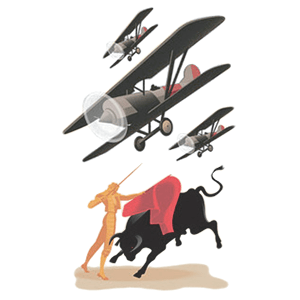
Show, don’t tell is an admonition to fiction writers to write in a manner that allows the reader to experience the story through a character’s action, words, thoughts, senses, and feelings rather than through the narrator’s exposition, summarization, and description. The advice is not to be heavy-handed, or to drown the reader in adjectives, but to allow issues to emerge from the text instead.
The advice applies equally to fiction and nonfiction, but the approach should not be applied to all incidents in the story. According to author James Scott Bell, ‘Sometimes a writer tells as a shortcut, to move quickly to the meaty part of the story or scene. Showing is essentially about making scenes vivid. If you try to do it constantly, the parts that are supposed to stand out won’t, and your readers will get exhausted.’ Continue reading →
Posted in Art, Language |
Leave a Comment »
January 1, 2012

Marbled meat is meat, especially red meat, which contains various amounts of intramuscular fat, giving it an appearance similar to a marble pattern. Marbling can be influenced by selective breeding. Cattle breeds such as Angus, Murray Grey, Shorthorns, and Wagyū type cattle and dairy breeds, such as the Jersey, Holstein-Friesian, and Braunvieh have higher marbling scores on average versus other cattle such as Simmentals, Charolais, or Chianina. Veal has little to no marbling since young cattle develop subcutaneous fat first, kidney, pelvic and heart fat second, intermuscular (between the muscle, or ‘seam fat’) third and then intramuscular fat – ‘marbling’ – last.
Marbling can also be influenced by time on feed and type of feed. The longer a pen of beef cattle are on feed in the feedlot, the higher the chance they will grade higher on quality scores, but will have much lower yield grades (percentage of carcass lean to fat ratio). Feeding a high amount of cereal grains, such as corn or barley, will change the color of the carcass fat from a yellowish to a white, plus increase the chance of obtaining a higher quality grade according to the USDA. But cows evolved to feed on low calorie grasses not energy rich cereal grains and can be made ill by overfeeding.
Posted in Food |
Leave a Comment »
January 1, 2012

Ubiquitous [yoo-bik-wi-tuhs] gaze, also referred to as pursuing eyes, is an art term for the effect created by certain portraits, such as the ‘Mona Lisa,’ which give the impression that the subject’s eyes are following the viewer.
When such a painting is viewed from any angle, the subject’s eyes still appear to be looking straight into the viewer’s. This is an effect of perspective and may be deliberate or not. Ubiquitous gaze is a common technique of the trompe-l’œil school of painting, and can be seen in numerous works.
Posted in Art |
1 Comment »
January 1, 2012

Trompe l’oeil [trawmp loy], French for ‘deceive the eye’, is an art technique involving extremely realistic imagery in order to create the optical illusion that the depicted objects appear in three dimensions. Although the phrase has its origin in the Baroque period, when it refers to perspectival illusionism, use of trompe-l’œil dates back much further. It was (and is) often employed in murals. Instances from Greek and Roman times are known, for instance in Pompeii. A typical trompe-l’œil mural might depict a window, door, or hallway, intended to suggest a larger room.
A version of an oft-told ancient Greek story concerns a contest between two renowned painters. Zeuxis (born around 464 BCE) produced a still life painting so convincing, that birds flew down from the sky to peck at the painted grapes. He then asked his rival, Parrhasius, to pull back a pair of very tattered curtains in order to judge the painting behind them. Parrhasius won the contest, as his painting was of the curtains themselves. Continue reading →
Posted in Art |
Leave a Comment »
January 1, 2012
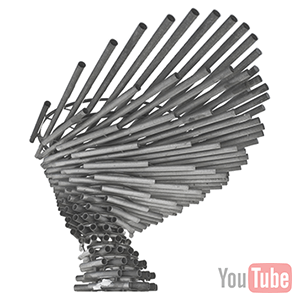
The Singing Ringing Tree is a wind powered sound sculpture resembling a tree set in the landscape of the Pennine mountain range overlooking Burnley, in Lancashire, England. Completed in 2006, it is part of the series of four sculptures within the Panopticons arts and regeneration project created by the East Lancashire Environmental Arts Network (ELEAN). The project was set up to erect a series of 21st-century landmarks, or Panopticons (structures providing a comprehensive view), across East Lancashire as symbols of the renaissance of the area.
Designed by architects Mike Tonkin and Anna Liu of Tonkin Liu, the Singing Ringing Tree is a 3 meter tall construction comprising pipes of galvanised steel which harness the energy of the wind to produce a slightly discordant and penetrating choral sound covering a range of several octaves. Some of the pipes are primarily structural and aesthetic elements, while others have been cut across their width enabling the sound. The harmonic and singing qualities of the tree were produced by tuning the pipes according to their length by adding holes to the underside of each.
Posted in Art, World |
Leave a Comment »
January 1, 2012
Michel Waisvisz [whyz-vizz] (1949 – 2008) was a Dutch composer, performer and inventor of experimental electronic musical instruments. He became the artistic director of STEIM (STudio for Electro Instrumental Music) in Amsterdam from 1981, where he collaborated with musicians and artists from all over the world. His involvement with STEIM goes back until 1969, when it had been co-founded by his mentor and friend Dick Raaymakers.
Waisvisz had a passionate dedication to a physical, bodily approach to electronic music which he has expressed in the use and presentation of his many developments of hardware and software instruments. From his point of view electronic music is created in direct musical interaction with individual technology, allowing for instant travels into sound through improvisation.
Posted in Art, Technology |
Leave a Comment »
January 1, 2012

STEIM (STudio for Electro Instrumental Music) is a center for research and development of new musical instruments in the electronic performing arts, located in Amsterdam. Electronic music in STEIM’s context is always strongly related to the physical and direct actions of a musician. In this tradition, STEIM supports artists in residence such as composers and performers, but also multimedia and video artists to develop setups which allow for improvisation and performance with individually designed technology. STEIM was founded in 1969 by a s group of Dutch composers seeking the reformation of Amsterdam’s feudal music structures; they enforced the first public fundings for experimental and improvised electronic music in Holland. Its premises include three studios, a concert hall, hardware and software workshops, offices, and a guesthouse for artists in residence.
For most of STEIM’s instrumental developments ‘Touch is crucial in communicating with the new electronic performance art technologies.’ As with traditional musical instruments, the physical touch of a musician contains essential aesthetic factors. These qualities tend to get lost in the non-realtime use of studio technology, in which the process of music production is distant and abstract. The Touch philosophy — which can be considered as STEIM’s interpretation of the widely used term interactivity — theoretically subsumes several stages of STEIM’s developments, from the analog touchable ‘Crackle’ surfaces in the 70s to today’s experimental Gestural MIDI Interfaces.
Posted in Art, Technology, World |
Leave a Comment »
January 1, 2012
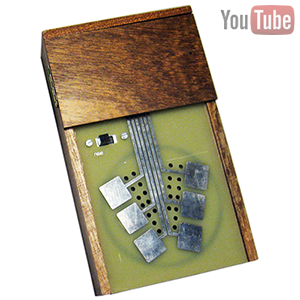
The Kraakdoos (or Cracklebox) is a custom made battery-powered noise-making device. It is a small box with six metal contacts on top, which when pressed by fingers generate all manner of unusual sounds and tones. The human body becomes a part of the circuit and determines the range of sounds possible — different people will generate different results.
The concept was first conceived by Michel Waisvisz and Geert Hamelberg in the 1960s, and developed further in the 1970s when Waisvisz joined STEIM (STudio for Electro Instrumental Music) in Amsterdam. The kraakdoos is a simple device, based around a single operational amplifier (one of the earliest models to be produced) and a few transistors, and can be easily constructed by someone with a basic understanding of electronics.
Posted in Art, Technology |
Leave a Comment »
December 31, 2011

Poverty pimp is a pejorative label used to convey that an individual or group is benefiting unduly by acting as an intermediary on behalf of the poor, the disadvantaged, or some other ‘victimized’ groups. Those who use this appellation suggest that those so labeled profit unduly from the misfortune of others, and therefore do not really wish the societal problems that they appear to work on to be eliminated permanently, as it is not in their own interest for this to happen.
The most frequent targets of this accusation are those receiving government funding or that solicit private charity to work on issues on behalf of various disadvantaged individuals or groups, but who never seem to be able to show any amelioration of the problems experienced by their target population. Some even suggest that that if profit were eliminated as a factor, greater steps in the alleviation of the oppressive situations could begin to truly occur.
Posted in Money, Politics |
Leave a Comment »
December 31, 2011

A welfare queen is a pejorative phrase used in the United States to describe people who are accused of collecting excessive welfare payments through fraud or manipulation. Reporting on welfare fraud began during the early 1960s, appearing in general interest magazines such as ‘Readers Digest.’
The term entered the American lexicon during Ronald Reagan’s 1976 presidential campaign when he described a ‘welfare queen’ from Chicago’s South Side. Since then, it has become a stigmatizing label placed on recidivist poor mothers, with studies showing that it often carries gendered and racial connotations. Although American women can no longer stay on welfare indefinitely due to the Personal Responsibility and Work Opportunity Act, the term continues to shape American dialogue on poverty.
Continue reading →
Posted in Language, Money, Politics |
Leave a Comment »
December 31, 2011

Some governments around the world have passed measures to phase out incandescent light bulbs for general lighting. The aim is to encourage the use and technological development of more energy-efficient lighting alternatives, such as compact fluorescent lamp (CFLs) and LED lamps. Brazil and Venezuela started to phase them out in 2005, and the European Union, Switzerland, and Australia started to phase them out in 2009. Likewise, other nations are planning scheduled phase-outs: Argentina, Russia, and Canada in 2012, and the United States and Malaysia in 2014.
There has been consumer resistance to phasing out of incandescent lamps, preferring the quality of light produced from incandescents, the libertarian political theory of free markets as trumping ‘national interest’ as a reason for regulation, and environmental concerns about mercury contamination with CFLs. Formerly, instant availability of light was an issue for CFLs, but newer CFLs have an Instant On feature, as well as a wide variety of correlated color temperatures. CFLs and LEDs labeled for dimmer control are also becoming available, although typically at higher cost. The phase out has been referred to as ‘light bulb socialism.’ The consumer preference for light bulbs in the EU is for incandescent bulbs, with many complaining about what was described as the ugliness or the cold, flat, unnatural, dull light emanating from CFLs. Bulk purchasing of incandescent bulbs was reported ahead of the EU lightbulb ban.
Posted in Politics, Technology, World |
Leave a Comment »
December 31, 2011


‘The White Negro: Superficial Reflections on the Hipster’ is a 9,000 word essay by Norman Mailer that recorded a number of young white people in the 1920s, 1930s and 1940s who liked jazz and swing music so much that they adopted black culture as their own.
It was first published in the Summer 1957 issue of ‘Dissent,’ before being published separately by ‘City Lights.’ The so-called white negroes adopted black clothing styles, black jive language, and black music. They mainly associated with black people, distancing themselves from white society. Continue reading →
Posted in Language, Politics |
1 Comment »



