December 25, 2011
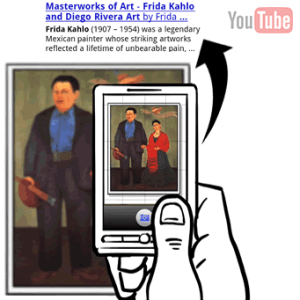
Google Goggles is an image recognition application used for searches based on pictures taken by handheld devices. The program proposed will be able to identify virtually anything. Currently the system can identify various labels or landmarks, allowing users to learn about such items without needing a text-based search. The system can identify products barcodes or labels that allow users to search for similar products and prices, and save codes for future reference, similar to the failed CueCat of the late ’90s, but with more functionality. The system will also recognize printed text and using optical character recognition (OCR) produce a text snippet, and in some cases even translate the snippet into another language.
Google is currently working to make the system able to recognize different plants and leaves, which can aid curious persons, those wishing to avoid toxic plants, and botanists and environmentalists searching for rare plants. Goggle applications are in the process of being used for metaverse virtual world image indexing and catalog applications. Regional coordinates are cammed by avatar-based movement in virtual camera scripted vehicles. In 2011, version 1.3 was released; it can solve Sudoku puzzles.
Posted in Technology |
Leave a Comment »
December 24, 2011


Word Lens is an augmented reality translation application for the iPhone from Quest Visual. It uses the built-in phone camera to identify text, such as a sign or a menu, in one language and have the words shown translated into another language. The words are displayed in the original context, on the original background, without connection to the internet. When it was released in 2010 only English and Spanish were supported. Word Lens is best used on clearly printed text and was not designed to translate handwritten or stylized fonts.
This application was created to help tourists understand signs and menus. The application was not designed to read books, but journalist Ben Rooney managed to understand a page from ‘Harry Potter y el Prisionero de Azkaban.’ The Google Goggles application for Android and iPhone also has the capability to translate text or identify objects in an image, but it requires users to take a picture with their phones, and an active internet connection. Word Lens does it on the fly, meaning it’s interpreting frames in video, almost in real time.
Posted in Language, Technology, World |
Leave a Comment »
December 23, 2011


The Schreiber theory is a writer-centered approach to film criticism which holds that the principal author of a film is generally the screenwriter rather than the director. The term was coined by David Kipen, Director of Literature at the US National Endowment for the Arts. In his 2006 book ‘The Schreiber Theory: A Radical Rewrite of American Film History,’ Kipen argues that the influential 1950s-era Auteur theory has wrongly skewed analysis towards a director-centered view of film. In contrast, Kipen believes that the screenwriter has a greater influence on the quality of a finished work and that knowing who wrote a film is ‘the surest predictor’ of how good it will be.
Kipen acknowledges that his writer-centered approach is not new, and pays tribute to earlier critics of Auteur theory such as Pauline Kael and Richard Corliss. He believes that the Auteurist approach remains dominant, however, and that films have suffered as a result of the screenwriter’s role being undervalued. Kipen refers to his book as a ‘manifesto’ and in an interview with the magazine ‘SF360’ stated that he wished to use Schreiber theory as ‘a lever to change the way people think about screenwriting, and movies in general.’ In seeking a name for his theory, Kipen chose the Yiddish word for writer – ‘schreiber’ – in honor of the many early American screenwriters who had Yiddish as their mother tongue.
Posted in Art, Language, Money |
1 Comment »
December 23, 2011

In film criticism, auteur theory holds that a director’s film reflects the director’s personal creative vision, as if they were the primary ‘auteur’ (the French word for ‘author’). In spite of—and sometimes even because of—the production of the film as part of an industrial process, the auteur’s creative voice is distinct enough to shine through all kinds of studio interference and through the collective process.
In law, the film is treated as a work of art, and the auteur, as the creator of the film, is the original copyright holder. Under European Union law, the film director is considered the author or one of the authors of a film, largely as a result of the influence of auteur theory. Continue reading →
Posted in Art, Language, Money |
2 Comments »
December 23, 2011
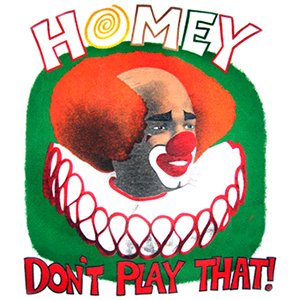
In Living Color was an American sketch comedy television series, which ran on the Fox Network from 1990 to 1994. Brothers Keenen and Damon Wayans created, wrote, and starred in the program. The show was produced by Ivory Way Productions. The show was taped before a live studio audience in Hollywood.
The title of the series was inspired by the NBC announcement of broadcasts being presented ‘in living color’ during the 1950s and 1960s, prior to popularization of color television. It also refers to the fact that most of the show’s cast was African-American, unlike other sketches comedy shows like ‘Saturday Night Live’ whose casts are usually mostly white. Continue reading →
Posted in Art, Humor |
Leave a Comment »
December 23, 2011
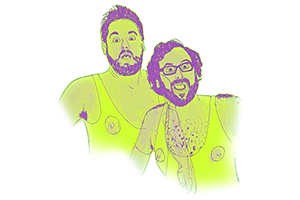

Tim and Eric Awesome Show, Great Job! is an American sketch comedy television series, created by and starring Tim Heidecker and Eric Wareheim, which premiered in 2007 on Cartoon Network’s ‘Adult Swim’ and ran until 2010. The program features surrealistic and often satirical humor (at points anti-humor), public-access television-style musical acts, bizarre faux-commercials, and editing and special effects chosen to make the show appear camp. The program has featured a wide range of actors such as Will Ferrell, John C. Reilly and Zach Galifianakis, as well as alternative comedians like Neil Hamburger, and television actors like Alan Thicke, celebrity look-alikes and impressionists.
The creators of the show have described it as ‘the nightmare version of television.’ The show expands the genre of the live-action material featured in Heidecker and Wareheim’s previous show ‘Tom Goes to the Mayor,’ such as Gibbons, the ‘Channel 5 Married News Team,’ and the Cinco Corporation with its variety of inefficient and tasteless products. New recurring characters and sketches include ‘Uncle Muscles Hour,’ a Public-access television variety program hosted by a gravelly-voiced ‘Weird Al’ Yankovic and Channel 5 News Correspondent Dr. Steve Brule, played by John C. Reilly.
Posted in Art, Humor |
1 Comment »
December 23, 2011

The Radium Girls were female factory workers who contracted radiation poisoning from painting watch dials with glow-in-the-dark paint at the United States Radium factory in Orange, New Jersey around 1917.
The women, who had been told the paint was harmless, ingested deadly amounts of radium by licking their paintbrushes to sharpen them. Some also painted their fingernails and teeth with the glowing substance. Five of the women challenged their employer in a court case that established the right of individual workers who contract occupational diseases to sue their employers. Continue reading →
Posted in Death, Money, Politics |
1 Comment »
December 23, 2011
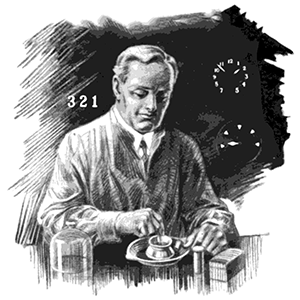
Undark was a trade name for luminous paint made with a mixture of radioactive radium and zinc sulfide, as produced by the U.S. Radium Corporation between 1917 and 1938. It was used primarily in watch dials.
The people working in the industry who applied the radioactive paint became known as the Radium Girls, because many of them became ill and some died from exposure to the radiation emitted by the radium contained within the product. The product was the direct cause of Radium jaw in the dial painters. Undark was also available as a kit for general consumer use and marketed as glow-in-the-dark paint.
Posted in Health, Money, Technology |
Leave a Comment »
December 23, 2011

Market failure occurs in economics when the allocation of goods and services by a free market is not efficient. In such cases the pursuit of pure self-interest leads to results that can be improved upon from the societal point-of-view. The first known use of the term by economists was in 1958, but the concept has been traced back to the Victorian philosopher Henry Sidgwick.
A market failure can occur for three main reasons: if the market is monopolized (a small group of businesses hold significant market power), if production of the good or service results in an externality (a cost or benefit that affects an unaffiliated third party), or if the good or service is a ‘public good’ (a non-excludable good like air). Continue reading →
Posted in Money, Politics |
Leave a Comment »
December 21, 2011

Aaron Koblin is an American digital media artist best known for his innovative uses of data visualization and crowdsourcing. He is currently Creative Director of the Data Arts Team at Google Creative Lab in San Francisco.
Koblin’s projects have been shown at international festivals including Ars Electronica, TED, and are part of the permanent collections at the Museum of Modern Art (MoMA) in New York and the Centre Georges Pompidou in Paris.
Posted in Art, Technology |
1 Comment »
December 21, 2011

A digital native is a person who was born during or after the general introduction of digital technology, and through interacting with digital technology from an early age, has a greater understanding of its concepts.
Alternatively, this term can describe people born in the latter 1960s or later, as the Digital Age began at that time; but in most cases the term focuses on people who grew up with the technology that became prevalent in the latter part of the 20th century, and continues to evolve today. Continue reading →
Posted in Language, Technology |
2 Comments »
December 21, 2011

net.art refers to a group of artists who have worked in the medium of Internet art from 1994 on. The main members of this movement are Vuk Ćosić, Jodi.org, Alexei Shulgin, Olia Lialina, and Heath Bunting. Although this group was formed as a parody of avant garde movements by writers such as Tilman Baumgärtel, Josephine Bosma, Hans Dieter Huber and Pit Schultz, their individual works have little in common.
The term ‘net.art’ is also used as a synonym for net art or Internet art and covers a much wider range of artistic practices. In this wider definition, net.art means art that uses the Internet as its medium and that cannot be experienced in any other way. Often net.art has the Internet as (part of) its subject matter but it is not a requirement.
Continue reading →
Posted in Art, Politics, Technology |
Leave a Comment »



