December 13, 2011

The Fools Guild is a Los Angeles organization themed around the medieval and renaissance idea of the Court jester. It’s central activity is producing three annual parties on Halloween, New Year’s Eve, and April Fool’s Day.
The Guild was born in 1979 at the Renaissance Pleasure Faire of Southern California, where the original improvisational team met while performing as jesters, jugglers, pass-the-hat-acts, and mimes. In 1982 they moved to West Hollywood, renting a house with a giant main room and very high ceilings, where the Fools began to host parties, workshops and other performance-centered events. Very quickly a social club of comedic performers evolved and the house became known as the Guild Hall. Continue reading →
Posted in Humor, Language |
Leave a Comment »
December 13, 2011
The Cacophony Society is ‘a randomly gathered network of free spirits united in the pursuit of experiences beyond the pale of mainstream society.’ It was started in 1986 by surviving members of the now defunct Suicide Club of San Francisco, a secret society devoted to urban exploration and anarchic pranks. Cacophony has been described as an indirect culture jamming outgrowth of the Dada movement, and the Situationists. One of its central concepts is the ‘Trip to the Zone,’ inspired by the 1979 Film ‘Stalker’ by Andrey Tarkovskiy.
According to self-designated members of the Society, ‘you may already be a member.’ The anarchic nature of the Society means that membership is left open-ended and anyone may sponsor an event, though not every idea pitched garners attendance by members. Cacophony events often involve costumes and pranks in public places and sometimes going into places that are off limits to the public. Cacophonists have been known to regale Christmas shoppers with improved Christmas carols while dressed as Santa Claus, and later invite strippers to sit on Santa’s lap at their annual SantaCon event.
Continue reading →
Posted in Games, Humor |
1 Comment »
December 13, 2011
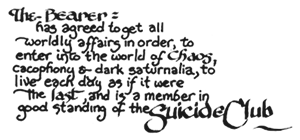

The Suicide Club was a secret society in San Francisco credited as the first modern extreme urban exploration (urbex) society, and also known for anarchic group pranks. The club was founded by Gary Warne in 1977 as a course he taught at the ‘Communiversity’ in San Francisco, part of the Free School Movement, and it lasted until shortly before Warne’s death in 1983.
Events generally started and ended in Warne’s used paperback bookstore, Circus of the Soul. The name of the Suicide Club was inspired by three stories written by Robert Louis Stevenson, where men who want to die belong to a club, where each evening one of them is randomly selected for death. The name belied the gentle albeit zany nature of its members, who had a predilection towards light-hearted practical jokes. Continue reading →
Posted in Games, Humor |
Leave a Comment »
December 13, 2011

SantaCon is a mass gathering of people dressed in Santa Claus costumes parading publicly on streets and in bars in cities around the world. The focus is on spontaneity and creativity, while having a good time and spreading cheer and goodwill. Sometimes known as Naughty Santas, Cheapsuit Santas, Santarchy, Santapalooza, and Santa Rampage, SantaCon incorporates elements of a flash mob in the context of cheerful bawdy and harmless behavior, the singing of naughty Christmas carols, and the giving of small gifts to strangers. In 2005, a more violent version of the event occurred when participants in New Zealand rioted, looting stores, throwing bottles at passing cars, and assaulting security guards.
In 1994, the Suicide Club (a secret society in San Francisco credited as the first modern extreme urban exploration society, and also known for anarchic group pranks) staged the first ‘Santarchy,’ which was later adopted as Santacon by offshoot the Cacophony Society (a randomly gathered network of free spirits united in the pursuit of experiences beyond the pale of mainstream society). Influenced by the surrealist movement, Discordianism, and other subversive art currents, the Cacophonists celebrated the Yule season in a distinctly anti-commercial manner, by mixing guerrilla street theater and pranksterism.
Posted in Games, Humor, Philosophy |
Leave a Comment »
December 12, 2011

The Copyright Term Extension Act (CTEA) of 1998 extended copyright terms in the United States by 20 years. Since the Copyright Act of 1976, copyright would last for the life of the author plus 50 years, or 75 years for a work of corporate authorship. The Act extended these terms to life of the author plus 70 years and for works of corporate authorship to 120 years after creation or 95 years after publication, whichever endpoint is earlier. Copyright protection for works published prior to 1978, was increased by 20 years to a total of 95 years from their publication date.
This law, also known as the Sonny Bono Act, or as the Mickey Mouse Protection Act, effectively ‘froze’ the advancement date of the public domain in the United States for works covered by the older fixed term copyright rules. Under this Act, additional works made in 1923 or afterwards that were still protected by copyright in 1998 will not enter the public domain until 2019 or afterward (depending on the date of the product) unless the owner of the copyright releases them into the public domain prior to that or if the copyright gets extended again. Unlike copyright extension legislation in the European Union, the Sonny Bono Act did not revive copyrights that had already expired.
Continue reading →
Posted in Money, Politics |
Leave a Comment »
December 12, 2011


Internet in a suitcase is a program reportedly developed or spearheaded by the U.S. Department of State to provide Internet and mobile phone service to dissidents that can bypass government censorship or shut down of telecommunications in countries such as the Islamic Republic of Iran, Syria and Libya. The plan reportedly involves utilizing common hardware components ‘into a package that could easily’ be smuggled ‘into a repressive country and quickly assembled to deliver wireless service across a wide area to maintain crucial communications between legitimately protesting citizens.’
Part of the operation includes a prototype ‘Internet in a suitcase’ being developed by a ‘group of young entrepreneurs’ led by Sascha Meinrath of the New America Foundation, a public policy think tank. Other projects employ tools ‘that have already been created by hackers in a so-called liberation-technology movement sweeping the globe,’ and stealth wireless networks.
Posted in Politics, Technology, World |
Leave a Comment »
December 12, 2011

The Stop Online Piracy Act (SOPA), also known as H.R.3261 was a proposed American law to stop copyright infringement on the Internet. The Internet community had major discussion over it, but the bill was not passed. The supporters claimed that current copyright laws are not effective in shutting down piracy websites. The opponents argued the law amounted to a broad censorship tool over the internet.
In protest, several major sites went dark on January 18, 2012. News aggregator site Reddit blocked access first and then others joined the movement. Wikipedia masked most of its pages with a banner to spotlight the value of open access to information on the Internet. Google put up a black censor board in front of its logo.
Posted in Money, Politics, Technology |
Leave a Comment »
December 12, 2011

The term First World Problems refers to issues perceived as difficult to those residing in the more developed nations in the global arena (i.e., the First World), but which are banal when compared to the difficulties encountered by those in the less developed Third World. First World Problems is often used in a derisive manner towards those who complain about the problems they experience in the ‘First World’ on a regular basis. However, it is also routinely used by scholars and economists in studying the relationship between the Third World and the First World.
The exact provenance of the term is uncertain, although some believe that it originated with comedic author David Rakoff, whose 2005 book ‘Don’t Get Too Comfortable’ is subtitled ‘The Indignities of Coach Class, the Torments of Low Thread Count, the Never-Ending Quest for Artisanal Olive Oil, and Other First World Problems.’ Many computer games, notably, provide a fascinating degree of First World escapism via a simulation of Third World Problems. For example, the infamous 1980s ASCII-based dungeon crawler ‘Rogue’ provided those First World denizens who had overcome the First World Problem of not owning a computer to experience such Third World Problems as starvation, existential ennui, and life-or-death hand-to-hand combat.
Posted in Money, Politics, World |
Leave a Comment »
December 11, 2011

Modesty Blaise is a British comic strip featuring a fictional character of the same name, created by Peter O’Donnell (writer) and Jim Holdaway (art) in 1963.
The strip follows the adventures of Modesty Blaise, an exceptional young woman with many talents and a criminal past, and her trusty sidekick Willie Garvin. It was adapted into films made in 1966, 1982, and 2003 and a series of 13 novels and short story collections, beginning in 1965.
Continue reading →
Posted in Art, Language |
Leave a Comment »
December 11, 2011

Stieg Larsson (1954 – 2004) was a Swedish journalist and writer, best known for his ‘Millennium series’ of crime novels, which were published posthumously.
Larsson lived and worked much of his life in Stockholm, in the field of journalism and as an independent researcher of right-wing extremism.
Continue reading →
Posted in Art, Language, Politics |
Leave a Comment »
December 11, 2011

The Millennium series (1954 – 2004) is a series of bestselling novels originally written in Swedish by the late Stieg Larsson. The primary characters in the series are Lisbeth Salander, an intelligent, eccentric woman in her twenties with a photographic memory and poor social skills, and Mikael Blomkvist, an investigative journalist and editor of a magazine called ‘Millennium.’ Blomkvist, the character, has a history similar to Larsson, the author.
There are three books in the series: ‘The Girl with the Dragon Tattoo,’ ‘The Girl Who Played with Fire,’ and ‘The Girl Who Kicked the Hornets’ Nest.’ When he died suddenly of a heart attack in 2004, Larsson left behind manuscripts of the completed but unpublished novels written as a series. He had written them for his own pleasure after returning home from his job in the evening, and had made no attempt to get them published until shortly before his death. Continue reading →
Posted in Art, Language |
Leave a Comment »
December 8, 2011

Personalized medicine is a medical model emphasizing the customization of healthcare, with all decisions and practices tailored to individual patients. Recently, this has mainly involved the systematic use of genetic or other information about an individual patient to select or optimize preventative and therapeutic care. Over the past century, medical care has centered on standards of care based on epidemiological studies of large cohorts. However, large cohort studies have previously been unable take into account the genetic variability of individuals within a population. Personalized medicine seeks to provide an objective basis for consideration of such individual differences. Traditionally, personalized medicine has been limited to the consideration of a patient’s family history, social circumstances, environment and behaviors.
Since the late 1990s, the advent of research using biobanks (cryogenic storage facilities that archive biological samples) has brought advances in a number of molecular profiling technologies including proteomic profiling, metabolomic analysis, genetic testing, and molecular medicine. Since about 2007 the term Stratified medicine has been used for the current approach.
Posted in Health, Technology |
Leave a Comment »



