November 10, 2011
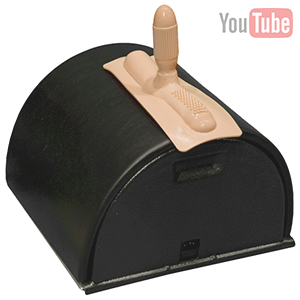
A Sybian is a masturbation device designed for use by females, developed by dance instructor Dave Lampert in the 1980s. It consists of a saddle-like seat containing an electric motor connected to a rod that protrudes from a hole in the center. Various attachments can be added to the rod, which vibrates, rotates and may also stimulate the clitoris externally. The intensity of the movements produced can be increased or decreased through a control box attached to the Sybian’s base. Lampert and his team initially called the device Master Better, shortened to ‘MB’ for about four years before selecting a new name for it. The prefix syb was derived from Sybaris, an Ancient Greek city in southern Italy which was associated with luxurious living.
Generally, the user of the Sybian straddles the machine and inserts the attachment vaginally. The vibration and rotation can be controlled by separate on/off switches and two rotary controls. The Sybian is sold with up to four phallus-shaped washable attachments of varying sizes made from synthetic rubber. Although the Sybian has been featured in many pornographic video productions since the early 2000s, primarily on the Internet, the device came to prominence on The Howard Stern Show since the show’s arrival on Sirius Satellite Radio. Howard Stern was given a Sybian as a birthday gift in 2006 and it remains in the Stern studio for use by willing guests.
Posted in Sex, Technology |
1 Comment »
November 10, 2011

A sex machine, also known as a fucking machine, is a mechanical device used to simulate human sexual intercourse. It is a more sophisticated version of the vibrator. These devices may be associated with, but are not limited to, BDSM play. Devices can be penetrative or extractive. A typical penetrative machine works by the transfer of rotational or reciprocating force from a motor to a directional motion on a shaft, which is tipped by a dildo. A hand-held modified reciprocating saw device is sometimes called a ‘fucksaw’ and a hand-held modified drill motor rotating device is sometimes called a ‘drilldo.’ An extractive device works like a milking machine and can be attached to the penis, breast, or other body part.
Modern automated erotic stimulation device differ from vibrators because they penetrate as well as throb. Mass attention is drawn to them on the Internet, while appetite for these powerful appliances has induced the establishment and growth of manufacturers to satisfy rising demand. Recently a new generation of these devices has hit the market under the name teledildonics. These devices are sometimes used as part of auto-erotic or partnered bondage play. Today the sex machines on the market include vacuum pumps, instruments that deliver calibrated electrical shocks to the nipples and genitals, and lifesize inflatable male and female dolls with penetrable and vibrating orifices.
Posted in Sex, Technology |
Leave a Comment »
November 10, 2011
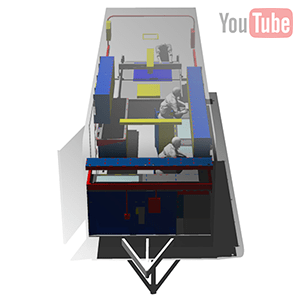
The mobile fab lab is a computer-controlled design and machining shop housed in a trailer. The first was built in 2007 by the Center for Bits and Atoms at the Massachusetts Institute of Technology. The mobile lab includes the same computer controlled fabrication machines found in fab labs world-wide. The fab lab trailer is 32′ long, 8′ wide, and 7′ high. The tailgate opens to add a 6′ deck at the back of the trailer. To run all the equipment in the lab at once (including AC and overhead lights) is about 20 kW.
This lab contains custom cabinetry which is example of a lab producing a part of another lab. The cabinetry was CAD-designed and fabricated on a CNC wood router similar to the wood router in the trailer. The router in the trailer is capable of making another set of cabinets. Two graffiti artists from the South Bronx were invited to design and paint the sides and top of the trailer in two weekends. It is now loaned to organizations for months or longer, typically to help create a permanent lab in that location.
Posted in Technology |
Leave a Comment »
November 10, 2011
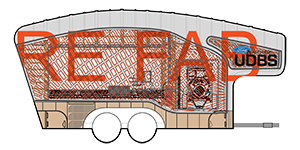

A Fab Lab (fabrication laboratory) is a small-scale workshop offering (personal) digital fabrication generally equipped with an array of flexible computer controlled tools that cover several different length scales and various materials, with the aim to make ‘almost anything.’ This includes technology-enabled products generally perceived as limited to mass production. While Fab Labs have yet to compete with mass production and its associated economies of scale in fabricating widely distributed products, they have already shown the potential to empower individuals to create smart devices for themselves. These devices can be tailored to local or personal needs in ways that are not practical or economical using mass production.
The fab lab program was started in the Media Lab at MIT, a collaboration between the Grassroots Invention Group and the Center for Bits and Atoms (CBA) at the Massachusetts Institute of Technology, broadly exploring how the content of information relates to its physical representation, and how a community can be powered by technology at the grassroots level. While the Grassroots Invention Group is no longer in the Media Lab, The Center for Bits and Atoms consortium is still actively involved in continuing research in areas related to description and fabrication but does not operate or maintain any of the labs worldwide (with the exception of the mobile fab lab). The fab lab concept also grew out of a popular class at MIT named ‘How To Make (Almost) Anything.’
Posted in Technology |
Leave a Comment »
November 10, 2011

Artificial scarcity describes the scarcity of items even though the technology and production capacity exists to create an abundance. The term is aptly applied to non-rival resources, i.e. those that do not diminish due to one person’s use, although there are other resources which could be categorized as artificially scarce. The most common causes are monopoly pricing structures, such as those enabled by intellectual property rights or by high fixed costs in a particular marketplace. The inefficiency associated with artificial scarcity is formally known as a deadweight loss.
An example of artificial scarcity is often used when describing proprietary, or closed-source, computer software. Any software application can be easily duplicated billions of times over for a relatively cheap production price (an initial investment in a computer, an internet connection, and any power consumption costs; and these are already fixed costs in most environments). On the margin, the price of copying software is next to nothing, costing only a small amount of power and a fraction of a second. Things like serial numbers, license agreements, and intellectual property create artificial scarcity, and give monetary value to otherwise free copies. Technocrats argue that if the price system were removed, there would be no personal incentive to artificially create scarcity in products, and thus something similar to the open source model of distribution would dominate.
Continue reading →
Posted in Money, Politics, Technology |
Leave a Comment »
November 10, 2011

Post scarcity is a hypothetical form of economy or society, in which things such as goods, services and information are free, or practically free. This would be due to an abundance of fundamental resources (matter, energy and intelligence), in conjunction with sophisticated automated systems capable of converting raw materials into finished goods, allowing manufacturing to be as easy as duplicating software.
Scarcity is the fundamental economic problem of having seemingly unlimited human needs and wants, in a world of limited resources. It states that society has insufficient productive resources to fulfill all human wants and needs. Alternatively, scarcity implies that not all of society’s goals can be pursued at the same time; trade-offs are made of one good against others. As such, the term post-scarcity economics may be somewhat paradoxical. To quote a 1932 essay by Lionel Robbins, economics is ‘the science which studies human behavior as a relationship between ends and scarce means which have alternative uses.’
Continue reading →
Posted in Money, Politics, Technology |
Leave a Comment »
November 10, 2011


A vanity label (related to the term ‘vanity press’) is an informal name given to a record label founded as a wholly or partially owned subsidiary of another, larger and better established (at least at the time of the vanity label’s founding) record label, where the subsidiary label is (at least nominally) controlled by a successful recording artist, designed to allow this artist to release music by other artists he or she admires. The parent label handles the production and distribution and funding of the vanity label, but the album is usually released with the vanity label brand name prominent. Usually, the artist/head of the vanity label is signed to the parent label, and this artist’s own recordings will be released under the vanity label’s brand name.
Creating a vanity label can be an attractive idea for the parent label primarily as a ‘perk’ to keep a successful artist on the label’s roster happy, providing an ego boost and a venue to bring fellow artists to the public’s attention. The parent label also hopes that the vanity label’s association with the famous artist will entice that artist’s audience to purchase other records on the vanity label, although only a relatively small number of new artists introduced by vanity labels have gone on to become major successes in their own right.
Posted in Art, Money |
Leave a Comment »
November 10, 2011
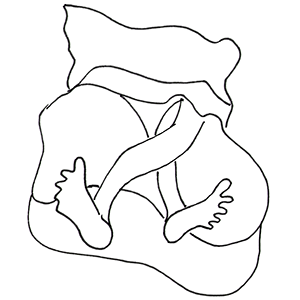
Restless legs syndrome (RLS) or Willis-Ekbom disease is a neurological disorder characterized by an irresistible urge to move one’s body to stop uncomfortable or odd sensations. It most commonly affects the legs, but can affect the arms, torso, and even phantom limbs. Moving the affected body part modulates the sensations, providing temporary relief. RLS sensations can most closely be compared to an itching or tickling in the muscles, like ‘an itch you can’t scratch’ or an unpleasant ‘tickle that won’t stop.’ The sensations typically begin or intensify during quiet wakefulness, such as when relaxing, reading, studying, or trying to sleep.
As with many diseases with diffuse symptoms, there is controversy among physicians as to whether RLS is a distinct syndrome. The U.S. National Institute of Neurological Disorders and Stroke publishes an information sheet characterizing the syndrome but acknowledging it as a difficult diagnosis. Physicians generally consider it a real entity that has specific diagnostic criteria., but many doctors express the view that the incidence of restless leg syndrome is exaggerated by manufacturers of drugs used to treat it. Others believe it is an underrecognized and undertreated disorder.
Posted in Drugs, Health, Money |
Leave a Comment »
November 10, 2011

In popular usage, eccentricity [ek-suhn-tris-i-tee] (also called quirkiness or kookiness) refers to unusual or odd behavior on the part of an individual. This behavior would typically be perceived as unusual or unnecessary, without being demonstrably maladaptive. Eccentricity is contrasted with ‘normal’ behavior, the nearly universal means by which individuals in society solve given problems and pursue certain priorities in everyday life. People who consistently display benignly eccentric behavior are labeled as ‘eccentrics.’
Derived from Greek ekkentros, ‘out of the center,’ the word ‘eccentric’ first appeared in English in 1551 as an astronomical term meaning ‘a circle in which the earth, sun, etc. deviates from its center.’ Five years later, in 1556, an adjective form of the word was added. 129 years later, in 1685, the definition evolved from the literal to the figurative, and eccentric began being used to describe unconventional or odd behavior. A noun form of the word – a person who possesses and exhibits these unconventional or odd qualities/behaviors – didn’t appear until 1832.
Continue reading →
Posted in Health, Language, Money |
1 Comment »
November 10, 2011
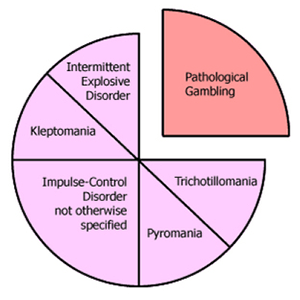
Impulse control disorder is a set of psychiatric disorders including intermittent explosive disorder, kleptomania, pathological gambling, pyromania (fire-starting), and three body-focused repetitive or compulsive behaviors (trichotillomania, a compulsion to pull one’s hair out; onychophagia, compulsive nail biting; and dermatillomania, compulsive skin picking). The onset of these disorders usually occurs between the ages of 7 and 15. Impulsivity, the key feature of these disorders, can be thought of as seeking a small, short term gain at the expense of a large, long term loss. Those with the disorder repeatedly demonstrate failure to resist their behavioral impetuosity.
Considered to be part of the obsessive-compulsive disorder spectrum, impulse control disorders are often associated with substance use disorders because ‘it has been speculated that these disorders are mediated by alterations of partially overlapping neural circuits.’ Impulse control disorders have two treatment options: psychosocial and pharmacological. Treatment methodology is informed by the presence of comorbid conditions.
Posted in Health |
Leave a Comment »
November 10, 2011

Compulsive hoarding (or disposophobia) is the acquisition of possessions (and failure to use or discard them) in excess of socially normative amounts, even if the items are worthless, hazardous, or unsanitary. Compulsive hoarding may impair mobility and interfere with basic activities, including cooking, cleaning, hygiene, sanitation, bathroom use and sleeping. It is not clear whether compulsive hoarding is an isolated disorder, or rather a symptom of another condition, such as obsessive-compulsive disorder.
While there is no clear definition of compulsive hoarding in accepted diagnostic criteria (such as the current DSM), there are several defining features: the acquisition of, and failure to discard, a large number of possessions that appear to be useless or of limited value; living spaces sufficiently cluttered so as to preclude activities for which those spaces were designed; significant distress or impairment in functioning caused by the hoarding; and reluctance or inability to return borrowed items; as boundaries blur, impulsive acquisitiveness could sometimes lead to stealing or kleptomania.
Continue reading →
Posted in Health, Money |
2 Comments »
November 9, 2011

The Mozart effect can refer to: A set of research results that indicate that listening to Mozart’s music may induce a short-term improvement on the performance of certain kinds of mental tasks known as spatial-temporal reasoning; popularized versions of the theory, which suggest that ‘listening to Mozart makes you smarter, or that early childhood exposure to classical music has a beneficial effect on mental development. The term was first coined by Alfred A. Tomatis who used Mozart’s music as the listening stimulus in his work attempting to cure a variety of disorders.
The approach has been popularized in a book by Don Campbell, and is based on an experiment published in ‘Nature’ suggesting that listening to Mozart temporarily boosted scores on one portion of the IQ test. As a result, the Governor of Georgia, Zell Miller, proposed a budget to provide every child born in Georgia with a CD of classical music. Subsequent studies have had limited success duplicating the Mozart effect, and its validity is debated.
Posted in Art, Education, Health |
Leave a Comment »



