September 13, 2011

Steatopygia [stee-at-uh-pahy-jee-uh] is a high degree of fat accumulation in and around the buttocks. The deposit of fat is not confined to the gluteal regions, but extends to the outside and front of the thighs, forming a thick layer reaching sometimes to the knee. This development constitutes a genetic characteristic of the Khoisan, an African ethnic group, where it is regarded as a sign of feminine beauty: it begins in infancy and is fully developed by the time of the first pregnancy. It is often accompanied by the formation known as elongated labia (labia minora that may extend as much as 4 inches outside the vulva). This was historically known as the ‘hottentot apron’ — now deemed a very offensive term.
It has been suggested that this feature was once more widespread. Paleolithic Venus figurines, sometimes referred to as ‘steatopygian Venus’ figures, discovered from Europe to Siberia and presenting a remarkable development of the thighs, and even the prolongation of the labia minora, have been used to support this theory. Whether these were intended to be lifelike or exaggeratory, even idealistic, is unclear. However, these figures do not strictly qualify as steatopygian, since they exhibit an angle of approximately 120 degrees between the back and the buttocks, while steatopygia is diagnosed at an angle of about 90 degrees only.
Posted in Health, Sex, World |
Leave a Comment »
September 13, 2011

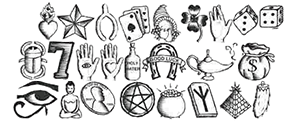
Apotropaic [ap-uh-truh-pey-ik] magic is the use of rituals to ward off harmful influences like the ‘evil eye’ or invidia (jealous or hostile gazes). This can be a long ritual, or it can take the form of simply wearing an amulet or other token, against bad luck, or gestures such as fingers crossed or knocking on wood. When faced with a bad omen the Greeks made offerings to the Averting Gods, underworld deities and heroes who might offer them protection Apotropaic rituals were practiced throughout the ancient Near East and Egypt. Fearsome deities were invoked to ward away evil spirits.
In ancient Egypt, these household rituals were embodied by the deity who personified magic itself, Heka. Other gods invoked include the hippopotamus-like fertility goddess, Taweret, and the lion-demon, Bes (who developed from the early apotropaic dwarf demon-god, Aha, literally meaning ‘fighter’). In the region today, symbol of an eye is common to represent apotropaic intentions. A Turkish airline has adopted the symbol (known as ‘Nazar bonjuk’) as a motif for its planes. The Yiddish expression, ‘Kain ein horeh’ is apotropaic in nature, and literally translates to ‘no evil eye,’ somewhat equivalent to the expression, ‘Knock on wood.’
Continue reading →
Posted in Philosophy, World |
Leave a Comment »
September 13, 2011
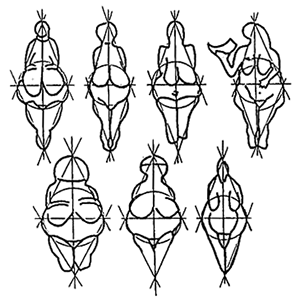
Venus figurines is an umbrella term for a number of prehistoric statuettes of women portrayed with similar physical attributes from the Upper Palaeolithic (between 40,000 and 10,000 years ago), mostly found in Europe, but with finds as far east as Siberia, extending their distribution to much of Eurasia.
These figurines were carved from soft stone (such as steatite, calcite or limestone), bone or ivory, or formed of clay and fired. The latter are among the oldest ceramics known. In total, over a hundred such figurines are known; virtually all of modest size, between 4 cm and 25 cm in height. They are some of the earliest works of prehistoric art.
Continue reading →
Posted in Art, Sex, World |
Leave a Comment »
September 13, 2011
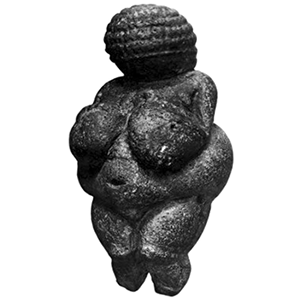
The Venus of Willendorf, also known as the ‘Woman of Willendorf,’ is an 11 cm (4.3 in) high statuette of a female figure estimated to have been made between 24,000 and 22,000 BCE. It was discovered in 1908 by archaeologist Josef Szombathy at a paleolithic site near Willendorf, a village in Lower Austria. It is carved from an oolitic limestone that is not local to the area, and tinted with red ochre. Several similar statuettes and other forms of art have been discovered, and they are collectively referred to as ‘Venus figurines,’ although they pre-date the mythological figure of Venus by millennia. The Willendorf figure was named following a model already over fifty years old, and shares many characteristics with other figures.
After a wide variety of proposed dates, following a revised analysis of the stratigraphy of its site in 1990, the figure has been estimated to have been carved 24,000–22,000 BCE. Very little is known about its origin, method of creation, or cultural significance. The Venus of Willendorf was recovered in a site that also contained a few amulets of Moldavite. The purpose of the carving is the subject of much speculation. It never had feet and does not stand on its own. The apparent large size of the breasts and abdomen, and the detail put into the vulva, have led scholars to interpret the figure as a fertility symbol. The figure has no visible face, her head being covered with circular horizontal bands of what might be rows of plaited hair, or a type of headdress. She was thought to be very healthy given her weight and size.
Posted in Art, Sex |
Leave a Comment »
September 12, 2011

A cheesesteak, also known as a Philly cheesesteak or a steak and cheese, is a sandwich made from thinly sliced pieces of steak and melted cheese in a long roll. A popular regional fast food, it has its roots in the city of Philadelphia. The cheesesteak was developed in the early 20th century ‘by combining frizzled beef, onions, and cheese in a small loaf of bread,’ according to the Historical Society of Pennsylvania.
Philadelphians Pat and Harry Olivieri are often credited with inventing the sandwich by serving chopped steak on hoagie rolls in the early 1930s. They began selling this variation of steak sandwiches at their hot dog stand near south Philadelphia’s Italian Market. They became so popular that Pat opened up his own restaurant which still operates today as Pat’s King of Steaks at the intersection of 9th Street and Passyunk Avenue in South Philly. Continue reading →
Posted in Food |
Leave a Comment »
September 12, 2011
Cheez Whiz is a thick processed cheese sauce or spread sold by Kraft Foods. It was developed by a team led by food scientist Edwin Traisman and was first marketed in 1953. The bright orange, viscous paste usually comes in a glass jar and is used as a topping for celery, cheesesteaks, corn chips, hot dogs and other foods. It is marketed in Canada, México, the Philippines, the United States and Venezuela.
Cheez Whiz is one of a number of ‘processed cheese foods,’ a category including some types of individually-wrapped cheese slices. These products contain regular cheese that has been reprocessed along with additional ingredients such as emulsifiers and stabilizing agents, such as xanthan gum or carrageenan. These products derive their tanginess and flavor from additional ingredients such as citric acid and flavoring compounds. Annatto is used for coloring. In some markets, the product has been sold in a narrow jar that tapered towards the base when sold as a spread. When Cheez Whiz is advertised as a dip or a sauce, the jars are larger and more of a squat cylindrical shape.
Posted in Food, Money |
Leave a Comment »
September 12, 2011

Easy Cheese is the trademark for a processed cheese product distributed by Kraft Foods, also referred to as aerosol cheese or spray cheese, and is a descendant of squeeze cheese (a semi-solid cheesefood from the 1970s packaged in a squeezable plastic tube). It comes packaged in a spray can, much like canned whipped cream and does not require refrigeration. Easy Cheese contains milk, water, whey protein concentrate, canola oil, milk protein concentrate, sodium citrate, sodium phosphate, calcium phosphate, lactic acid, sorbic acid, sodium alginate, apocarotenal, annatto, cheese culture, and enzymes.
Although sometimes called ‘aerosol cheese,’ its container is not actually an aerosol spray can. Rather, the can contains a piston and a barrier plastic cap which squeezes the cheese through the nozzle in a solid column when the nozzle is pressed and the propellant expands in volume. The propellant, therefore, does not mix with the cheese. This explains why the can has a small rubber plug on its base. The can design also ensures that the cheese can be dispensed with the can upright or inverted.
Posted in Food, Money, Technology |
Leave a Comment »
September 12, 2011


Processed cheese is a food product made from normal cheese and sometimes other unfermented dairy ingredients, plus emulsifiers, extra salt, food colorings, or whey. Many flavors, colors, and textures of processed cheese exist. In the United States, the most recognizable variety of processed cheese is sold under the name American cheese, although this name also has other meanings. The Laughing Cow is an example of processed cheese.
Although processed cheese was first invented in 1911 by Walter Gerber of Thun, Switzerland, it was James L. Kraft who first applied for an American patent for his method in 1916. Kraft Foods also created the first commercially available sliced processed cheese, which was introduced in 1950. This form of sliced cheese and its derivatives have become commonplace in the United States, most notably used for cheeseburgers and grilled cheese sandwiches.
Continue reading →
Posted in Food, Health, Money |
Leave a Comment »
September 12, 2011

Kraft Singles is a processed ‘cheese product’ manufactured and sold by Kraft Foods, introduced in 1949. Although processed cheese was first invented in 1911 by Walter Gerber of Thun, Switzerland, it was James L. Kraft who first applied for an American patent for his method in 1916. Kraft Foods also created the first commercially available sliced processed cheese, which was introduced in 1950.
One of the more famous ad campaigns in the 1980s claimed that each ¾ ounce slice contained ‘five ounces of milk’ (with milk being poured into a glass next to Kraft Singles), which makes them taste better than imitation cheese slices made mostly with vegetable oil and water (with oil being poured into a glass next to imitation cheese) and hardly any milk. The campaign was lambasted for its implications that each slice contained the same amount of calcium as a five ounce glass of milk and also more calcium than imitation cheese slices, which eventually led to a ruling by the Federal Trade Commission in 1992 that ordered Kraft to stop making false claims in its advertising. Kraft removed the ads, but continues to taut the use of milk in its ‘cheese products.’
Posted in Food, Money, Politics |
Leave a Comment »
September 12, 2011
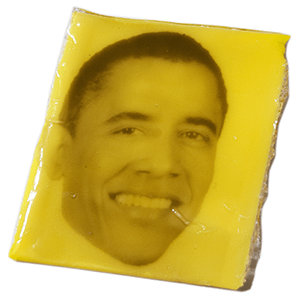
American cheese is a processed cheese, mild in flavor, with a medium-firm consistency, which melts easily. It was originally only white in color, but is usually now darkened to yellow or orange, typically with annatto, a natural food coloring.
At one time it was made from a blend of cheeses, most often Colby and Cheddar, but today’s American cheese is typically manufactured from raw ingredients, such as milk, whey, milkfat, milk protein concentrate, whey protein concentrate, and salt. In many jurisdictions, it does not meet the legal definition of cheese and must be labeled as ‘cheese analogue,’ ‘cheese product,’ ‘processed cheese,’ or similar and is commonly referred to as ‘plastic cheese’ or ‘burger cheese’ in the UK.
Continue reading →
Posted in Food, Money, World |
1 Comment »
September 11, 2011

Figure 8 racing is a form of automobile racing that combines elements of oval racing, demolition derby, and road racing. Racing is done on a track shaped like an 8. The cars cross paths at the center of the 8, which is known as the ‘crossover.’ Because of this layout, crashes are inevitable. Figure 8 racing is a unique sport that requires strict attention to detail and timing to successfully navigate the crossover. The oldest operating figure 8 track in the United States is Indianapolis Speedrome in Indianapolis, Indiana. The track has been in operation since the 1940s. It hosts the annual World Figure 8 race, which is considered the world championship event. The first 3 hour long endurance race was held in 1977.
Figure 8 track racing began right after World War II in the late 1940s. The track may have had an overpass so that the cars did not cross each other’s paths. Most historians believe that the first track where drivers crossed each other’s paths was the 1/5 mile long Indianapolis Speedrome. The sport received nationwide publicity when it was frequently televised on ABC’s ‘Wide World of Sports’ in the 1960s, usually from the Islip Speedway in New York. The cars used are often standard cars, but are usually modified for lightness and safety. A wing much like a sprint car may be placed on the roof to increase downforce. The cars’ bodies are typically made out of sheet metal.
Posted in Games, Humor |
Leave a Comment »
September 11, 2011

Placentophagy [pluh-sen-tof-uh-jee] is the act of mammals eating the placenta of their young after childbirth. The placenta contains high levels of prostaglandin which stimulates shrinking or return to a former size of the uterus. The placenta also contains small amounts of oxytocin which eases birth stress and causes the smooth muscles around the mammary cells to contract and eject milk. Although the placenta is revered in many cultures, very few customarily eat the placenta after the newborn’s birth. Those who advocate placentophagy in humans believe that eating the placenta prevents postpartum depression and other pregnancy complications. The Royal College of Obstetricians and Gynaecologists states that there is no medical reason to eat the placenta: ‘Animals eat their placenta to get nutrition – but when people are already well-nourished, there is no benefit, there is no reason to do it.’ Human placenta has also been an ingredient in some traditional Chinese medicines.
There is a school of thought that holds that placentophagy naturally occurred to hide any trace of childbirth from predators in the wild, though the fact that amniotic fluid is not similarly ingested by the mother seems to discredit this theory. Most placental mammals participate in placentophagy, including, surprisingly, herbivorous ones. Whales and seals are exceptions to mammalian placentophagy, as is the camel. Marsupials (pouched mammals) resorb rather than deliver the placenta, and therefore cannot engage in placentophagia; they do, however, vigorously lick birth fluids as they are excreted.
Posted in Food, Health |
1 Comment »



