August 26, 2011

Cyanotype [sahy-an-uh-tahyp] is a photographic printing process that gives a cyan-blue print. The process was popular in engineering circles well into the 20th century. The simple and low-cost process enabled them to produce large-scale copies of their work, referred to as blueprints. Two chemicals are used in the process: Ammonium iron(III) citrate and Potassium ferricyanide.
The English scientist and astronomer Sir John Herschel discovered this procedure in 1842. Though the process was developed by Herschel, he considered it as mainly a means of reproducing notes and diagrams, as in blueprints. It was Anna Atkins who brought this to photography. She created a limited series of cyanotype books that documented ferns and other plant life from her extensive seaweed collection. Atkins placed specimens directly onto coated paper, allowing the action of light to create a silhouette effect. By using this photogram process, Anna Atkins is regarded as the first female photographer.
Continue reading →
Posted in Art, Technology |
1 Comment »
August 26, 2011
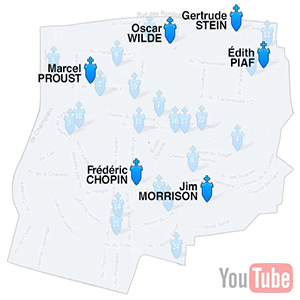
Père Lachaise Cemetery [peyr /luh-shez] is the largest cemetery in the city of Paris, France, and is reputed to be the world’s most-visited cemetery, attracting hundreds of thousands of visitors annually to the graves of those who have enhanced French life over the past 200 years. It is also the site of three World War I memorials. Notable residents include Georges Bizet, Maria Callas, Frédéric Chopin, Marcel Marceau, Jim Morrison, Marcel Proust, and Oscar Wilde.
The cemetery is on Boulevard de Ménilmontant. The Paris Métro station Philippe Auguste is next to the main entrance, while the station called Père Lachaise, on line 3, is 500 meters away near a side entrance. Many tourists prefer the Gambetta station as it allows them to enter near the tomb of Oscar Wilde and then walk downhill to visit the rest of the cemetery.
Continue reading →
Posted in Death, World |
Leave a Comment »
August 25, 2011

In decision making and psychology, decision fatigue refers to the deteriorating quality of decisions made by an individual, after a long session of decision making. It is now understood as one of the causes of irrational trade-offs in decision making. For instance, judges have been shown to make poorer decisions later in the day. Decision fatigue can not only results in fast and careless decisions, but even in decision paralysis where no decision is made at all. In the formal approach to decision quality management, specific techniques have been devised to help managers cope with decision fatigue.
Trade-offs, where either of two choices have positive and negative elements, are an advanced and energy consuming form of decision making. A person who is mentally depleted becomes reluctant to make trade-offs, or makes very poor choices. Jonathan Levav at Stanford University designed experiments showing how decision fatigue can leave a person vulnerable to sales and marketing strategies designed to time the sale.
Continue reading →
Posted in Health, Money, Science |
Leave a Comment »
August 25, 2011
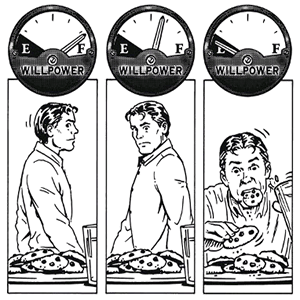
Ego depletion refers to the idea that self-control or willpower is an exhaustible resource that can be used up. When that energy is low, mental activity that requires self-control is impaired. In other words, using one’s self-control impairs the ability to control one’s self later on. In an illustrative experiment on ego depletion, participants who controlled themselves by trying not to laugh while watching a comedian did worse on a later task that required self-control compared to participants who watching the video and were free to laugh.
Much of the early research on ego depletion was performed by social psychologists Roy Baumeister, Mark Muraven, and their colleagues. In a recent series of studies, they suggest that a positive mood stimulus could help restore the depleted energy. For example, watching short clips of stand-up comedy by Robin Williams and Eddie Murphy can restores the capacity to self-regulate. The work is experimental and does not consider in depth the mechanisms by which performance is restored. Whether it is because of an actual restoration of self-regulatory resources or provides an additional motivation to press on with a depleted self remains an open question., and a study from Carol Dweck and other researchers from Stanford University, questions the ego depletion theory, and presents evidence that ‘a person’s mindset and personal beliefs about willpower determine how long and how well they’ll be able to work on a tough mental exercise.’
Posted in Health, Language, Science |
Leave a Comment »
August 25, 2011

Persistence hunting is a hunting technique in which hunters use a combination of running and tracking to pursue prey to the point of exhaustion. While humans can sweat to reduce body heat their quadruped prey would need to slow from a gallop to pant. Today, it is very rare and seen only in a few groups such as Kalahari bushmen and the Tarahumara or Raramuri people of Northern Mexico. Persistence hunting requires endurance running – running many miles for extended periods of time. Among primates, endurance running is only seen in humans, and persistence hunting is thought to have been one of the earliest forms of human hunting, having evolved 2 million years ago.
The persistence hunt may well have been the first form of hunting practiced by hominids. It is likely that this method of hunting evolved before humans invented projectile weapons, such as darts, spears, or slings. Since they could not kill their prey from a distance and were not fast enough to catch the animal, one reliable way to kill it would have been to run it down over a long distance.
Continue reading →
Posted in Food, Games, Science |
1 Comment »
August 25, 2011

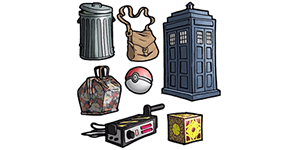
Magic satchel is a term often used in reference to role-playing video games. It refers to the use of a character’s inventory in the game, which can often contain more items (or items of too large a size) than is physically possible for the character to carry without any visible means to hold or transport them. The concept is so common in fantasy fiction that it is parodied by the character The Luggage in Terry Pratchett’s ‘Discworld’ series, a semi-sentient, bottomless treasure chest that follows its owner around.
The term ‘hammerspace’ describes the seemingly invisible place from which fictional characters, such as cartoon characters, pull out very large objects, such as mallets. Technically the term hammerspace is not used to refer to a magic satchel itself, but rather the area or pocket of space that a magic satchel occupies; a magic satchel is like a door to hammerspace. The ‘bag of holding’ is a similar concept in the role-playing game ‘Dungeons & Dragons.’ A real-world example is the clown car which often is used in the circus, in which numerous clowns clamber out of a tiny automobile.
Continue reading →
Posted in Games, Humor |
1 Comment »
August 25, 2011


Hammerspace (also known as malletspace) is a fan-envisioned extradimensional, instantly accessible storage area in fiction, which is used to explain how animated, comic and game characters can produce objects out of thin air. Inexplicable production of items dates back to the very beginning of animated shorts and was a fairly common occurrence during the golden age of animation. Warner Bros. cartoon characters are particularly well-known for often pulling all sorts of things — guns, disguises, bombs, anvils, mallets— from behind their backs or just offscreen. However, the explanation for this phenomenon was mostly just left to suspension of disbelief.
The term ‘Hammerspace’ itself originates from a gag common in certain anime and manga. A typical example would be when a male character would anger or otherwise offend a female character, who would proceed to produce, out of thin air, an oversized wooden rice mallet (saizuchi) and hit him on the head with it in an exaggerated manner. The strike would be purely for comic effect, and would not have any long-lasting effects. The term was largely popularized first by fans of ‘Urusei Yatsura’ (a comedic manga, popular in the 1980s).
Continue reading →
Posted in Games, Humor, Language |
1 Comment »
August 25, 2011

Snow Crash is Neal Stephenson’s third novel, published in 1992. Like many of Stephenson’s other novels it covers a large range of topics including: history, linguistics, anthropology, archaeology, religion, computer science, politics, cryptography, memetics, and philosophy. Stephenson explained the title of the novel in his 1999 essay ‘In the Beginning… was the Command Line’ as his term for a particular software failure mode on the early Apple Macintosh computer, ‘When the computer crashed and wrote gibberish into the bitmap, the result was something that looked vaguely like static on a broken television set — a ‘snow crash.”
The book presents the Sumerian language as the firmware programming language for the brainstem, which is supposedly functioning as the BIOS for the human brain. According to characters in the book, the semetic goddess Asherah is the personification of a ‘linguistic virus,’ similar to a computer virus. The Sumerian god Enki created a counter-program which he called a ‘nam-shub’ that caused all of humanity to speak different languages as a protection against Asherah (a re-interpretation of the ancient Near Eastern story of the Tower of Babel).
Continue reading →
Posted in Art, Money, Technology |
Leave a Comment »
August 23, 2011

David Foster Wallace (1962 – 2008) was an American author of novels, essays, and short stories, and a professor at Pomona College in Claremont, California. He was widely known for his 1996 novel ‘Infinite Jest.’ In 1997, Wallace received a MacArthur Fellowship. He was born in Ithaca, New York. His father teaches philosophy at the University of Illinois and his mother teaches English at a community college in Champaign. In fourth grade, he moved to Urbana, Illinois. As an adolescent, he was a regionally ranked junior tennis player.
He attended his father’s alma mater, Amherst College, and majored in English and philosophy, with a focus on modal logic and mathematics. His philosophy senior thesis on modal logic, titled ‘Richard Taylor’s ‘Fatalism’ and the Semantics of Physical Modality’ was awarded the Gail Kennedy Memorial Prize by Amherst. His other senior thesis, in English, would later become his first novel, ‘The Broom of the System,’ which centers on an emotionally challenged, 24-year-old telephone switchboard operator who has issues about whether or not she’s real.
Continue reading →
Posted in Art, Language, Philosophy |
Leave a Comment »
August 23, 2011

Infinite Jest is a 1996 novel by David Foster Wallace that presents a dystopian vision of North America in the near future. The intricate narrative treats elements as diverse as junior tennis, substance abuse and recovery programs, depression, child abuse, family relationships, advertising and popular entertainment, film theory, and Quebec separatism. The novel includes copious endnotes which explain or expound upon points in the story.
In an interview with Charlie Rose, Wallace characterized their use as a method of disrupting the linearity of the text while maintaining some sense of narrative cohesion. The novel’s title is from ‘Hamlet,’ who holds the skull of the court jester, Yorick, and says ‘Alas, poor Yorick! I knew him, Horatio: a fellow of infinite jest, of most excellent fancy: he hath borne me on his back a thousand times; and now, how abhorred in my imagination it is!’ Continue reading →
Posted in Art, Language, Money |
Leave a Comment »
August 22, 2011
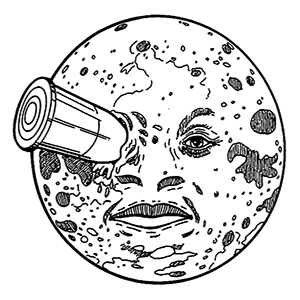
Georges Méliès [mey-lyes] (1861 – 1938) was a French filmmaker famous for leading many technical and narrative developments in the earliest cinema. He was very innovative in the use of special effects. He accidentally discovered the ‘stop trick,’ or substitution, in 1896, and was one of the first filmmakers to use multiple exposures, time-lapse photography, dissolves, and hand-painted color in his films. Because of his ability to seemingly manipulate and transform reality through cinematography, Méliès is sometimes referred to as the First ‘Cinemagician,’ and before making films, he was a stage magician at the Theatre Robert-Houdin.
His most famous film is ‘A Trip to the Moon’ (‘Le voyage dans la Lune’) made in 1902, which includes the celebrated scene in which a spaceship hits the eye of the man in the moon.
Continue reading →
Posted in Art, Money, Technology |
Leave a Comment »
August 22, 2011

Compositing [kuhm-poz-it-ing] is the combining of visual elements from separate sources into single images, often to create the illusion that all those elements are parts of the same scene. Live-action shooting for compositing is variously called ‘blue screen,’ ‘green screen,’ ‘chroma key,’ and other names. Today, most, though not all, compositing is achieved through digital image manipulation. Pre-digital compositing techniques, however, go back as far as the trick films of Georges Méliès in the late 19th century; and some are still in use.
All compositing involves the replacement of selected parts of an image with other material, usually, but not always, from another image. In the digital method of compositing, software commands designate a narrowly defined color as the part of an image to be replaced. Then every pixel within the designated color range is replaced by the software with a pixel from another image, aligned to appear as part of the original. For example, a TV weather person is recorded in front of a plain blue or green screen, while compositing software replaces only the designated blue or green color with weather maps.
Continue reading →
Posted in Art, Technology |
Leave a Comment »





