August 22, 2011

Cinemagraphs are still photographs in which a minor and repeated movement action occurs. They are produced by taking a series of photographs or a video recording, and, using image editing software, compositing the photographs or the video frames into an animated GIF file in such a manner that motion in part of the subject between exposures (for example, a person’s dangling leg) is perceived as a repeating or continued motion.
The term was coined by U.S. photographers Kevin Burg and Jamie Beck, who used the technique to animate their fashion and news photographs beginning in early 2011.
Posted in Art, Technology |
Leave a Comment »
August 18, 2011
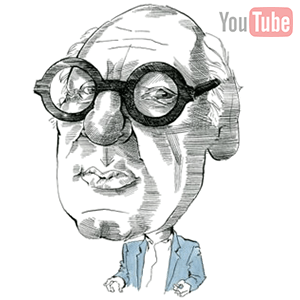
Michael Nyman (b. 1944) is an English composer of minimalist music, pianist, and musicologist, known for the many film scores he wrote during his lengthy collaboration with the filmmaker Peter Greenaway, and his soundtrack album to Jane Campion’s ‘The Piano.’ He has composed operas, concertos, string quartets, and many other chamber works, many for his Michael Nyman Band, with and without whom he tours as a performing pianist. Nyman has stated his preference for writing opera to other sorts of music.
In 1969, he provided the libretto for Harrison Birtwistle’s opera, ‘Down by the Greenwood Side’ and directed the short film ‘Love Love Love’ (based on, and identical length to, The Beatles’ ‘All You Need Is Love’) before settling into music criticism, where he is generally acknowledged to have been the first to apply the term ‘minimalism’ to music (in a 1968 article in The Spectator magazine about the English composer Cornelius Cardew). Continue reading →
Posted in Art |
Leave a Comment »
August 18, 2011

Alan Smithee was an official pseudonym used by film directors who wish to disown a project, coined in 1968. Until its use was formally discontinued in 2000, it was the sole pseudonym used by members of the Directors Guild of America (DGA) when a director dissatisfied with the final product proved to the satisfaction of a guild panel that he or she had not been able to exercise creative control over a film. The director was also required by guild rules not to discuss the circumstances leading to the move or even to acknowledge being the actual director.
Prior to 1968, DGA rules did not permit directors to be credited under a pseudonym. This was intended to prevent producers from forcing them upon directors, which would inhibit the development of their résumés. The guild also required that the director be credited, in support of the DGA philosophy that the director was the primary creative force behind a film.
Continue reading →
Posted in Art, Humor, Money |
Leave a Comment »
August 18, 2011

The Adidas Samba is an indoor soccer training shoe. It has been among Adidas’ most popular, best selling shoes in recent times, the second best sold Adidas shoe ever with over 35 million sold pairs worldwide, behind the legendary Adidas Stan Smith. It is produced in a variety of color schemes, yet the classic black with three white stripes is the most popular. The shoe features a tan gumsole that distinguishes it from other Adidas shoes.
The shoe was first produced in 1950 to enable association football players to train on icy hard ground (hence the suction cups on the gumsole). Its original design featured the classic three stripes, as well as the gold trefoil on the foldable tongue. As years progressed, the Samba evolved into the Samba Millennium (which was made without the extended tongue) and the Samba ’85. Classic models of the shoe are still in production, under the name Classic M. the original model is sometimes used for training, street play, and futsal (a variant of indoor soccer).
Posted in Games, Money |
Leave a Comment »
August 18, 2011

Adidas Stan Smith is a tennis shoe made by Adidas. Stan Smith was an American tennis star of the 1960s and ’70s. Adidas approached him in 1971 to endorse the Haillet shoe (designed for French tennis pro Jean-Louis Haillet). The shoe, usually made with a leather upper, has a simple design and unlike most of the Adidas range has no external stripes.
Instead there are three rows of perforations in the same pattern. There is a sketched picture of the tennis player on the tongue of the shoe. The brand is the biggest-selling tennis shoe ever.
Posted in Games, Money |
Leave a Comment »
August 17, 2011


Juggalo or Juggalette (the latter being feminine) is a name given to fans of Insane Clown Posse or any other Psychopathic Records hip hop group. Juggalos have developed their own idioms, slang, and characteristics. The term originated during a 1994 live performance by Insane Clown Posse. During the song ‘The Juggla,’ Joseph Bruce addressed the audience as Juggalos, and the positive response resulted in him and Joseph Utsler using the word thereafter to refer to themselves and their friends, family, and fans, including other Psychopathic Records artists.
Juggalos have compared themselves to a family. Common characteristics include drinking the inexpensive soft drink Faygo, wearing face paint and an interest in professional wrestling. They view the lyrics of Psychopathic Records artists (which are often violent in nature) as a catharsis for aggression.
Continue reading →
Posted in Art, Language |
Leave a Comment »
August 17, 2011
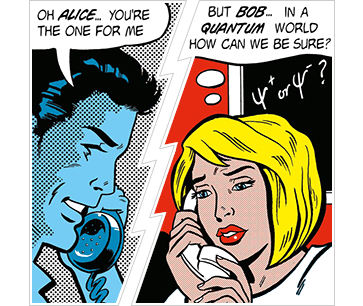
The names Alice and Bob are commonly used placeholder names for archetypal characters in fields such as cryptography and physics. The names are used for convenience; for example, ‘Alice sends a message to Bob encrypted with his public key’ is easier to follow than ‘Party A sends a message to Party B encrypted by Party B’s public key.’ Following the alphabet, the specific names have evolved into common parlance within these fields—helping technical topics to be explained in a more understandable fashion.
In cryptography and computer security, there are a number of widely used names for the participants in discussions and presentations about various protocols. The names are conventional, somewhat self-suggestive, sometimes humorous, and effectively act as metasyntactic variables. In typical implementations of these protocols, it is understood that the actions attributed to characters such as Alice or Bob need not always be carried out by human parties directly, but also by a trusted automated agent (such as a computer program) on their behalf. Despite the advantage of Alice and Bob’s distinct genders in reducing ambiguity, there has been little tendency to introduce inanimate parties so they could be referred by neuter pronouns. Continue reading →
Posted in Language, Science, Technology |
1 Comment »
August 17, 2011
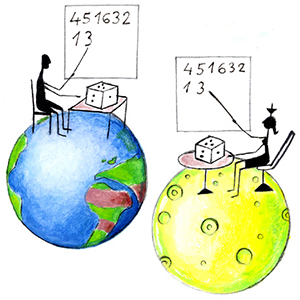
An ansible [an-si-bull] is a hypothetical machine capable of instantaneous or superluminal (faster-than-light) communication. They are used as science fiction plot devices and in thought experiments of theoretical physics. The word was coined by American author Ursula K. Le Guin in her 1966 novel, ‘Rocannon’s World.’
She derived the name from ‘answerable,’ as the device would allow its users to receive answers to their messages in a reasonable amount of time, even over interstellar distances. The name of the device has since been borrowed by authors such as Orson Scott Card and Vernor Vinge; similar devices are present in the works of numerous others, such as Frank Herbert. One ansible-like device which predates Le Guin’s is the ‘Dirac communicator’ in James Blish’s 1954 short story ‘Beep.’ The device received the sum of all transmitted messages in universal space-time, in a single pulse, so that demultiplexing yielded information about the past, present, and future. Continue reading →
Posted in Language, Science, Technology |
Leave a Comment »
August 16, 2011

Toasting, chatting, or deejaying is the act of talking or chanting, usually in a monotone melody, over a rhythm or beat by a deejay. The lyrics can be either improvised or pre-written. Toasting has been used in various African traditions, such as griots (storytellers) chanting over a drum beat, as well as in Jamaican music forms, such as dancehall, reggae, ska, dub, and lovers rock. The combination of singing and toasting is known as singjaying.
In the late 1950s deejay toasting was developed by Count Machuki. He conceived the idea from listening to disc jockeys on American radio stations. He would do American jive over the music while selecting and playing R&B music. Deejays like Count Machuki working for producers would play the latest hits on traveling sound systems at parties and add their toasts or vocals to the music. These toasts consisted of comedy, boastful commentaries, chants, half-sung rhymes, rhythmic chants, squeals, screams, and rhymed storytelling.
Continue reading →
Posted in Art, Language, World |
1 Comment »
August 16, 2011
Riddim is the Jamaican Patois pronunciation of the English word ‘rhythm,’ but in dancehall/reggae parlance it refers to the instrumental accompaniment to a song. Thus, a dancehall song consists of the riddim plus the ‘voicing’ (vocal part) sung by the deejay (not to be confused with disc jockeys who select and play music, and are called selectors in Jamaica). The resulting song structure may be taken for granted by dancehall fans, but is in many ways unique. A given riddim, if popular, may be used in dozens—or even hundreds—of songs, not only in recordings, but also in live performances. Some ‘classic’ riddims, such as ‘Nanny Goat’ and ‘Real Rock’ are essentially the accompaniment tracks to the original 1960s reggae songs with those names.
Since the 1980s, however, riddims started to be originally composed by producers/beatmakers, who give the riddims original names and, typically, contract artists to ‘voice’ over them. Thus, for example, ‘Diwali’ is the name not of a song, but of a riddim created by Lenky Marsden, subsequently used as the basis for several songs, such as Sean Paul’s ‘Get Busy’ and Bounty Killer’s ‘Sufferer.’ Riddims are the primary musical building blocks of Jamaican popular songs. At any given time, ten to fifteen riddims are widely used in dancehall recordings, but only two or three of these are the now ‘ting’ (the latest riddims that everyone must record over if they want to get them played in the dance or on radio). In dancehall performing, those whose timing is right on top of the rhythm are said to be ‘ridding di riddim.’ Continue reading →
Posted in Art, Language, World |
Leave a Comment »
August 16, 2011

In motorsports, homologation [huh-mol-uh-gey-shun] is the approval process a vehicle, race track or standardized part must go through to race in a given league or series. The regulations and rules that must be met are generally set by the series’ sanctioning body. The word is derived from the Greek homologeo—literally ‘same words’—for ‘agree.’ The names of the Ferrari 250 GTO, 288 GTO, Pontiac GTO, and Mitsubishi GTO, where ‘GTO’ stands for ‘Gran Turismo Omologato’ (‘Grand Touring, Homologated’), use the term explicitly.
In racing series that are ‘production-based’ (that is, the vehicles entered in the series are based on production vehicles for sale to the public), homologation requires not only compliance with a racing series’ technical guidelines (for example, engine displacement, chassis construction, suspension design and such) but it often includes minimum levels of sales to ensure that vehicles are not designed and produced solely for racing in that series. Since such vehicles are primarily intended for the race track, practical use on public roads is generally a secondary design consideration, so long as government regulations are met.
Continue reading →
Posted in Games, Language, Money |
Leave a Comment »
August 16, 2011

Raymond Loewy [loh-ee] (1893 – 1986) was an industrial designer. Born in France, he spent most of his professional career in the United States. Among his work were the Shell and former BP logos, the Greyhound bus, the Coca-Cola bottle, the Pennsylvania Railroad GG1 and S-1 locomotives, the Lucky Strike package, Coldspot refrigerators, the Studebaker Avanti and Champion, and the Air Force One livery. His career spanned seven decades.
Loewy was born in Paris in 1893, the son of a Jewish Viennese journalist and French woman. He served in the French army during World War I, attaining the rank of captain. He boarded a ship to America in 1919 with only his French officer’s uniform and $50 in his pocket. He lived in New York and found work as a window designer for department stores, including Macy’s, Wanamaker’s and Saks in addition to working as a fashion illustrator for Vogue and Harper’s Bazaar. Continue reading →
Posted in Art, Money, Technology |
Leave a Comment »




