August 3, 2011

The Acid Tests were a series of parties held by Ken Kesey in the San Francisco Bay Area during the mid 1960s, centered entirely around the use of, experimentation with, and advocacy of, the psychedelic drug LSD, also known as ‘acid.’ The name ‘Acid Test’ was coined by Kesey, after the term ‘acid test’ used by gold miners in the 1850s.
He advertised the parties with posters that read, ‘Can YOU Pass The Acid Test?,’ and the name was later popularized in Tom Wolfe’s 1968 book, ‘The Electric Kool-Aid Acid Test.’ Musical performances by the Grateful Dead were commonplace, along with black lights, strobe lights, and fluorescent paint. The Acid Tests are notable for their influence on the LSD-based counterculture of the San Francisco area and subsequent transition from the beat generation to the hippie movement.
Posted in Drugs, Games, Humor |
Leave a Comment »
August 3, 2011

The Electric Kool-Aid Acid Test is a work of literary journalism by Tom Wolfe, published in 1968. Using techniques from the genre of hysterical realism and pioneering new journalism, the ‘nonfiction novel’ tells the story of Ken Kesey and his band of Merry Pranksters.
The book follows the Pranksters across the country driving in a psychedelic painted school bus dubbed ‘Furthur,’ reaching what they considered to be personal and collective revelations through the use of LSD and other psychedelic drugs. The book also describes the Acid Tests, early performances by The Grateful Dead, and Kesey’s exile to Mexico.
Posted in Art, Drugs, Language |
Leave a Comment »
August 2, 2011

Sky lanterns, also known as Kongming Lantern are airborne paper lanterns found in some Asian cultures. They are constructed from oiled rice paper on a bamboo frame, and contain a small candle or fuel cell composed of a waxy flammable material. When lit, the flame heats the air inside the lantern, thus lowering its density causing the lantern to rise into the air. The sky lantern is only airborne for as long as the flame stays alight, after which the lantern floats back to the ground.
According to popular lore, the Kongming Lantern was the first hot air balloon, said to be invented by the Chinese sage and military strategist Zhuge Liang, whose reverent term of address (i.e. Chinese style name) was Kongming. They were first deployed at the turn of the 3rd century as a type of signaling balloon or, it is claimed, as a type of spy blimp in warfare. Alternatively the name may come from the lantern’s resemblance to the hat Kongming is traditionally shown to be wearing. Continue reading →
Posted in Games, Technology, World |
Leave a Comment »
August 2, 2011
Rudolf Dassler (1898 – 1974) was the German founder of the sportswear company PUMA and the older brother of Adidas founder, Adolf ‘Adi’ Dassler. The brothers were partners in a shoe company Adi started, Gebrüder Dassler Schuhfabrik (Dassler Brothers Shoe Factory). Rudi joined in 1924, however the brothers became rivals following World War II and started their own companies in 1948. Initially calling the new company ‘Ruda,’ it was soon changed to its present name of Puma. Puma is the word for cougar in German as well as other languages. Under his direction, Puma remained a small provincial company. Only under the direction of his son, Armin Dassler, did it become the worldwide known company it remains today.
With the rise of Adolf Hitler in the 1930s, both Dassler brothers joined the Nazi Party, with Rudolf reputed as being the more ardent National Socialist. Rudolf was drafted, and later captured, while Adi stayed behind to produce boots for the Wehrmacht (Nazi military). During the war, a growing rift between the pair reached a breaking point after an Allied bomb attack in 1943 when Adi and his wife climbed into a bomb shelter that Rudolf and his family were already in: ‘The dirty bastards are back again,’ Adi said, apparently referring to the Allied war planes, but Rudolf was convinced his brother meant him and his family. Rudolf, upon his capture by American troops, was suspected of being a member of the SS, information supposedly supplied by none other than his brother Adi.
Posted in Games, Money, War |
Leave a Comment »
August 2, 2011

Adolf Dassler (1900 – 1978), known as ‘Adi,’ was the founder of the German sportswear company Adidas. Trained as a cobbler, Dassler started to produce his own sports shoes in his mother’s laundry after his return from World War I. His father, Christoph, who worked in a shoe factory, and the Zehlein brothers, who produced the handmade spikes for track shoes in their blacksmith’s shop, supported Dassler in starting his own business. In 1924, his older brother Rudolf joined the business, which became the Gebrüder Dassler Schuhfabrik (Dassler Brothers Shoe Factory). At the 1928 Olympics, Dassler equipped several athletes, laying the foundation for the international expansion of the company. During the 1936 Summer Olympics in Berlin, Dassler equipped Jesse Owens of the USA with his shoes. Owens went on to win four gold medals in that Olympics.
With the rise of Adolf Hitler in the 1930s, both Dassler brothers joined the Nazi Party, with Rudolf reputed as being the more ardent National Socialist. Rudolf was drafted, and later captured, while Adi stayed behind to produce boots for the Wehrmacht (Nazi military). The war exacerbated the differences between the brothers and their wives. Rudolf, upon his capture by American troops, was suspected of being a member of the SS, information supposedly supplied by none other than his brother Adi. By 1948, the rift between the brothers widened. Rudolf left the company to found Puma on the other side of town (across the Aurach River), and Adolf Dassler renamed the company Adidas after his own nickname (Adi Dassler).
Posted in Games, Money, War |
Leave a Comment »
August 1, 2011

Billy Preston (1946 – 2006) was an African American rhythm and blues musician from Houston, Texas, raised mostly in Los Angeles. In addition to his career as a solo artist, Preston collaborated with some of the greatest names in the music industry, including The Beatles, The Rolling Stones, Nat King Cole, Little Richard, Ray Charles, Elton John, Eric Clapton, Bob Dylan, Aretha Franklin, and Johnny Cash. He played the Fender Rhodes electric piano and the Hammond organ on the Get Back sessions in 1969.
Preston began playing piano while sitting on his mother’s lap at age three, and he was considered something of a child prodigy on piano and organ. By the age of 10 he was performing in the bands of gospel singers Mahalia Jackson, James Cleveland, and Andrae Crouch. In the 1960s he performed with Little Richard and Ray Charles, and in 1963, aged just 16, he played organ on the Sam Cooke album ‘Night Beat.’ He also began a recording career as a solo artist with the 1965 album ‘The Most Exciting Organ Ever.’ Continue reading →
Posted in Art |
Leave a Comment »
August 1, 2011

Stephen LaBerge (born 1947) is a psychophysiologist and a leader in the scientific study of lucid dreaming. In 1967 he received his Bachelor’s Degree in mathematics. He received his Ph.D. in Psychophysiology at Stanford University in 1980.
He developed a technique to enable himself and other researchers to enter a lucid dream state at will, MILD (mnemonic induction of lucid dreams), which was necessary for many forms of dream experimentation. In 1987, he founded The Lucidity Institute, an organization that promotes research into lucid dreaming, as well as running courses for the general public on how to achieve a lucid dream. Continue reading →
Posted in Health, Science |
1 Comment »
August 1, 2011

Freckles are clusters of concentrated melanin (an organic pigment ubiquitous in nature) which are most often visible on people with a fair complexion. A freckle is also called an ‘ephelis.’ In contrast to lentigines (liver spots) and moles, freckles do not have an increased number of melanin producing cells (melanocytes). Freckles can be found on anyone no matter their genetic background; however, having freckles is genetic and is related to the presence of a dominant gene.
The formation of freckles is triggered by exposure to sunlight: UV-B radiation activates melanocytes to increase melanin production, which can cause freckles to become darker. Freckles are predominantly found on the face, although they may appear on any skin exposed to the sun, such as the shoulders. They are rare on infants, and more commonly found on children before puberty. Upon exposure to the sun, freckles will reappear if they have been altered with creams or lasers and not protected from the sun, but do fade with age in some cases. They can also be treated with citric acid.
Posted in Health, Science |
Leave a Comment »
July 31, 2011
NAD is an electronics firm whose products include low-cost home audiophile amplifiers and related components. NAD was an acronym for New Acoustic Dimension. The company was founded in London, England in 1972 by Dr. Martin L. Borish, an electrical engineer with a Ph.D. in Physics. Its most famous product is the late-1970s NAD 3020 amplifier, designed by Bjørn Erik Edvardsen, which became a staple of low-budget Hi-Fi in Britain. NAD’s philosophy is to include only genuinely useful features for aesthetically understated designs. The company focuses on ‘effective power’ and its amplifiers have been known for delivering generous headroom, meaning that they can deliver dynamic power bursts far in excess of their rated power. The key to this feature is a flexible power supply which stores significant reserve current for quick release at moments of high musical load. The various incarnations of this design have been associated with different names over the years including Power Envelope and recently PowerDrive.
Additional benefits of this approach include the fact that amplifiers using this technology can handle complex, real-life, lower-impedance loudspeaker loads as compared with the simple 8-ohm resistor typically used to calculate advertised power ratings and the fact that the circuitry in this approach requires less cooling, while maintaining ability to handle complex impedance loads as low as 2 ohms. An amplifier that is overdriven, or pushed beyond its designed power capabilities, produces audible distortion known as clipping by cutting off extremes of the music waveform, resulting in harshly unpleasant sound and threatening damage to speakers, particularly tweeters. NAD amplifiers incorporate a user-defeatable ‘Soft-Clipping’ circuit to address this issue. It gently transforms the music waveform as the point of clipping approaches, the goal being clearer reproduction and simultaneous protection of speakers.
Posted in Money, Technology |
Leave a Comment »
July 30, 2011

Max Hattler (b. 1976) is a German video artist and experimental filmmaker best-known for his kaleidoscopic political short films ‘Collision’ (2005) and ‘Spin’ (2010), abstract stop motion work ‘Aanaatt’ (2008), and psychedelic animation loops ‘1923 aka Heaven’ and ‘1925 aka Hell’ (2010).
He also works extensively in the field of audiovisual performance, and has created concert visuals for Basement Jaxx, Diplo, Jovanotti, The Egg, and Ladyscraper.
Posted in Art, Technology |
Leave a Comment »
July 30, 2011
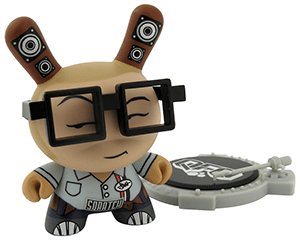

Turntablism is the art of manipulating sounds and creating music using phonograph turntables and a DJ mixer. The word ‘turntablist’ was coined in 1995 by DJ Babu to describe the difference between a DJ who just plays records, and one who performs by touching and moving the records, stylus and mixer to manipulate sound. The new term co-occurred with a resurgence of the art of hip hop style DJing in the 1990s.
Composer John Oswald described the art: ‘A phonograph in the hands of a ‘hiphop/scratch’ artist who plays a record like an electronic washboard with a phonographic needle as a plectrum, produces sounds which are unique and not reproduced — the record player becomes a musical instrument.’
Continue reading →
Posted in Art, Games, Technology |
Leave a Comment »
July 29, 2011


The Invisibl Skratch Piklz were a group of Filipino American turntablists. The members of the group were originally hip-hop DJs, who were among the pioneers of the turntablism movement in the 1990s; turntablists create musical pieces by mixing samples from records, by using multiple turntables as instruments.
The group started in 1989 as Shadow of the Prophet, with DJ Q-bert, Mix Master Mike, and DJ Apollo, who left the group in 1993. Continue reading →
Posted in Art, Games, Technology |
Leave a Comment »



