May 18, 2011
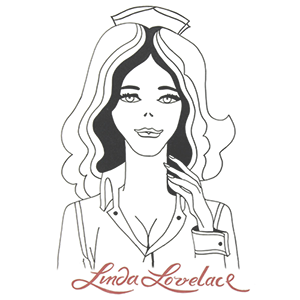
Deep Throat is a 1972 American pornographic starring Linda Lovelace (Linda Susan Boreman). One of the first pornographic films to feature a plot, character development and relatively high production standards, Deep Throat earned mainstream attention and launched the ‘porn chic’ trend despite the film being banned in some regions and the subject of obscenity trials.
The 61-minute movie is intended to be humorous, with highly tongue-in-cheek dialogue and songs; fireworks going off and bells ringing during Lovelace’s orgasms. The film’s popularity helped launch a brief period of upper-middle class interest in explicit pornography referred to by Ralph Blumenthal of The New York Times as ‘porno chic.’ Several mainstream celebrities admitted to having seen Deep Throat, including Martin Scorsese, Truman Capote, Jack Nicholson and Johnny Carson.
Continue reading →
Posted in Money, Politics, Sex |
Leave a Comment »
May 18, 2011


In the context of a work of fiction, the term canon denotes the material accepted as ‘official,’ in a fictional universe’s fan base. It is often contrasted with, or used as the basis for, works of fan fiction, which are not considered canonical. It is used in two slightly different meanings: first, it refers to the overall set of storylines, premises, settings, and characters offered by the source media text. In this sense, canon is the original work from which the fan fiction author borrows. Secondly, it is used as a descriptor of specific incidents, relationships, or story arcs that take place within the overall canon; thus certain incidents or relationships may be described as being canon or not.
The use of the word ‘canon’ in reference to a set of texts derives from Biblical canon, the set of books regarded as scripture. The term was first used in the context of fiction to refer to the Sherlock Holmes stories and novels, written by Sir Arthur Conan Doyle, to distinguish those works from subsequent pastiches by other authors. It has subsequently been applied to many media franchises. Among these are science fiction franchises such as Star Trek, Star Wars, and Doctor Who, in which many stories have been told in different media, some of which contradict or appear to contradict each other.
Posted in Art, Language |
Leave a Comment »
May 18, 2011
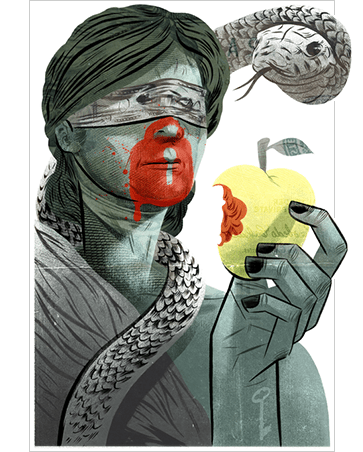
In economics, regulatory capture occurs when a state regulatory agency created to act in the public interest instead advances the commercial or special interests that dominate the industry or sector it is charged with regulating. Regulatory capture is a form of government failure, as it can act as an encouragement for large firms to produce negative externalities (a cost or benefit incurred by a party who did not agree to the action causing the cost or benefit). The agencies are called ‘captured agencies.’
In the aftermath of the 2010 Deepwater Horizon oil spill, the Minerals Management Service (MMS), which had had regulatory responsibility for offshore oil drilling, was widely cited as an example of regulatory capture. The MMS is now known as the Bureau of Ocean Energy Management, Regulation and Enforcement (BOEMRE).
Posted in Money, Politics |
Leave a Comment »
May 18, 2011

The chupacabra (literally ‘goat sucker’) is a legendary cryptid rumored to inhabit parts of the Americas. The name comes from the animal’s reported habit of attacking and drinking the blood of livestock, especially goats.
The most common description of chupacabras is a reptile-like being, appearing to have leathery or scaly greenish-gray skin and sharp spines or quills running down its back. Approximately 3 to 4 feet (1 to 1.2 m) high, it stands and hops in a similar fashion to a kangaroo.
Posted in Humor, Language, World |
Leave a Comment »
May 18, 2011

Tartanry [tahr-tn-ree] is a word used to describe the kitsch elements of Scottish culture that have been overemphasized or superimposed on the country first by the emergent Scottish tourist industry in the 18th and 19th centuries, and later by an American film industry. The earliest use of the word ‘tartanry’ itself is said to have been in 1976.
It refers to often misrepresented or invented aspects of Scotland such as clan tartans, kilts, bagpipes, Scottish Gaelic and Highland culture more generally.
Posted in Language, Money, World |
Leave a Comment »
May 18, 2011


Tartan [tahr-tn] is a pattern consisting of criss-crossed horizontal and vertical bands in multiple colors that originated in Scotland. Scottish kilts almost always have tartan patterns. Tartan is also known as ‘plaid’ in North America, but in Scotland, a plaid is a tartan cloth slung over the shoulder, or a blanket. The Dress Act of 1746 attempted to bring the warrior clans under government control by banning the tartan and other aspects of Gaelic culture. When the law was repealed in 1782, it was no longer ordinary Highland dress, but was adopted instead as the symbolic national dress of Scotland. It is generally stated that the most popular tartans today are the Black Watch (also known as Old Campbell, Grant Hunting, Universal, Government) and Royal Stewart.
Tartan is made with alternating bands of colored (pre-dyed) threads woven as both warp and weft at right angles to each other. The weft is woven in a simple twill, two over – two under the warp, advancing one thread each pass. This forms visible diagonal lines where different colors cross, which give the appearance of new colors blended from the original ones. The resulting blocks of color repeat vertically and horizontally in a distinctive pattern of squares and lines known as a sett.
Posted in Art, Language, World |
Leave a Comment »
May 18, 2011

In weaving cloth, the warp is the set of lengthwise yarns that are held in tension on a frame or loom. The yarn that is inserted over-and-under the warp threads is called the weft, woof, or filler. Each individual warp thread in a fabric is called a warp end or end. Warp means ‘that which is thrown across in Old English.’ Because the warp is held under extreme tension during the entire process of weaving, warp yarn must be strong.
Traditional fibers for warping are wool, linen and silk. With the improvements in spinning technology during the Industrial Revolution, it became possible to make cotton yarn of sufficient strength to be used as the warp in mechanized weaving. Later, artificial or man-made fibers such as nylon or rayon were employed.
Posted in Language, Technology |
Leave a Comment »
May 17, 2011

Iggy Pop (b. 1947), born James Newell Osterberg, is an American musician. He is considered an influential innovator of punk rock music. He began calling himself ‘Iggy’ after his first band in high school (for which he was drummer), The Iguanas. He was lead singer/songwriter of influential protopunk band The Stooges and became known for his outrageous and unpredictable stage antics. Inspired by the antagonism of Jim Morrison, Pop was the first performer to do a stage-dive, which he started at a concert in Detroit. Other exploits of Pop include rolling around in broken glass, exposing himself to the crowd and vomiting on stage.
Osterberg was raised in a trailer park in Ypsilanti, Michigan. He began his music career as a drummer in different high school bands in Ann Arbor, Michigan. He later moved to Chicago where he played drums in blues clubs, helped by Sam Lay (formerly of the Paul Butterfield Blues Band). In 1968, he and his new band, ‘The Stooges,’ signed with Elektra Records, again following in the footsteps of The Doors, who were Elektra’s biggest act at the time. Reportedly, Pop called Moe Howard to see if it was alright to call his band ‘The Stooges,’ to which Howard responded by merely saying ‘I don’t care what they call themselves, as long as they’re not the Three Stooges!’ and hung up the phone).
Posted in Art |
Leave a Comment »
May 17, 2011
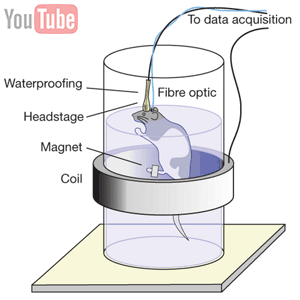
Optogenetics is a neuromodulation technique employed in neuroscience where light pulses are used to activate and deactivate neurons which have been genetically sensitized to photons. It employs a combination of techniques from optics and genetics to control and monitor the activities of individual neurons in living tissue—even within freely-moving animals—and to precisely measure the effects of those manipulations in real-time. The key reagents used in optogenetics are light-sensitive proteins.
The earliest approaches were developed and applied in the lab of Gero Miesenböck, now Waynflete Professor of Physiology at the University of Oxford, and Richard Kramer and Ehud Isacoff at the University of California, Berkeley; these methods conferred light sensitivity but were never reported to be useful by other laboratories due to the multiple components these approaches required. A distinct single-component approach involving microbial opsin genes introduced in 2005 turned out to be widely applied. Optogenetics is known for the high spatial and temporal resolution that it provides in altering the activity of specific types of neurons to control a subject’s behavior.
Posted in Health, Science, Technology |
Leave a Comment »
May 17, 2011


Barbecue [bahr-bi-kyoo] (BBQ; ‘barbie’ in Australia and New Zealand; ‘braai’ in South Africa) is a special type of grill. It is also a way to prepare meat which is then cooked with that instrument. Barbecue cooking means to cook very slowly. It is not as hot or fast as standard grilling. Some meats must be cooked slowly to be tender, and easy to chew. Sometimes, meat may be slowly cooked for 8 to 24 hours in a barbecue. People in the United States barbecue chicken, beef and pork, depending on the part of the country.
Barbecuing is very popular in the Central and Southern U.S., especially in Texas with beef and Kansas City with pork. In the United States barbecued meat is usually covered in barbecue sauce, a type of thick, dark red sauce that often contains spices, tomatoes, and honey. Very often, American barbecue grills get heat from hickory wood. In California, it was common to barbecue beef in a hole in the ground rather than a grill. This is called a ‘pit barbecue.’
Continue reading →
Posted in Food, Language, World |
Leave a Comment »
May 17, 2011
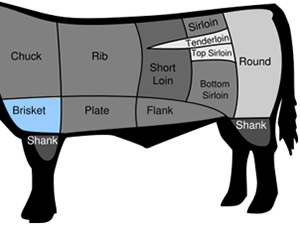

Brisket [bris-kit] is a cut of meat from the breast or lower chest of a cow. The beef brisket is one of the eight beef primal cuts. The brisket muscles include the superficial and deep pectorals. As cattle do not have collar bones, these muscles support about 60% of the body weight of standing/moving cattle. This requires a significant amount of connective tissue, so the resulting meat must be cooked thoroughly to tenderize the connective tissue.
The term derives from Old Norse ‘brjósk,’ meaning cartilage. The cut overlies the sternum, ribs and connecting costal cartilages. Popular brisket recipes in the Southern United States include rubbing with a spice rub or marinating the meat, then cooking slowly over indirect heat from charcoal or wood. This is a form of smoking the meat. Additional basting of the meat is often done during the cooking process. Continue reading →
Posted in Food, Language, World |
1 Comment »
May 17, 2011


Burnt ends are flavorful pieces of meat cut from the point half of a smoked brisket. A traditional part of Kansas City Barbecue, burnt ends are considered a delicacy in barbecue cooking. Either the entire brisket is cooked whole, then the point end removed and cooked further, or the point and flat are separated prior to cooking. Due to the higher fat content of the brisket point, it takes longer to fully cook to tender and render out fat and collagen. This longer cooking gave rise to the name. Sometimes when the flat is done, the point is returned to the smoker for further cooking. Some cooks re-season the point at this time.
Kansas City style burnt ends are usually served cubed with sauce either on top or on the side. A ‘proper’ burnt end should display a modest amount of ‘bark’ or char on at least one side. Burnt ends can be served alone (sometimes smothered in barbecue sauce) or in sandwiches, as well as in a variety of other dishes, including baked beans and gumbo.
Posted in Food |
Leave a Comment »