February 2, 2011

Keepon is a small yellow robot designed to study social development by interacting with children. It was developed at the National Institute of Information and Communications Technology (NICT) in Kyoto, Japan. Keepon has four motors, a rubber skin, two cameras in its eyes, and a microphone in its nose.
Its simple appearance and behavior are intended to help children, even those with developmental disorders such as autism, to understand its attentive and emotive actions. The robot, usually under the control of a teleoperator, has interacted with children in schools and remedial centers for developmental disorders since 2003. Keepon is currently available for purchase at $30,000, though a price drop is speculated after simpler mechanisms are developed.
Posted in Health, Humor, Technology |
Leave a Comment »
February 1, 2011

A script doctor is a highly-skilled screenwriter, hired by a film or television production, to rewrite or polish specific aspects of an existing screenplay, including structure, characterization, dialogue, pacing, theme, and other elements. Script doctors generally do their work uncredited, for a variety of commercial and artistic reasons. Script doctors are usually brought in during the development and pre-production phases of a film, to address specific issues with the script, as identified by the financiers, production team, and cast. They may also be employed during post production, to help address narrative problems that crop up during the editing process.
The use of script doctors was first revealed at the 1973 Academy Awards when Francis Ford Coppola thanked Robert Towne for his work on The Godfather. Since then, the use of script doctors has been downplayed within the industry, to avoid overshadowing the work of the original writers. Under the WGA screenwriting credit system, a screenwriter must contribute 50 percent to the story and/or characterization in order to qualify for credit. Uncredited screenwriters are not eligible to win the Academy Award for Best Screenplay or the Writers Guild of America Awards.
Posted in Art, Language, Money |
Leave a Comment »
February 1, 2011

In vitro meat, also known as cultured meat, is an animal flesh product that has never been part of a complete, living animal. Several current research projects are growing in vitro meat experimentally, although no meat has yet been produced for public consumption. The first-generation products will most likely be minced meat, and a long-term goal is to grow fully developed muscle tissue. Potentially, any animal’s muscle tissue could be grown through the in vitro process.
Posted in Food, Money, Science |
Leave a Comment »
February 1, 2011

EarthBound is a 1994 role-playing video game co-developed by Ape and HAL Laboratory and published by Nintendo for the Super NES video game console. The game has been lauded by gamers for its humorous depictions of American culture and parody of the RPG genre, and has since become a cult classic.
The game takes place on Earth in the year 199X. The game’s main antagonist is Giygas, an alien from a distant galaxy with the power to influence people using their own evil nature.
Posted in Art, Games, Humor |
Leave a Comment »
February 1, 2011
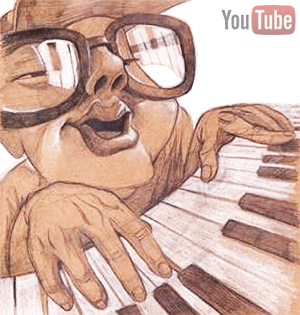
Ronald Jenkees is an American composer and musician best known for his YouTube keyboard performances. He has released two independent albums: the self-titled Ronald Jenkees (2007), and Disorganized Fun (2009).
Posted in Art, Technology |
Leave a Comment »
January 31, 2011

The Meisner Technique is an acting technique developed by the American theatre practitioner Sanford Meisner. Students develop an ability to improvise, to access an emotional life, and finally to bring the spontaneity of improvisation and the richness of personal response to text. The most fundamental exercise in Meisner training is Repetition: Two actors face each other and ‘repeat’ their observations about one another back and forth. An example of such an exchange might be: ‘You’re smiling.’ ‘I’m smiling.’ ‘You’re smiling!’
Meisner is based on the work of Russian thespian Constantin Stanislavski (1863 – 1938), as are a number of acting techniques, including Lee Strasberg’s. As in all Stanislavskian-derived approaches, for a actor traditional line memorization methods that include vocal inflections or gestures are avoided. It is taught that doing so merely increases the chance the actor will miss a ‘real moment’ in service of a rehearsed habit or line reading. Solid preparation supports the spontaneity, an idea articulated by Martha Graham when she wrote, ‘I work eight hours a day, every day, so that in the evenings I can improvise.’
Posted in Art |
Leave a Comment »
January 31, 2011

Omar Little is a fictional character on the HBO drama The Wire, portrayed by Michael K. Williams.
Omar is a renowned stick-up man who lives by a strict moral code and never deviates from his rules, foremost of which is that he never robs or menaces people who are not involved in ‘the game.’ Omar is gay, and the only major character on the series who claims to make a point of not using profanity.
Posted in Art |
Leave a Comment »
January 31, 2011

The Wire is an American television drama series set and produced in and around Baltimore, Maryland. Created and primarily written by author and former police reporter David Simon. The series was broadcast by HBO from 2002 – 2008, comprising sixty episodes over five seasons. The show is recognized for its realistic portrayal of urban life, its literary ambitions, and its uncommonly deep exploration of sociopolitical themes. Each season focuses on a different facet of the city of Baltimore. They are, in chronological order: the illegal drug trade, the seaport system, the city government and bureaucracy, the school system, and the print news media.
The large cast consists mainly of character actors who are little known for their other roles. Simon has said that despite its presentation as a crime drama, the show is ‘really about the American city, and about how we live together. It’s about how institutions have an effect on individuals. Whether one is a cop, a longshoreman, a drug dealer, a politician, a judge or a lawyer, all are ultimately compromised and must contend with whatever institution they are committed to.’
Posted in Art, Drugs, Politics |
1 Comment »
January 31, 2011

Vajazzling is the act of applying glitter and jewels to a woman’s nether regions for aesthetic purposes.
Posted in Art, Money, Sex |
Leave a Comment »
January 31, 2011

Rejected is a surrealist animated short comedy film by Don Hertzfeldt that was nominated for an Academy Award for Best Animated Short Film in 2000. A fictional frame story explains that Hertzfeldt was commissioned to do animated segments for commercials and television network interstitials, but they were all rejected upon receipt. Towards the end of the short the animator begins to break down mentally and the animated world he created literally begins to fall apart, brutally killing all of his characters in the process.
Posted in Art, Humor |
Leave a Comment »
January 31, 2011

Miracle fruit refers to any of three plants that share the same common name: Synsepalum dulcificum, source of a berry that increases the perceived sweetness of foods; Gymnema sylvestre, source of an herb that reduces the perceived sweetness of foods; and Thaumatococcus daniellii, source of a spice that has an intensely sweet flavor. Recently, this phenomenon has enjoyed some revival in food-tasting events, referred to as ‘flavor-tripping parties.’ Tasters consume sour and bitter foods, such as lemons, radishes, pickles, hot sauce, and beer, to experience the taste changes that occur.
Synsepalum dulcificum produces berries that, when eaten, cause sour foods (such as lemons and limes) subsequently consumed to taste sweet. The berry itself has a low sugar content. This effect is due to a chemical called miraculin, which is used commercially as a sugar substitute. While the exact cause for this change is unknown, one theory is that miraculin works by distorting the shape of sweetness receptors so that they become responsive to acids, instead of sugar and other sweet things for 15–60 minutes.
Posted in Drugs, Food |
Leave a Comment »
January 31, 2011

Photoshop tennis is a game played through sequential alternating photoshopping of an image. Photoshop tennis originated in graphics-related internet forums in the late-1990s/early-2000s. The game was made popular by art director Jim Coudal, and the matches on coudal.com have since been renamed Layer Tennis, as they are no longer restricted to the use of Adobe Photoshop. Each match of Photoshop tennis is generally played with two competing players. The players pick a starting image, or one is ‘served’ by a player, then another player makes some sort of alteration to the image in any chosen image editor (matches are not exclusive to Adobe Photoshop).
He or she then sends that altered image to the other player or players, usually via e-mail or by posting the image to a Photoshop tennis forum, who then edits that image and sends it back to the first player. This process goes back and forth until a predetermined number of rounds have elapsed, or the players otherwise wish to end the game. When the final round is over, there may be an independent judge who determines who has played the best shots, and declares that person the winner, or players may play without a clear winner. Sometimes extra rules can be enforced, such as sticking to one particular software package, or keeping to a particular theme.
Posted in Art, Games, Humor |
Leave a Comment »


 The Daily Omnivore