January 12, 2011
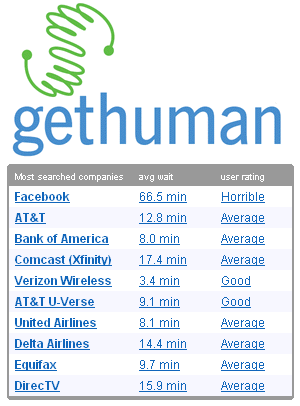
Paul English, cofounder and CTO of Kayak.com is also founder of the “gethuman” movement to restore personal contact in customer service. The most popular part of the gethuman.com website is a database of phone numbers and shortcuts to reach a humans at 500 major US corporations.
Posted in Money, Technology |
Leave a Comment »
January 12, 2011
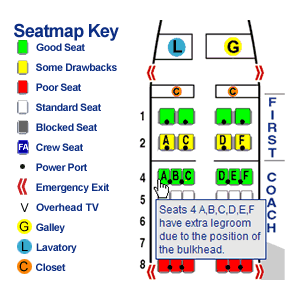
SeatGuru is a website that features aircraft seat maps, seat reviews, and a color-coded system to identify superior and substandard airline seats. It also features information about in-flight amenities and airline specific information regarding Check-in, Baggage, Unaccompanied Minors and Traveling with Infants and Pets. SeatGuru covers more than 700 aircraft seatmaps from more than 95 different airlines. In 2007, SeatGuru was purchased by Expedia subsidiary, TripAdvisor.
Posted in Money, Technology |
Leave a Comment »
January 12, 2011

A black light is a lamp that emits electromagnetic radiation almost exclusively in the soft near ultraviolet range that is only partially visible. It is mainly seen by humans using the low-light receptors in the eye, which are sensitive to near ultraviolet. The low-light receptors however also have the distinctive feature that they are more accurate in the peripheral vision, this means black light will always look out of focus when looked at directly. In medicine, forensics, and some other scientific fields, such a light source is referred to as a Wood’s lamp (named for American physicist, Robert Williams Wood).
Black light sources have many uses. They may be employed for decorative and artistic lighting effects, for diagnostic and therapeutic uses in medicine, for the eradication of microorganisms, for the observation or detection of substances tagged with other substances that exhibit a fluorescent effect, for the curing of plastic resins and for attracting insects. Strong sources of long-wave ultraviolet light are used in tanning beds. Black light lamps are used for the detection of counterfeit money.
Posted in Technology |
Leave a Comment »
January 12, 2011


Wunderwaffe (‘wonder weapon’) and was a term assigned during World War II by the German propaganda ministry to a few revolutionary ‘superweapons.’ Most of these weapons however remained more or less feasible prototypes, or reached the combat theatre too late, and in too insignificant numbers (if at all) to have a military effect. A derisive abbreviation of the term emerged: Wuwa, pronounced ‘voo-vah.’
The ‘V’-weapons (including the V-2 rocket), which were developed earlier, and saw considerable deployment especially against Great Britain, trace back to the same pool of highly inventive armament concepts. Although the Wunderwaffen failed to meet their strategic objective of turning the tides of World War II in Nazi Germany’s favor at a time when the war was already strategically lost, they represented designs and prototypes that were extremely advanced for their time including some of the the earliest work on rockets, jets, night vision, orbital weapons, and ballistic missile submarines.
Posted in Technology, War |
1 Comment »
January 12, 2011

Creative Commons (CC) is a non-profit organization headquartered in San Francisco, devoted to expanding the range of creative works available for others to build upon legally and to share. The organization has released several copyright-licenses known as Creative Commons licenses free of charge to the public. These licenses allow creators to communicate which rights they reserve, and which rights they waive for the benefit of recipients or other creators. Wikipedia is one of the notable web-based projects using one of its licenses.
The organization was founded in 2001 with support of the Center for the Public Domain. The first set of copyright licenses were released in late 2002. Creative Commons is governed by a board of directors and a technical advisory board. Joi Ito is currently the chair of the board and CEO. Creative Commons has been described as being at the forefront of the copyleft movement, which seeks to support the building of a richer public domain by providing an alternative to the automatic ‘all rights reserved’ copyright.
Posted in Money, Politics |
Leave a Comment »
January 12, 2011

The Forer effect (also called the Barnum Effect after P.T. Barnum) is the observation that individuals will give high accuracy ratings to descriptions of their personality that supposedly are tailored specifically for them, but are in fact vague and general enough to apply to a wide range of people. This effect can provide a partial explanation for the widespread acceptance of some beliefs and practices, such as astrology, fortune telling, and some types of personality tests like the Myers-Briggs test.
Continue reading →
Posted in Language, Money, Science |
Leave a Comment »
January 12, 2011

A personality test aims to describe aspects of a person’s character that remain stable throughout their lifetime (patterns of behavior, thoughts, and feelings). The 20th century heralded a new interest in defining and identifying separate personality types, in close correlation with the emergence of the field of psychology. As such, several distinct tests emerged; some attempt to identify specific characteristics, while others attempt to identify personality as a whole. The Myers-Briggs Type Indicator describes categories of functioning where individuals differ, such as introverted or extroverted.
The Strength Deployment Inventory assesses motivation, or purpose, of behavior, rather than the behavior itself. The 5-factor test is popular a tool for career planning, and has been shown to predict job satisfaction and performance. However, it is easy for personality test participants to become complacent about their own personal uniqueness and instead become dependent on the description associated with them. This can be potentially dangerous with persons who are already suffering from a form of identity disorder or may be a catalyst to instigate particular behaviors in a person who was previously believed to be of sound mental health.
Posted in Health, Philosophy, Science |
Leave a Comment »
January 12, 2011

The theory of multiple intelligenceswas proposed by American Psychologist Howard Gardner in 1983. It describes nine types of intelligence: Spatial, Linguistic, Logical-mathematical, Bodily-kinesthetic, Musical, Interpersonal, Intrapersonal, Naturalistic, and Existential.
Of the schools implementing Gardner’s theory, the most well-known is New City School, in St. Louis, Missouri, which has been using the theory since 1988. Traditionally, schools have emphasized the development of logical intelligence and linguistic intelligence (mainly reading and writing). IQ tests focus mostly on those areas as well.
Continue reading →
Posted in Education, Science |
Leave a Comment »
January 12, 2011

The Pale Blue Dot is a photograph of planet Earth taken in 1990 by Voyager 1 from a record distance, showing it against the vastness of space. By request of Carl Sagan, NASA commanded the Voyager 1 spacecraft, having completed its primary mission and now leaving the Solar System, to turn its camera around and to take a photograph of Earth across a great expanse of space. Subsequently, the title of the photograph was used by Sagan as the primary title of his 1994 book, ‘Pale Blue Dot: A Vision of the Human Future in Space.’
Posted in Science, Technology |
Leave a Comment »
January 11, 2011

The Walker Library of Human Imagination is the private library of Priceline.com founder Jay S. Walker opened in 2002. The library occupies 3,600 square feet in his Connecticut home. It showcases a collection of rare books, artworks, maps and manuscripts as well as artifacts both modern and ancient. Rare books in the collection include: a complete Bible handwritten on sheepskin from 1240; the first illustrated history book (1493); the first illustrated medical book (1499); the first medical book to illustrate the human brain (1550); a copy of ‘Micrographia’ (1664), the first book of illustrations of images seen in the first microscopes; and a 1699 atlas containing the first maps to show the sun, not the earth, as the center of the known universe.
Historical artifacts include: an original 1957 Russian Sputnik backup; an instruction manual for a Saturn V rocket, along with a signed American flag carried to the surface of moon and back on the first lunar landing; and the napkin on which President Franklin D. Roosevelt jotted down his plan to win World War II, just four months after Pearl Harbor; one of two known Anastatic Facsimiles of the original 1776 Declaration of Independence (made directly from the original using a wet-copy process); a leaf from a Gutenberg Bible, the first book printed using movable type; and a Nazi Engima Machine decoder. Distributed around the Library are a series of etched-glass art panels by artist, Clyde Lynds, which illustrate major achievements in the history of human invention.
Posted in Art, Money, Technology |
Leave a Comment »
January 11, 2011

A tin foil hat is a piece of headgear made from one or more sheets of aluminum foil or similar material or a conventional hat lined with foil worn to shield the brain from electromagnetic fields, or against mind control and/or mind reading; or attempt to limit the transmission of voices directly into the brain. The concept of wearing a tin foil hat for protection from such threats has become a popular stereotype and term of derision; the phrase serves as a byword for paranoia and persecutory delusions, and is associated with conspiracy theorists.
Posted in Humor |
Leave a Comment »
January 11, 2011

Tux is a penguin character and the official mascot of the Linux operating system originally created as an entry to a Linux logo competition. The concept of the Linux mascot being a penguin came from Linus Torvalds, the creator of Linux. Tux was created by Larry Ewing in 1996 after an initial suggestion made by Alan Cox and further refined by Linus Torvalds on the Linux kernel mailing list.
Posted in Technology |
Leave a Comment »



 The Daily Omnivore