January 1, 2011
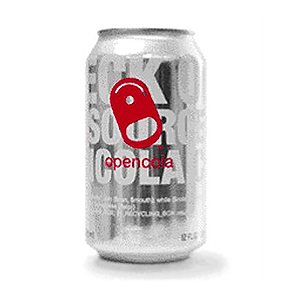
OpenCola is a brand of cola unique in that the instructions for making it are freely available and modifiable. Anybody can make the drink, and anyone can modify and improve on the recipe as long as they, too, license their recipe under the GNU General Public License. Since recipes are, by themselves, not copyrightable, the legal basis for this is untested.
The original version 1.0 was released on 27th January 2001. Current Version is 1.1.3. Although originally intended as a promotional tool to explain free and open source software, the drink took on a life of its own and 150,000 cans were sold. The Toronto-based company Opencola founded by Grad Conn, Cory Doctorow, and John Henson became better known for the drink than the software it was supposed to promote. Laird Brown, the company’s senior strategist, attributes its success to a widespread mistrust of big corporations and the ‘proprietary nature of almost everything.’
Posted in Food, Money, Politics |
Leave a Comment »
January 1, 2011

Blockhead (real name Tony Simon) is an American Hip hop producer based in Manhattan, New York. Aside from his solo efforts released on the Ninja Tune label, he is most associated with producing for Aesop Rock, a rapper for the Definitive Jux independent hip hop label. He is also a member of the hip hop/comedy group Party Fun Action Committee. His father, the late Sidney Simon, was a well known sculptor in New York City.
Posted in Art |
Leave a Comment »
December 24, 2010


In Jamaican popular culture, a sound system is a group of disc jockeys, engineers and MCs playing ska, rocksteady or reggae music. The sound system scene is generally regarded as an important part of Jamaican cultural history and as being responsible for the rise of several modern Jamaican musical genres.
The sound system concept first became popular in the 1950s, in the ghettos of Kingston. DJs would load up a truck with a generator, turntables, and huge speakers and set up street parties. In the beginning, the DJs played American rhythm and blues music, but as time progressed the sound migrated to a local flavor.
Continue reading →
Posted in Art, World |
Leave a Comment »
December 24, 2010

Dubstep is a genre of electronic dance music, originating from Croydon, UK. Its overall sound has been described as ‘tightly coiled productions with overwhelming bass lines and reverberant drum patterns, clipped samples, and occasional vocals.’
The earliest dubstep releases, which date back to 1998, were darker, more experimental, instrumental dub remixes of 2-step garage tracks attempting to incorporate the funky elements of breakbeat, or the dark elements of drum and bass into 2-step.
Continue reading →
Posted in Art, Technology |
1 Comment »
December 24, 2010


Pulp from the Latin ‘pulpa’ (animal or plant pulp, pith of wood). Pulp is the fibrous material used to make paper. It is also refers to the juice vesicles of a citrus fruit. The adjective meaning ‘sensational’ is from pulp magazines, named for the wood pulp paper used in cheaply made magazines and books. Pulp magazines (often referred to as ‘the pulps’), also collectively known as pulp fiction, refers to inexpensive fiction magazines published from 1896 through the 1950s. Pulps were printed on inexpensive paper with ragged, untrimmed edges.
Pulp is also name of a 1972 British comedy thriller starring Michael Caine as a writer of cheap paperback detective novels. The English alternative rock band Pulp formed six years later drew its name from the film. Pulp is also the title of the last novel by American writer Charles Bukowski. Additionally, Pulp refers to the central part of a tooth, commonly referred to as the nerve, it branches out and continues down each root through the canals of the tooth and stops just shy of the apex, or tip of the tooth. Red pulp and white pulp describes tissue in the spleen, an organ which creates blood cells.
Posted in Language, Science |
Leave a Comment »
December 23, 2010

Tadoma is a method of communication used by deafblind individuals, in which they place their thumb on the speaker’s lips and their fingers along the jawline. The middle three fingers often fall along the speaker’s cheeks with the little finger picking up the vibrations of the speaker’s throat. It is sometimes referred to as ‘tactile lipreading,’ as the deafblind person feels the movement of the lips, as well as vibrations of the vocal cords, puffing of the cheeks and the warm air produced by nasal sounds such as ‘N’ and ‘M.’
It is a difficult method to learn and use, and is rarely used nowadays. However, a small number of deafblind people successfully use Tadoma in everyday communication. Helen Keller also used a form of Tadoma.
Continue reading →
Posted in Health, Language |
Leave a Comment »
December 23, 2010
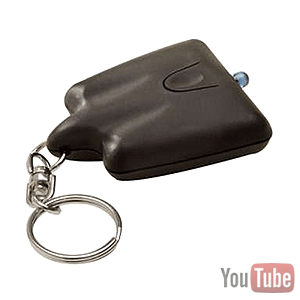
TV-B-Gone is a type of simple universal remote control device for turning off a large majority of the current available brands of television sets. It was created to allow people in a public place to turn off nearby television sets, presumably because the broadcast was distracting them from other activities. Its inventor has referred to it as ‘an environmental management device.’
The device is part of a key-chain, and, like other remote devices, is battery-powered. Although it can require up to 69 seconds for the device to find the proper code for a particular television receiver, the most popular televisions turn off in the first few seconds. During the 2008 Consumer Electronics Show, some individuals from gadget blog, Gizmodo brought a TV-B-Gone remote control and shut off many display monitors at booths and during demos affecting several companies. These actions caused the individual from Gizmodo to be banned for life from future CES events.
Posted in Humor, Technology |
Leave a Comment »
December 23, 2010

A cochlear [kok-leer] implant (CI) is a surgically implanted electronic device that provides a sense of sound to a person who is profoundly deaf or severely hard of hearing. The cochlear implant is often referred to as a bionic ear. It will not cure deafness or hearing impairment, but is a prosthetic substitute for hearing.
While cochlear implants restore physical ability to hear, this does not mean the brain can learn to process and distinguish speech if the recipient has passed the critical period of adolescence. As a result, those born profoundly deaf who receive an implant as an adult can only distinguish simple sounds, such as a ringing phone vs. a doorbell, while others who receive implants early can understand speech.
Continue reading →
Posted in Health, Technology |
Leave a Comment »
December 23, 2010

FakeTV is a burglar deterrent that makes it look like someone is home watching television by recreating the sort of light produced by an HDTV. It comes with an internal light sensor which allows the device to activate when it becomes totally dark (0.5 lux or lower) and a built in timer with four modes of operation: Always On, Dusk +4 HRS, Dusk +7 HRS, and Off. It retails for $30.
Posted in Money, Technology |
Leave a Comment »
December 22, 2010

An ambigram [am-bi-gram] is a typographical design or artform that may be read as one or more words not only in its form as presented, but also from another viewpoint, direction, or orientation.
The words readable in the other viewpoint, direction or orientation may be the same or different from the original words. Different ambigram artists (sometimes called ambigramists) may create completely different ambigrams from the same word or words, differing in both style and form.
Posted in Art, Language |
Leave a Comment »
December 22, 2010

Freestyle is a touch screen soda fountain introduced by The Coca-Cola Company in 2009. The machine features over 100 different Coca-Cola drink products, and custom flavors. Microdosing blends one or more concentrated ingredients in 46-ounce packets with water and sweetener at the point where the beverage is dispensed, thus avoiding the use of traditional 5-gallon boxes of syrup (also known as a bag-in-a-box). Cartridges store concentrated ingredients in the dispenser cabinet and are RFID enabled. The machine uses RFID chips to detect its supplies and to radio resupplying needs to other units.
These machines include flavors not previously available to the American market including Orange Coke which was previously sold only in Russia and the Baltics, and flavored Dasani waters. The machines transmit supply and demand data to both Coca-Cola and the owner including brands sold, times of the day of sales, troubleshooting information, and service data. They also use Coca-Cola’s loyalty program to let people earn secret flavors.
Posted in Food, Money, Technology |
Leave a Comment »
December 22, 2010

Chuck Close (b. 1940) is an American painter and photographer who achieved fame as a photorealist, through his massive-scale portraits.
Though a catastrophic spinal artery collapse in 1988 left him severely paralyzed, he has continued to paint and produce work that remains sought after by museums and collectors. Ironically, while being one of the most successful portrait artists of his time, Close is also afflicted with prosopagnosia (face blindness), a condition that prevents him from recognizing people’s faces.
Continue reading →
Posted in Art |
2 Comments »



 The Daily Omnivore