November 9, 2010

Easter eggs are hidden messages, in-jokes or features in things like video games, web sites, DVDs and other media. For example, the HP 54622D, a professional oscilloscope, has an ‘Asteroids’ clone called ‘Rocks’ that can be accessed by entering a secret sequence of buttons. Google Maps contains an easter egg whereby a user asking for directions from Japan to China would be directed to jetski across the Pacific Ocean.
Continue reading →
Posted in Games, Humor, Technology |
Leave a Comment »
November 9, 2010

Traditional Arabic houses sometimes have a Bab Al-Sirr: a secret door used as an emergency exit built into the walls and hidden with a window sill or a bookcase. The name comes from one of the six gates cut through an ancient wall in Aden (in modern-day Yemen), which was opened only in the event of a state security emergency. In modern-day Spain, the Arab fortress of Benquerencia has a Bab al-Sirr known as the ‘Door of Treason.’
Posted in Technology, World |
Leave a Comment »
November 9, 2010

A spider hole is U.S. military parlance for a camouflaged one-man foxhole, used for observation. They are typically a shoulder-deep, protective, round hole, often covered by a camouflaged lid, in which a soldier can stand and fire a weapon. A spider hole differs from a foxhole in that a foxhole is usually deeper and designed to emphasize cover rather than concealment.
The term is usually understood to be an allusion to the camouflaged hole constructed by the trapdoor spider. According to United States Marine Corps historian Major Chuck Melson, the term originated in the American Civil War, when it meant a hastily-dug foxhole. Spider holes were used during World War II by Japanese forces in many Pacific battlefields, including Leyte in the Philippines and Iwo Jima. The Japanese called them ‘octopus pots.’ On 13 December 2003, U.S. troops in Iraq undertaking Operation Red Dawn discovered Iraqi dictator Saddam Hussein hiding in what was characterized as a spider hole in a farmhouse near his hometown of Tikrit.
Posted in Language, War, World |
Leave a Comment »
November 9, 2010
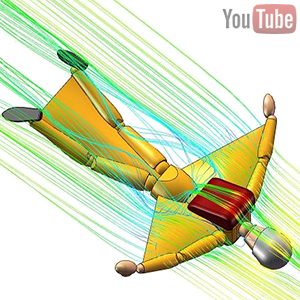
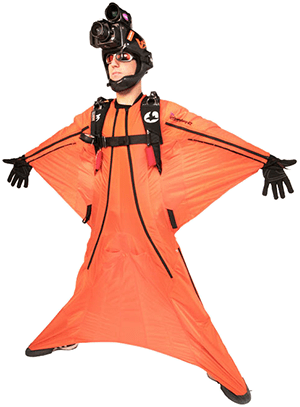
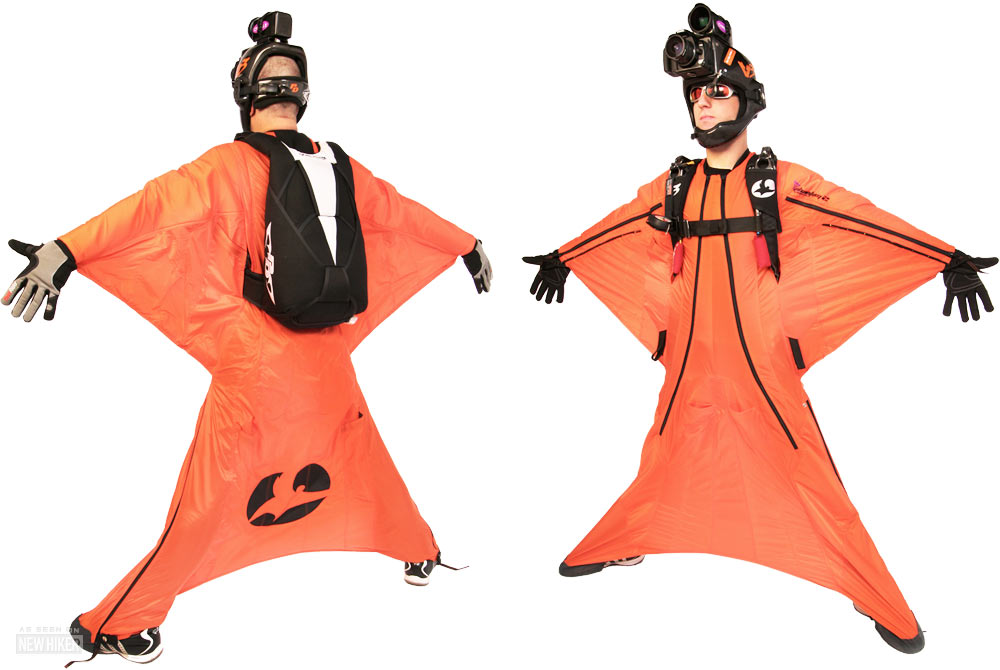
Wingsuit flying is the sport of flying the human body through the air using a special jumpsuit, called a wingsuit, which adds surface area to the human body to create lift. The wingsuit creates the surface area with fabric between the legs and under the arms. A wingsuit may be referred to as a birdman suit or squirrel suit. A wingsuit flight ends with a parachute opening, so a wingsuit can be flown from any point that provides sufficient altitude to glide through the air, such as skydiving aircraft or BASE jumping exit points, and to allow a parachute to deploy. In the mid-1990s, French skydiver Patrick de Gayardon developed a wingsuit that had unparalleled safety and performance. Unfortunately, de Gayardon died on April 13, 1998 while testing a new modification to his parachute container in Hawaii; his death is attributed to a rigging error which was part of the new modification rather than a flaw in the suit’s design.
In early 1998, Tom Begic, a BASE jumper from Australia, built and flew his own wingsuit based on a photograph of Patrick de Gayardon and his ideas. The suit was developed to assist Begic in capturing freefall footage of BASE jumpers while jumping the high cliffs of Europe. The benefits of the suit included: reduced freefall descent rates, increased freefall times, greater maneuverability around other jumpers and objects whilst in freefall, the potential to jump off sites around the world that were not possible without wingsuits, and the ability to accelerate away from underhung walls much more quickly.
Posted in Games |
Leave a Comment »
November 9, 2010

Speedflying (also known as speedriding) is a form of snowkiting, which is an outdoor winter sport where people uses kite power to glide on snow or ice. The sport is similar to kitesurfing, but with the footwear used in snowboarding or skiing. In the early days of snowkiting, foil kites were the most common type; nowadays some kitesurfers use their water gear such as inflatable kites. Snowkiting differs from other alpine sports in that it is possible for the snowkiter to travel uphill and downhill with any wind direction.
Snowkiting is becoming increasingly popular in places often associated with skiing and snowboarding, such as Russia, Canada, Iceland, France, Switzerland, Austria, Norway, Sweden and the Northern and Central United States. The sport is becoming more diverse as adventurers use kites to travel great distances and sports enthusiasts push the boundaries of freestyle, big air and back country exploration Riders can reach speeds over 90 miles per hour; descending from the top of Mont Blanc to the valley floor in Chamonix, 12,000 feet below takes about 10 minutes.
Posted in Games |
Leave a Comment »
November 8, 2010

A bialy [bee-ah-lee] is a small roll that is a traditional dish in Polish Ashkenazi cuisine. A traditional bialy has a diameter of up to 15 cm (6 inches) and is a chewy yeast roll similar to a bagel. Unlike a bagel, which is boiled before baking, a bialy is simply baked, and instead of a hole in the middle it has a depression. Before baking, this depression is filled with diced onions and other ingredients, including garlic, poppy seeds, or bread crumbs. The name bialy is Yiddish and short for ‘bialystoker kuchen’ (Bialystok Cake). Białystok is a city in Poland. The bialy was formerly little known outside of New York City, but has started to move into the larger market. They were originally brought into the United States by Ashkenazi Jewish immigrants during the late 19th and early 20th centuries.
The bialy was first marketed in the United States during the early 1900s in the state of New York by Harry Cohen, a proprietor of a bagel (and later bialy) establishment. In 2002, former New York Times food writer Mimi Sheraton wrote a book dedicated to the bialy, called The Bialy Eaters: The Story of a Bread and a Lost World. She examined bialy making and used Kossar’s Bialys as the background, and its long-time union bakers as key references for her research that took her to Poland in search of the original bialy bakers.
Posted in Food, World |
Leave a Comment »
November 8, 2010

Agnotology is the study of culturally-induced ignorance or doubt, particularly the publication of inaccurate or misleading scientific data. The neologism was coined by Robert N. Proctor, a Stanford University professor specializing in the history of science and technology. More generally, the term also highlights the increasingly common condition where more knowledge of a subject leaves one more uncertain than before. Proctor studied the tobacco industry’s conspiracy to manufacture doubt about the cancer risks of tobacco use. Under the banner of science, the industry produced research about everything except tobacco hazards to exploit public uncertainty.
Some of the root causes for culturally-induced ignorance are media neglect, corporate or governmental secrecy and suppression, document destruction, and myriad forms of inherent or avoidable culturopolitical selectivity, inattention, and forgetfulness. Agnotology also focuses on how and why diverse forms of knowledge do not ‘come to be’,’ or are ignored or delayed. For example, knowledge about plate tectonics was delayed for at least a decade because key evidence was classified military information related to underseas warfare.
Posted in Language, Science |
Leave a Comment »
November 8, 2010

Jainism [jahy-niz-uhm] is an Indian religion that prescribes a path of non-violence towards all living beings. Its philosophy and practice emphasize the necessity of self-effort to move the soul towards divine consciousness and liberation. Any soul that has conquered its own inner enemies and achieved the state of supreme being is called Jina (Conqueror or Victor). Jainism, which its followers consider to have always existed, has prehistoric origins dating before 3000 BC, and before the beginning of Indo-Aryan culture. Organized Jainism is believed by historians to have arisen between the ninth and the sixth centuries BCE. Some have speculated that the religion may have its roots in much earlier times, reflecting native spirituality prior to the Indo-Aryan migration into India.
In the modern world, it is a small but influential religious minority with as many as 4.2 million followers in India, and successful growing immigrant communities in North America, Western Europe, the Far East, Australia and elsewhere. Jains have successfully sustained this longstanding religion to the present day and have significantly influenced and contributed to ethical, political and economic spheres in India. Jains have an ancient tradition of scholarship and have the highest degree of literacy in India; Jain libraries are the oldest in the country.
Posted in Philosophy, World |
Leave a Comment »
November 8, 2010

A snowclone is a type of cliché and phrasal template originally defined as ‘a multi-use, customizable, instantly recognizable, time-worn, quoted or misquoted phrase or sentence that can be used in an entirely open array of different variants.’
An example of a snowclone is ‘grey is the new black,’ a version of the template ‘X is the new Y.’ Both the generic formula and the new phrases produced from it are called snowclones.
Continue reading →
Posted in Language |
Leave a Comment »
November 8, 2010

A sporf is a single eating utensil combining the properties of a spoon, fork, and knife. It was invented by William McArthur in the 1940s in Australia and sold with the brand name ‘Splayd.’ A sporf typically has a spoon shape with fork tines in the middle and flat edges on one or both sides suitable for cutting through soft food.
Posted in Food, Technology |
1 Comment »
November 8, 2010
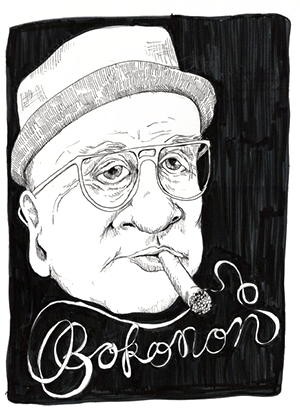
Bokononism is a fictional religion practiced by many of the characters in Kurt Vonnegut’s novel ‘Cat’s Cradle.’ It is based on the concept of ‘foma,’ which are defined as harmless untruths. The primary tenet of Bokononism is to ‘Live by the foma that make you brave and kind and healthy and happy.’
Many of the sacred texts of Bokononism were written in the form of calypsos. The foundation of Bokononism is that all religion, including Bokononism and all its texts, is formed entirely of lies; however, one who believes and adheres to these lies will at least have peace of mind, and perhaps live a good life.
Continue reading →
Posted in Humor, Language, Philosophy |
Leave a Comment »
November 8, 2010

In the novel Nineteen Eighty-Four, doublethink is the act of simultaneously accepting as correct two mutually contradictory beliefs. It is related to, but distinct from, hypocrisy and neutrality. Its opposite is cognitive dissonance, where the two beliefs cause conflict in one’s mind.
Posted in Language, Politics |
Leave a Comment »