August 16, 2010

Yandex is a Russian IT company which operates the largest search engine in Russia (with 64% market share, ranked eighth-largest in the world) and develops a number of Internet-based services and products. Yandex was launched in 1997 and began earning a profit in 2002. Its name stands for ‘Yet Another iNDEXer.’
Posted in Money, Technology, World |
Leave a Comment »
August 16, 2010

A chipper is an occasional drug user who does not use drugs with the regularity or frequency typical of addicts. It is used particularly to refer to opiate users and tobacco smokers. Above a certain threshold they develop regular cravings and become addicted. The term dates at least to the 1970s, where it is used in reference to opiate use and was used notably in reference to tobacco by psychologist Saul Shiffman and journalist Malcolm Gladwell.
Posted in Drugs, Health, Science |
Leave a Comment »
August 12, 2010

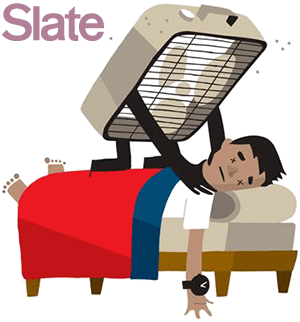
Fan death is a putative phenomenon, generally accepted only in South Korea, in which an electric fan left running overnight in a closed room can cause the death of those inside. Fans sold in Korea are equipped with a timer switch that turns them off after a set number of minutes, which users are frequently urged to set when going to sleep with a fan on.
The genesis of this misconception is unclear. Some have speculated that the South Korean government created the idea of fan death as propaganda in order to curb the energy consumption of Korean households. This theory is based on the fact that reports of fan death first appeared in the 1970s. This coincided with the 1970s energy crisis, which led to a short supply and high prices of oil; it also coincided with the rule of President Park Chung-hee, who listed attaining a self-reliant economy and modernization as his top goals, as announced in his Five Year Economic development Plan.
Continue reading →
Posted in Death, Money, World |
1 Comment »
August 12, 2010


Umami [oo-mah-mee], also referred to as savoriness, has been proposed as one of the basic tastes sensed by specialized receptor cells present on the human and animal tongue. Umami is a loanword from Japanese meaning ‘good flavor’ or ‘good taste.’ In English, however, ‘brothy,’ ‘meaty,’ or savory’ have been proposed as alternative translations. Inasmuch as it describes the flavor common to savory products such as meat, cheese, and mushrooms, umami is similar to French gastronome Brillat-Savarin’s concept of osmazome, an early attempt to describe the main flavoring component of meat as extracted in the process of making stock.
The umami taste is due to the detection of the carboxylate anion of glutamic acid, a naturally occurring amino acid common in meat, cheese, broth, stock, and other protein-heavy foods. Salts of glutamic acid, known as glutamates, easily ionize to give the same carboxylate form and therefore the same taste. For this reason, they are used as flavor enhancers. The most commonly used of these is monosodium glutamate (MSG).
Posted in Food, Science, World |
Leave a Comment »
August 12, 2010
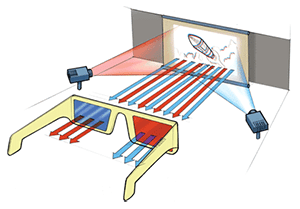

Anaglyph [an-uh-glif] images are used to provide a stereoscopic 3D effect, when viewed with 2 color glasses (usually red and cyan). Video games, theatrical films, and other media can be shown in the anaglyph 3D process. Practical images, for science or design, where depth perception is useful, include the presentation of full scale and microscopic stereographic images.
Examples from NASA include Mars Rover imaging, and 3D images of the sun. Other applications include geological illustrations by the USGS. A recent application is for stereo imaging of the heart using 3D ultra-sound with plastic red/cyan glasses. Anaglyph images are much easier to view than stereograms, but don’t render colors as accurately. Recently, cross-view prismatic glasses with adjustable masking have appeared, that offer a wider image on the new HD video and computer monitors.
Posted in Art, Technology |
Leave a Comment »
August 12, 2010

Anti-climb paint (also known as Anti Vandal Paint) is a class of paint which is a thick glutinous coating that is applied with a stiff brush, trowel or by hand using a protective glove. In appearance it is similar to smooth gloss paint when applied but it remains slippery indefinitely so preventing any intruder from gaining a foothold. It is used to prevent climbing on objects such as lampposts, walls and fences. It owes its effectiveness to the fact that it is based on a non-drying oil and keeps the surface greasy and slippery. As an additional advantage, it leaves its mark on the person touching it and hence makes it possible for intruders to be identified.
Posted in Politics, Technology |
1 Comment »
August 12, 2010
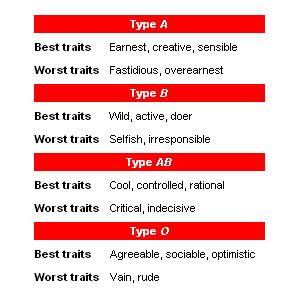

Ketsuekigata is a Japanese pseudoscience based on human blood types. There is a popular belief in Japan that a person’s ABO blood type is predictive of their personality, temperament, and compatibility with others. Ultimately deriving from ideas of historical scientific racism, the popular belief originates with publications by Masahiko Nomi in the 1970s. The scientific community dismisses such beliefs as superstition. Discussion of blood types is widely popular in women’s magazines as a way of gauging relationship compatibility with a potential or current partner. Morning television shows feature blood type horoscopes, and similar horoscopes are published daily in newspapers. In addition, a series of four books that describe people’s character by blood type ranked third, fourth, fifth and ninth on a list of best selling books in Japan in 2008.
Although there is no proven correlation between blood type and personality, it remains popular with the many matchmaking services that cater to blood type. In this way, it is similar to the use of astrological signs in the West, which is also popular in Japan. Asking one’s blood type is common in Japan, and people are often surprised when a non-Japanese does not know his or her own blood type.
Posted in Humor, Philosophy, World |
Leave a Comment »
August 12, 2010

Formosa [fawr-moh-suh] is the name given to Taiwan (Ilha Formosa, ‘Beautiful Isle’) by passing Portuguese mariners in 1544. It is now also the name of a province of Argentina, a city in Brazil, a small island off the northwest coast of Africa, and the language of Taiwanese aborigines.
Posted in Language, World |
Leave a Comment »
August 11, 2010

Hollywood accounting refers to the notoriously opaque accounting methods used by Hollywood to budget and record profits for film projects. Expenditures can be inflated to reduce or eliminate the profit of the project thereby reducing the amount which the corporation must pay in royalties or other profit-sharing agreements based on the net profit.
For example, Winston Groom’s price for the screenplay rights to his novel Forrest Gump included a share of the profits; however, due to Hollywood accounting, the film’s commercial success was converted into a net loss, and Groom received nothing. That being so, he has refused to sell the screenplay rights to the novel’s sequel, stating that he, ‘cannot in good conscience allow money to be wasted on a failure.’
Posted in Art, Money, Politics |
Leave a Comment »
August 11, 2010

Fecal bacteriotherapy, also known as fecal transfusion, fecal transplant, or human probiotic infusion (HPI), is a medical treatment for patients with gastrointestinal conditions which require restoration of normal bacterial flora from stool obtained from a healthy donor.
Posted in Health, Science |
Leave a Comment »
August 11, 2010

Flashblood (also called Flushblood) is a technique employed by drug users in which an addict injects himself with blood extracted from another drug user, most commonly one who has injected heroin. After injecting themselves with heroin using a syringe, the user will extract approximately one teaspoon of blood from the vein. Another user will then inject the withdrawn blood into themselves. It is unclear if there is enough heroin in the injected blood to get high or if the high that many users claim is a result of traces of the heroin that had been injected by the user, or if the high is simply the result of the placebo effect.
Posted in Drugs, Health |
1 Comment »
August 11, 2010

A police box is a British telephone kiosk or callbox located in a public place for the use of members of the police, or for members of the public to contact the police. Unlike an ordinary callbox, its telephone is located behind a hinged door so it can be used from the outside, and the interior of the box is, in effect, a miniature police station for use by police officers. Police boxes pre-date the era of mobile telecommunications; now police officers, in many countries, carry two-way radios and/or mobile phones rather than relying on fixed kiosks. Many boxes are now disused or have been withdrawn from service.
British police boxes were usually blue, except in Glasgow, where they were red until the late sixties. In addition to a telephone, they contained equipment such as an incident book and a first aid kit. Today the image of the blue police box is a trademark of the BBC as it is widely associated with the science fiction television programme Doctor Who, in which the protagonist’s time machine, a TARDIS, is in the shape of a 1960s British police box.
Posted in World |
Leave a Comment »







 The Daily Omnivore