November 24, 2015

Headis (Header Table Tennis) is a hybrid game that combines table tennis with soccer. Players strike a 7-inch rubber ball with their head. Physically headis is more comparable to badminton than to table tennis, but the rules are closer to table tennis with a few exceptions. Volleys (striking the ball before it hits the player’s own side) are allowed, as well as touching the table with any part of the body. Each game is played to 11 points and up to 2 sets, although a player must be ahead by two points to win each set.
The sport was invented in 2006 by René Wegner, a Saarbrücken sports science student at the time, at the ‘Wesch,’ a swimming pool in Kaiserslautern, Germany. The soccer field was occupied, which was why he and a friend started heading the ball back and forth at the table tennis table. In 2008 headis became part of the sports program at the University of Saarbrücken.
Posted in Games, Humor |
Leave a Comment »
November 23, 2015

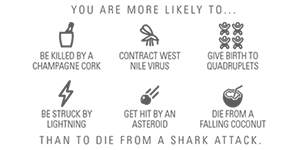
The Summer of the Shark refers to the coverage of shark attacks by American news media in the summer of 2001. The sensationalist coverage of shark attacks began in early July following the Fourth of July weekend shark attack on 8-year-old Jessie Arbogast, and continued almost unabated—despite no evidence for an actual increase in attacks—until the September 11 terrorist attacks shifted the media’s attention away from beaches. The ‘Summer of the Shark’ has since been remembered as an example of tabloid television perpetuating a story with no real merit beyond its ability to draw ratings.
In mid-August, many networks were showing footage captured by helicopters of hundreds of sharks coalescing off the southwest coast of Florida. Beach-goers were warned of the dangers of swimming, despite the fact that the swarm was likely part of an annual shark migration. The repeated broadcasts of the shark group has been criticized as blatant fear mongering, leading to the unwarranted belief of a so-called shark ‘epidemic.’ Continue reading →
Posted in Death, Language, Money |
Leave a Comment »
November 20, 2015
Red mercury is a hoax substance of uncertain composition purportedly used in the creation of nuclear bombs, as well as a variety of unrelated weapons systems. It is purported to be mercuric iodide, a poisonous, odorless, tasteless, water-insoluble scarlet-red powder that becomes yellow when heated above 126 °C (258 °F), due to a thermochromatic change in crystalline structure.
However, samples of ‘red mercury’ obtained from arrested would-be terrorists invariably consisted of nothing more than various red dyes or powders of little value, which some suspect was being sold as part of a campaign intended to flush out potential nuclear smugglers. The hoax was first reported in 1979 and was commonly discussed in the media in the 1990s. Prices as high as $1,800,000 per kilogram were reported.
Continue reading →
Posted in Humor, Science, War |
1 Comment »
November 19, 2015

Afghanistanism is a term, first recorded in the US, for the practice of concentrating on problems in distant parts of the world while ignoring controversial local issues. In other contexts, it has referred to ‘hopelessly arcane and irrelevant scholarship,’ ‘fascination with exotic, faraway lands,’ or ‘railing and shaking your fist at an unseen foe who is quite unaware of your existence, much less your fury.’
The first known citation of the expression was a quote by newspaper editor J. Lloyd Jones in 1948: ‘I don’t wish to belabor this subject of Afghanistanism, this business of taking forthright stands on elections in Costa Rica, while the uncollected local garbage reeks beneath the editor’s window.’ Continue reading →
Posted in Politics, War, World |
1 Comment »
November 17, 2015

News values, or ‘news criteria,’ determine how much prominence a news story is given by a media outlet, and the attention it garners from its audience. These values are not universal and can vary widely between different cultures. In Western practice, decisions on the selection and prioritization of news are ostensibly made by editors on the basis of their experience and intuition.
However, a seminal analysis by Norwegian sociologists Johan Galtung and Mari Ruge in the ‘Journal of Peace Research’ in 1965 showed that several factors are common, such as familiarity (stories that ‘hit close to home’), negativity (‘if it bleeds, it leads’), and Unexpectedness (‘don’t report on fire in a furnace’). Basing his judgement on many years as a newspaper journalist Tim Hetherington has said that ‘anything which threatens people’s peace, prosperity, and well being is news and likely to make headlines.’ Continue reading →
Posted in Language, Money, Politics |
1 Comment »
November 16, 2015

The Great Disappointment was the reaction that followed Baptist preacher William Miller’s proclamations that Jesus Christ would return to the earth in 1844. Many Millerites had given away all of their possessions and were left bereft when the prophecy proved false. Despite this, the movement wasn’t entirely disbanded, and eventually developed into several other denominations of Christianity, notably the Seventh Day Adventists.
The event is viewed by some scholars as indicative of ‘cognitive dissonance’ (discomfort from holding conflicting views) and ‘true-believer syndrome’ (maintaining a belief in the face of evidence to the contrary). The theory was proposed by social psychologist Leon Festinger to describe the formation of new beliefs and increased proselytizing in order to reduce the tension, or dissonance, that results from failed prophecies. His theory was that believers experienced emotional strain following the failure of Jesus’ reappearance in 1844, which led to a variety of new explanations, some of which outlived the disappointment. Continue reading →
Posted in Philosophy |
1 Comment »
November 14, 2015

Dysrationalia [dis-rash-uh-ney-lee-uh] is defined as the inability to think and behave rationally despite adequate intelligence. Dysrationalia can be a resource to explain why smart people fall for Ponzi schemes and other fraudulent encounters. A survey given to a Canadian Mensa club (which grants membership solely based on high IQ scores) on the topic of paranormal belief found that 44% of the members believed in astrology.
There are many examples of people who are famous because of their intelligence, but often display irrational behavior. Martin Heidegger, a renowned philosopher, was also a Nazi apologist and used the most fallacious arguments to justify his beliefs. William Crookes, a famous scientist who discovered the element thallium and a Fellow of the Royal Society, was continually duped by spiritual ‘mediums’ yet never gave up his spiritualist beliefs. Continue reading →
Posted in Health |
1 Comment »
November 13, 2015


Political correctness (PC) means using words or behavior which will not offend any group of people. The term arose in the 1970s as a way of encouraging the replacement of bygone phrases such as ‘colored.’ By the 1990s, it had taken on pejorative and mocking overtones, and was described as symptomatic of excessive liberalism and the ‘nanny state.’ The phrase was widely used in the debate about the 1987 book ‘The Closing of the American Mind’ by philosopher Allan Bloom, and gained further currency in response to social commentator Roger Kimball’s ‘Tenured Radicals’ (1990).
Conservative author Dinesh D’Souza’s ‘Illiberal Education’ duology of books (1991, 1992) condemned what he saw as liberal efforts to advance victimization, multiculturalism through language, and affirmative action. Advocates of political correctness, however, argue that libertarians made an issue of the term in order to divert attention from more substantive matters of discrimination and as part of a broader culture war against liberalism. They have also said that the right wing has it own forms of political correctness. Continue reading →
Posted in Language, Politics |
Leave a Comment »
November 12, 2015

Jugaad [joo-gard] is a colloquial Hindi and Punjabi word that can mean an innovative fix or a simple work-around, used for solutions that bend rules, or a resource that can be used as such, or a person who can solve a complicated issue. It is used as much to describe enterprising street mechanics as for political fixers. This meaning is often used to signify creativity to make existing things work or to create new things with meagre resources.
Jugaad is similar to the Western concepts of a ‘hack’ or ‘kludge,’ or to bodge or (‘British English’), but can be thought of more as a survival tactic than a mere workaround. But all such concepts express a need to do what needs to be done, without regard to what is conventionally supposed to be possible.
Posted in Money, Technology, World |
Leave a Comment »
November 11, 2015

A whispering gallery is a circular room in which whispers can be heard clearly across great distances. The sound is carried by waves, known as ‘whispering-gallery waves,’ that travel around the circumference clinging to the walls, an effect that was discovered in the whispering gallery of St Paul’s Cathedral in London. Other historical examples are the Gol Gumbaz mausoleum in India and the Echo Wall of the Temple of Heaven in Beijing.
The gallery may also be in the form of an ellipse or ellipsoid, with an accessible point at each focus. In this case, when a visitor stands at one focus and whispers, the line of sound emanating from this focus reflects directly to the focus at the other end of the gallery, where the whispers may be heard. In a similar way, two large concave parabolic dishes, serving as acoustic mirrors, may be erected facing each other in a room or outdoors to serve as a whispering gallery, a common feature of science museums. Egg-shaped galleries, such as the Golghar Granary in India, and irregularly shaped smooth-walled galleries in the form of caves, such as the Ear of Dionysius in Syracuse, also exist.
Posted in Science, Technology |
Leave a Comment »
November 10, 2015

Jailhouse lawyer is a colloquial term in North American English to refer to an inmate in a jail or other prison who, though usually never having practiced law nor having any formal legal training, informally assists other inmates in legal matters relating to their sentence (e.g. appeal of their sentence, pardons, stays of execution, etc.) or to their conditions in prison. Sometimes, he or she also assists other inmates in civil matters of a legal nature. The term can also refer to a prison inmate who is representing themselves in legal matters relating to their sentence.
The important role that jailhouse lawyers play in the criminal justice system has been recognized by the US Supreme Court, which has held that jailhouse lawyers must be permitted to assist illiterate inmates in filing petitions for postconviction relief unless the state provides some reasonable alternative. Many states have ‘Jailhouse Lawyer Statutes,’ some of which exempt inmates acting as lawyers from the licensing requirements imposed on other attorneys when they are helping indigent inmates with legal matters. Cases brought by inmates have also called attention to the need for jailhouse lawyers to have access to law libraries.
Posted in Politics |
2 Comments »
November 9, 2015

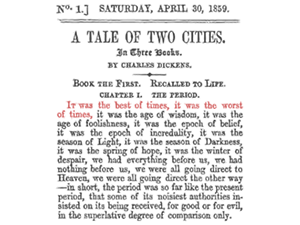
‘Once upon a time‘ is a stock phrase used to introduce a narrative of past events, typically in fairy tales and folktales. It has been used in some form since at least 1380 in storytelling in the English language and has opened many oral narratives since 1600. These stories often then end with ‘and they all lived happily ever after,’ or, originally, ‘happily until their deaths.’
The phrase is particularly common in fairy tales for younger children, where it is almost always the opening line of a tale. It was commonly used in the original translations of the stories of Charles Perrault as a translation for the French ‘il était une fois,’ of Hans Christian Andersen as a translation for the Danish ‘der var engang,’ (literally ‘there was once’), the Brothers Grimm as a translation for the German ‘es war einmal’ (literally ‘it was once’). An alternative German fairy tale opening translates to: ‘Back in the days when it was still of help to wish for a thing…’
Posted in Art, Language |
Leave a Comment »


 The Daily Omnivore