August 15, 2011
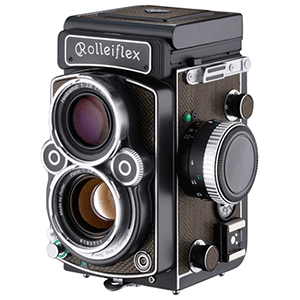
A twin-lens reflex camera (TLR) is a type of camera with two objective lenses of the same focal length. One of the lenses is the photographic objective or ‘taking lens,’ while the other is used for the viewfinder system, which is usually viewed from above at waist level. In addition to the objective, the viewfinder consists of a 45-degree mirror (the reason for the word reflex in the name), a matte focusing screen at the top of the camera, and a pop-up hood surrounding it. The two objectives are connected, so that the focus shown on the focusing screen will be exactly the same as on the film.
However, many inexpensive TLRs are fixed-focus models. Most TLRs use leaf shutters with shutter speeds up to 1/500th sec with a B setting. For practical purposes, all TLRs are film cameras, most often using 120 film, although there are many examples which used other formats. No general-purpose digital TLRs exist, since their heyday ended long prior to the digital era. The main exception is the collector-oriented Rollei Mini-Digi, introduced as a rather expensive ‘toy’ in 2004.
read more »
Posted in Art, Money, Technology |
Leave a Comment »
August 12, 2011

A Mouli grater is a hand-operated cooking tool designed for grating or pureeing small quantities of food. The device consists of a small metal drum with holes that grate the food and a handle for turning the drum. Mouli is a French brand name that later changed into Moulinex. A grating cylinder similar to the one used in this design later turned up in food processors from that company.
The hand-held unit consists of two sections with hinged handles. The end of one handle contains a food hopper with a grating cylinder and a crank for rotating the cylinder. The other section has a rounded surface that acts as a clamp, pressing the food to be grated into the grating cylinder. The hinged handles are held in one hand and squeezed so that the food presses against the grating cylinder. Meanwhile, the other hand turns the crank, causing the cylinder to rotate and the food to be grated.
Posted in Food, Technology |
Leave a Comment »
July 24, 2011

God Helmet refers to an experimental apparatus used in neuroscience, primarily in the field of neurotheology (the study of correlations of neural phenomena with subjective experiences of spirituality). Originally called the ‘Koren helmet’ after its inventor Stanley Koren, it was conceived to study creativity and the effects of subtle stimulation of the temporal lobes. Reports by participants of a ‘sensed presence’ brought public attention to the device. The apparatus, placed on the head of an experimental subject, generates weak fluctuating (i.e. ‘complex’) magnetic fields. These fields are approximately as strong as those generated by a land line telephone handset or an ordinary hair dryer, but far weaker than that of an ordinary fridge magnet.
Michael Persinger, a Canadian neuroscientist, has published extensively about the effects on the human brain of the ‘complex’ magnetic fields generated by the God helmet and similar devices. Many subjects have reported ‘mystical experiences and altered states’ while wearing the God Helmet.
read more »
Posted in Health, Philosophy, Technology |
1 Comment »
July 12, 2011

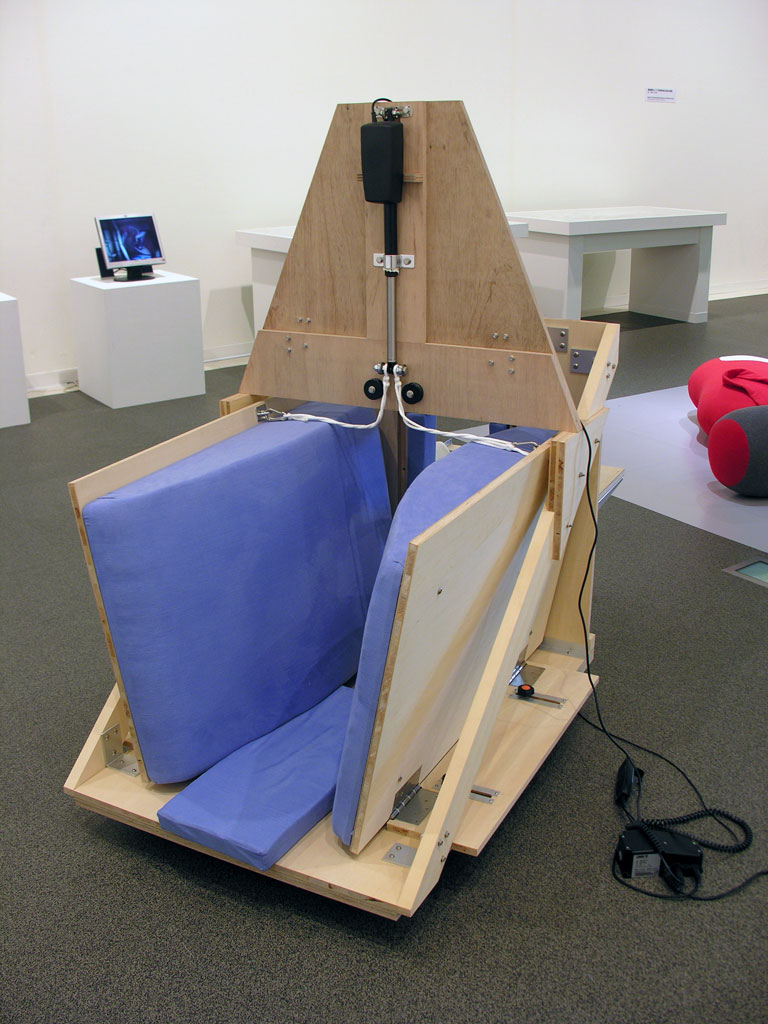
A hug machine, or squeeze box, is a deep-pressure device designed to calm hypersensitive persons, usually individuals with autism spectrum disorders. The therapeutic, stress-relieving device was invented by professor of animal science Temple Grandin in 1965.
Autism and autism-spectrum disorders have profound effects upon both social interactions and sensitivity to sensory stimulation in persons with such conditions, often making it uncomfortable or impractical for them to turn to other human beings for comfort. Grandin solved this by designing the hug machine so both she and others could turn to it for sensory relief, whenever needed or simply desired.
read more »
Posted in Health, Technology |
2 Comments »
July 11, 2011

The Tamagotchi [tom-uh-gotchee] is a handheld digital pet, created in Japan by Akihiro Yokoi of WiZ and Aki Maita of Bandai. It was first sold by Bandai in 1996 in Japan. As of 2010, over 76 million Tamagotchis have been sold world-wide. Most Tamagotchis are housed in a small egg-shaped computer with an interface usually consisting of three buttons, although the number of buttons may vary for different variations. According to Bandai, the name is a portmanteau combining the Japanese word ‘tamago,’ which means ‘egg,’ and the English word ‘watch.’
Upon removing the tag of a Tamagotchi unit, an egg will appear on the screen. After setting the Tamagotchi unit’s clock, the Tamagotchi will hatch, after which the player will be told of its gender and will be given the opportunity to give it a name. From then on, the player is given the task of raising the Tamagotchi to good health throughout its life and attending to its needs, such as feeding it, playing games to make it happy, and keep it at a healthy weight, cleaning up its excrement, punishing or praising the Tamagotchi based on its actions, returning it to proper health with medicine if it gets sick, and shutting off the lights when it goes to bed.
read more »
Posted in Games, Technology, World |
Leave a Comment »
July 11, 2011

A MiniDisc (MD) is a magneto-optical disc-based data storage device initially intended for storage of up to 74 minutes and, later, 80 minutes, of digitized audio. In the form of Hi-MD, it has also developed into a general-purpose storage medium. MiniDisc was released in 1992, first in Japan, and then in Europe and the U.S. The music format was originally based exclusively on ATRAC audio data compression, but the option of linear PCM recording was later introduced to attain audio quality comparable to that of a compact disc.
Sony’s MiniDisc was one of two rival digital systems introduced in 1992, that were both targeted as a replacement for the Philips analog cassette audio tape system: the other was Digital Compact Cassette (DCC), created by Philips and Matsushita. Sony had originally intended for Digital Audio Tape (DAT) to be the dominant home digital audio recording format, replacing the analog cassette. Unfortunately, due to technical delays, DAT was not launched until 1989, and by then, the U.S. dollar had fallen so far in relation to the yen, the introductory DAT machine Sony had intended to market for about $400 in the late 1980s now had to retail for $800 or even $1000 to break even, putting it out of reach for most users. Relegating DAT for pro use, Sony immediately set to work to come up with a simpler, more economical digital home format.
read more »
Posted in Money, Technology, World |
Leave a Comment »
June 28, 2011

The iBOT is a very stable and mobile powered wheelchair developed by Dean Kamen in a partnership between DEKA and Johnson and Johnson’s Independence Technology division. It is a medical technology, made to help people with severe mobility problems.
As of 2006 the iBOT retailed for approximately $26,100 and required a prescription in the U.S. As of 2009, it is no longer available for sale from Independence Technology, but support for existing units will be available until the end of 2013.
read more »
Posted in Health, Technology |
1 Comment »
June 20, 2011

A camera lucida [loo-si-duh] (Latin: ‘light room’) is an optical device used as a drawing aid by artists. The camera lucida performs an optical superimposition of the subject being viewed upon the surface upon which the artist is drawing. The artist sees both scene and drawing surface simultaneously, as in a photographic double exposure. This allows the artist to duplicate key points of the scene on the drawing surface, thus aiding in the accurate rendering of perspective. At times, the artist can even trace the outlines of objects.
The camera lucida was patented in 1807 by William Hyde Wollaston. There seems to be evidence his idea was actually nothing but a reinvention of a device clearly described 200 years earlier by Johannes Kepler. By the 19th century, Kepler’s description had totally fallen into obscurity.
read more »
Posted in Art, Technology |
Leave a Comment »
June 10, 2011

The term color organ refers to a tradition of mechanical (18th century), then electromechanical, devices built to represent sound or to accompany music in a visual medium—by any number of means. In the early 20th century, a silent color organ tradition (Lumia) developed. In the 60s and 70s, the term ‘color organ’ became popularly associated with electronic devices that responded to their music inputs with light shows. The term ‘light organ’ is increasingly being used for these devices; allowing ‘color organ’ to reassume its original meaning.
The dream of creating a visual music comparable to auditory music found its fulfillment in animated abstract films by artists such as Oskar Fischinger, Len Lye and Norman McLaren; but long before them, many people built instruments, usually called ‘color organs,’ that would display modulated colored light in some kind of fluid fashion comparable to music. In 1590, Gregorio Comanini described an invention by the Mannerist painter Arcimboldo of a system for creating color-music based on apparent luminosity (light-dark contrast) instead of hue.
read more »
Posted in Art, Technology |
Leave a Comment »
June 6, 2011

The multiplane camera is a special motion picture camera used in the traditional animation process that moves a number of pieces of artwork past the camera at various speeds and at various distances from one another. This creates a three-dimensional effect, although not actually stereoscopic.
Various parts of the artwork layers are left transparent, to allow other layers to be seen behind them. The movements are calculated and photographed frame-by-frame, with the result being an illusion of depth by having several layers of artwork moving at different speeds – the further away from the camera, the slower the speed. The multiplane effect is sometimes referred to as a parallax process.
read more »
Posted in Art, Technology |
Leave a Comment »
April 25, 2011

The magic lantern or Laterna Magica is an early type of image projector developed in the 17th century. It has a concave mirror in front of a light source that gathers light and projects it through a slide with an image printed on it.
The lens throws an enlarged picture of the original image from the slide onto a screen. The main light sources used during the time it was invented were candles or oil lamps. These light sources were quite inefficient and produced weak projections.
read more »
Posted in Art, Technology |
Leave a Comment »
April 18, 2011
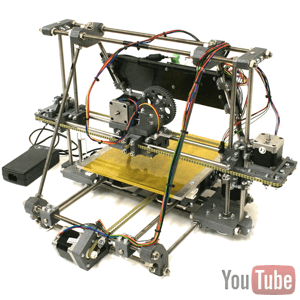
The RepRap project is an initiative to develop a 3D printer (RepRap, short for ‘replicating rapid prototyper’) that can print most of its own components. As an open design, all of the designs produced by the project are released under a free software license. The device uses a variant of fused deposition modeling, an additive manufacturing technique.
Due to the self-replicating ability of the machine, authors envision the possibility to cheaply distribute RepRap units to people and communities, enabling them to create (or download from the internet) complex products without the need for expensive industrial infrastructure.
Posted in Money, Technology |
1 Comment »



 The Daily Omnivore