August 22, 2011

Cinemagraphs are still photographs in which a minor and repeated movement action occurs. They are produced by taking a series of photographs or a video recording, and, using image editing software, compositing the photographs or the video frames into an animated GIF file in such a manner that motion in part of the subject between exposures (for example, a person’s dangling leg) is perceived as a repeating or continued motion.
The term was coined by U.S. photographers Kevin Burg and Jamie Beck, who used the technique to animate their fashion and news photographs beginning in early 2011.
Posted in Art, Technology |
Leave a Comment »
August 17, 2011
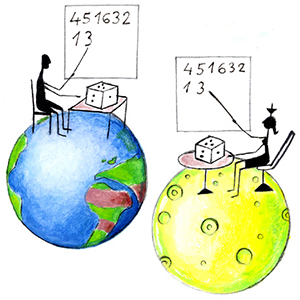
An ansible [an-si-bull] is a hypothetical machine capable of instantaneous or superluminal (faster-than-light) communication. They are used as science fiction plot devices and in thought experiments of theoretical physics. The word was coined by American author Ursula K. Le Guin in her 1966 novel, ‘Rocannon’s World.’
She derived the name from ‘answerable,’ as the device would allow its users to receive answers to their messages in a reasonable amount of time, even over interstellar distances. The name of the device has since been borrowed by authors such as Orson Scott Card and Vernor Vinge; similar devices are present in the works of numerous others, such as Frank Herbert. One ansible-like device which predates Le Guin’s is the ‘Dirac communicator’ in James Blish’s 1954 short story ‘Beep.’ The device received the sum of all transmitted messages in universal space-time, in a single pulse, so that demultiplexing yielded information about the past, present, and future.
read more »
Posted in Language, Science, Technology |
Leave a Comment »
August 14, 2011

Greenwashing (a compound word modelled on ‘whitewash’), or ‘green sheen,’ is a form of spin in which ‘green’ PR or ‘green’ marketing is deceptively used to promote the perception that a company’s policies or products are environmentally friendly. The term was coined by New York environmentalist Jay Westerveld in a 1986 essay regarding the hotel industry’s practice of placing placards in each room promoting reuse of towels ostensibly to ‘save the environment.’
Westerveld noted that, in most cases, little or no effort toward reducing energy waste was being made by these institutions — as evidenced by the lack of cost reduction this practice effected. Westerveld opined that the actual objective of this ‘green campaign’ on the part of many hoteliers was, in fact, increased profit. Westerveld thus labeled this and other outwardly environmentally conscientious acts with a greater, underlying purpose of profit increase as greenwashing.
read more »
Posted in Money, Politics, Science |
1 Comment »
August 11, 2011

Pinko is a term for a person regarded as sympathetic to communism, though not necessarily a Communist Party member. The term has its origins in the notion that pink is a lighter shade of red, the color associated with communism. The word was coined by Time magazine in 1925 as a variant on the noun and adjective pink, which had been used along with ‘parlor pink’ since the beginning of the 20th century to refer to those of leftish sympathies, usually with an implication of ‘effeteness.’
In the 1920s, for example, a Wall Street Journal editorial described supporters of the progressive politician Robert La Follette as ‘visionaries, ne’er do wells, parlor pinks, reds, hyphenates [Americans with divided allegiance], soft handed agriculturalists and working men who have never seen a shovel.’
read more »
Posted in Language, Politics |
Leave a Comment »
August 9, 2011

Moombahton is a genre of electronic dance music that was created by American dj/producer Dave Nada (aka Dave Villegas) at a high school homecoming ‘skipping party’ for his younger cousin in Washington, D.C., in the fall of 2009.
The specific event that stimulated NADA’s development of the Moombahton genre was his slowing the Afrojack remix of the Silvio Ecomo and DJ Chuckie song ‘Moombah’ to 108 beats per minute. Because that tempo nears that of the reggaeton, Nada created the neologism ‘Moombahton.’
Posted in Art, Technology |
Leave a Comment »
August 8, 2011

Hipster is a slang term that first appeared in the 1940s, was revived in the 1990s, and continued to be used in the 2000s and 2010s, to describe young, recently settled urban middle class adults and older teenagers with musical interests mainly in indie rock. Other interests in media would include independent film, magazines such as Vice and Clash, and websites like Pitchfork Media. In some contexts, hipsters are also called scenesters.
‘Hipster’ has been used in sometimes contradictory ways, making it difficult to precisely define ‘hipster culture,’ which has been described as a ‘mutating, trans-Atlantic melting pot of styles, tastes and behavior.’ Hipsterism fetishizes the authentic elements of all of the ‘fringe movements of the postwar era—beat, hippie, punk, even grunge,’ and draws on the ‘cultural stores of every unmelted ethnicity,’ and ‘regurgitates it with a winking inauthenticity.’ Others, like Arsel and Thompson, argue that hipster signifies a cultural mythology, a crystallization of a mass-mediated stereotype generated to understand, categorize, and marketize indie consumer culture, rather than an objectified group of people.
read more »
Posted in Art, Language, Money |
Leave a Comment »
July 24, 2011


Security theater is a term that describes security countermeasures intended to provide the feeling of improved security while doing little or nothing to actually improve security. The term was coined by computer security specialist and writer Bruce Schneier, but has gained currency in security circles, particularly for describing airport security measures.
Security theater typically involves restricting certain aspects of people’s behavior in very visible ways, that could involve potential restrictions of personal liberty and privacy, ranging from negligible (where bottled water can be purchased) to significant (prolonged screening of individuals to the point of harassment).
read more »
Posted in Politics, War |
Leave a Comment »
July 23, 2011

Dieselpunk is a sub-genre of the pop surrealist art movement, as well as a budding subculture, that combines the aesthetics of the interbellum period through the early 1950s with postmodern technology and sensibilities. First coined in 2001 as a marketing term by game designer Lewis Pollak to describe his role-playing game ‘Children of the Sun,’ dieselpunk has grown to describe a distinct style.
The name ‘dieselpunk’ is a derivative of the 1980s science fiction genre cyberpunk, and is used to represent the time period – or ‘era’- when diesel-based locomotion was the main technological focus of Western culture. The ‘-punk’ suffix attached to the name is representative of the counterculture nature of the genre with regards to its opposition of contemporary aesthetics. The term also refers to the tongue-in-cheek name given to a similar cyberpunk derivative, ‘steampunk,’ which focuses on science fiction set within the Victorian era.
read more »
Posted in Art, Language, Technology |
2 Comments »
July 22, 2011

Steampunk is a sub-genre of science fiction, alternate history, and speculative fiction that came into prominence during the 1980s and early 1990s. It involves a setting where steam power is still widely used—usually the Victorian era Britain—that incorporates elements of either science fiction or fantasy.
Works of steampunk often feature anachronistic technology or futuristic innovations as Victorians may have envisioned them; based on a Victorian perspective on fashion, culture, architectural style, art, etc. This technology may include such fictional machines as those found in the works of H. G. Wells and Jules Verne.
read more »
Posted in Art, Language, Technology |
Leave a Comment »
July 15, 2011

Lysenkoism [li-seng-koh-iz-uhm] is used colloquially to describe the manipulation or distortion of the scientific process as a way to reach a predetermined conclusion as dictated by an ideological bias, often related to social or political objectives. The word is derived from a set of political and social campaigns in science and agriculture by the director of the Soviet Lenin All-Union Academy of Agricultural Sciences, Trofim Lysenko and his followers, which began in the late 1920s and formally ended in 1964.
In 1928, Trofim Lysenko, a previously unknown plant scientist, claimed to have developed an agricultural technique, termed vernalization, which tripled or quadrupled crop yield by exposing wheat seed to high humidity and low temperature. While cold and moisture exposure are a normal part of the life cycle of fall-seeded winter cereals, the vernalization technique claimed to enhance yields by increasing the intensity of exposure, in some cases planting soaked seeds directly into the snow cover of frozen fields. In reality, the technique was neither new (it had been known since 1854, and was extensively studied during the previous twenty years), nor did it produce the yields he promised.
read more »
Posted in Politics, Science, World |
1 Comment »
June 11, 2011

A Googlewhack is a type of a contest for finding a Google search query consisting of exactly two words without quotation marks, that returns exactly one hit. A Googlewhack must consist of two actual words found in a dictionary. A Googlewhack is considered legitimate if both of the searched-for words appear in the result page.
Published googlewhacks are short-lived, since when published to a web site, the new number of hits will become at least two, one to the original hit found, and one to the publishing site. The term Googlewhack first appeared on the web at UnBlinking in 2002; the term was coined by Gary Stock. Subsequently, Stock created The Whack Stack, at googlewhack.com, to allow the verification and collection of user-submitted Googlewhacks.
read more »
Posted in Games, Humor, Technology |
Leave a Comment »
June 7, 2011

Tecnocumbia [tek-noh-koom-bee-uh] is a style of Cumbia (Latin American folk music) were there is a fusion between electronic sounds generated by electronic musical instruments and traditional instruments. The term ‘tecnocumbia’ was coined in Mexico to describe this type of music, but the style of music was developed throughout South America with different names given to it. In Mexico, it developed as a variant of the Mexican cumbia that started in the early 80s. The style added electronic instruments along with samplers to the Mexican cumbia music. One of the first musical groups with electrical 80’s sounds was Super Show de los Vazkez from Veracruz, formed in 1981. In the early 90s Selena the ‘Tex-mex queen’ had hits in U.S. and Mexico in the tecnocumbia style.
In South America, where the Colombian Cumbia most easily expanded in popularity, different ‘modern’ styles of the original Colombian rhythm were started mainly in the countries of Peru, Ecuador and Bolivia. The Peruvian cumbia, developed in the early 60s, used electric guitars and synthesizers along with the other classical instruments of the Colombian cumbia in order to create a kind of tropical sound. Variations within the Peruvian cumbia added more tropical rhythms along with a more Andean flavor, which eventually resulted in the creation of the Andean cumbia (Commonly called ‘Chicha music’ in Peru).
Posted in Art, Technology, World |
Leave a Comment »



 The Daily Omnivore