March 23, 2026

A miniature is a small bottle of a spirit, liqueur or other alcoholic beverage. Their contents, typically 50 ml, are intended to comprise an individual serving (one shot of liquor in the U.S. is 44 ml).
Miniatures may be used as gifts, samples, or for promotional purposes. In Scotland and the Northeastern United States they are often known as nips, short for nipperkin (one-eighth of a pint of beer or any other liquor). The name has been also used as inspiration for drinking dens and bars around England, with the most notable being The Nipperkin in Mayfair, London. In New England, miniature bottles of alcohol are often referred to as ‘nips.’
read more »
Posted in Drugs |
Leave a Comment »
March 3, 2025
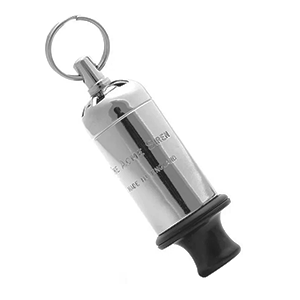
The Acme siren is a musical instrument used in concert bands for comic effect. Often used in cartoons, it produces the stylized sound of a police siren. It is one of the few aerophones in the percussion section of an orchestra. The instrument is typically made of metal and is cylindrical. Inside the cylinder is a type of fan-blade which, when the performer blows through one end, spins and creates the sound. The faster the performer blows, the faster the fan-blade moves and the higher the pitch the instrument creates. Conversely, the slower the performer blows, the lower the pitch.
Iannis Xenakis used it in the 1960s in his works Oresteia, Terretektorh, and Persephassa. A siren was used in Bob Dylan’s classic album, ‘Highway 61 Revisited.’ One is also heard in Stevie Wonder’s song ‘Sir Duke’ just before the second chorus. Dan Zanes also uses a siren in his version of ‘Washington at Valley Forge.’ Acme is the trade name of J Hudson & Co of Birmingham, England, who developed and patented the Acme siren in 1895. It was sometimes known as ‘the cyclist’s road clearer.’
Posted in Art, Humor |
Leave a Comment »
February 5, 2025
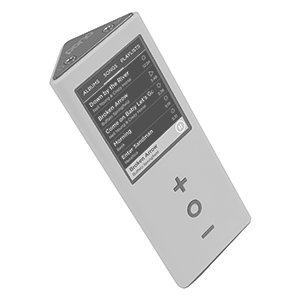
Pono [poh-noh] (Hawaiian for ‘proper’ or ‘righteousness’) was a portable digital media player and music download service for high-resolution audio. It was developed by musician Neil Young and his company PonoMusic, which raised money for development and initial production through a crowd-funding campaign on Kickstarter. Production and shipments to backers started in 2014, and shipments to the general public began in the first quarter of 2015.
Pono’s stated goal to present songs ‘as they first sound during studio recording sessions,’ using ‘high-resolution’ 24-bit 192kHz audio instead of ‘the compressed audio inferiority that MP3s offer’ received mixed reactions, with some describing Pono as a competitor to similar music services such as HDtracks, but others doubting its potential for success. Pono was discontinued in 2017, and alternative plans were later abandoned.
read more »
Posted in Art, Money, Technology |
Leave a Comment »
January 1, 2021

Chia Pets are American styled terracotta figurines used to sprout chia, where the chia sprouts grow within a couple of weeks to resemble the animal’s fur or hair.
A range of generic animals has been produced, including a turtle, pig, puppy, kitten, frog, and hippopotamus. Cartoon characters have also been licensed, including Garfield, Scooby-Doo, Looney Tunes, Shrek, The Simpsons, and SpongeBob. Additionally, there are Chia Pets depicting real people, including Barack Obama and Bob Ross.
read more »
Posted in Humor, Money |
2 Comments »
April 4, 2020


Saturday night special is a colloquial term for inexpensive, compact, small-caliber handguns of perceived low quality. Some states define these junk guns by means of composition or material strength. In the late 19th century and early 20th century, they were commonly referred to as ‘suicide specials.’ Although the term implies such a gun is for use in crime, studies show that criminals prefer high-quality guns, in the largest caliber they can easily conceal.
The legal definition of a ‘junk gun’ usually specifies the materials used in its manufacture, targeting zinc castings, low melting points (usually 800 degrees Fahrenheit), powder metallurgy, and other low-cost manufacturing techniques. Nearly all guns made this way are chambered for low-pressure cartridges. The low-strength materials and cheap construction result in poor durability and marginal accuracy at longer ranges, but as most of these guns are sold for use in self-defense, accuracy and durability are not primary design goals.
read more »
Posted in Money |
Leave a Comment »
March 28, 2020
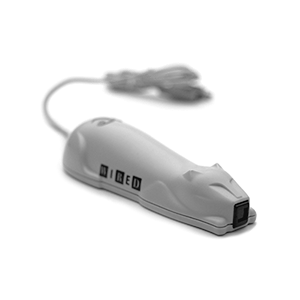
The CueCat, styled :CueCat with a leading colon, is a cat-shaped handheld barcode reader that was given away free to Internet users starting in 2000 by the now-defunct Digital Convergence Corporation. It enabled a user to open a link to an Internet URL by scanning a barcode — called a ‘cue’ by Digital Convergence — appearing in an article or catalog or on some other printed matter.
The company asserted that the ability of the device to direct users to a specific URL, rather than a domain name, was valuable. In addition, television broadcasters could use an audio tone in programs or commercials that, if a TV was connected to a computer via an audio cable, acted as a web address shortcut.
read more »
Posted in Money, Technology |
Leave a Comment »
February 21, 2020
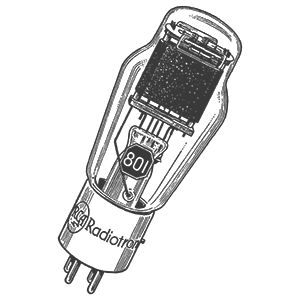
A vacuum tube, also called a ‘valve’ in British English, is a device that controls electric current flow in a high vacuum between electrodes (conductors that emit or receive electrons). Tubes were used in many radios, television sets, and amplifiers until they were supplanted by lower cost transistors in the 1960s that performed the same function but used less electricity and were more durable.
In a vacuum tube, a cathode (an electrode that emits electrons) is heated, as in a light bulb, so it will emit electrons. This is called ‘thermionic emission.’ The electrons are accelerated from the cathode to the anode (an electrode that receives electrons) by the electric field in the tube. Vacuum tubes must be hot to work. Most are made of glass, thus are fragile and can break. Vacuum tubes were used in the first computers like the ENIAC, which were large and need much work to continue operating.
read more »
Posted in Art, Technology |
Leave a Comment »
February 21, 2020
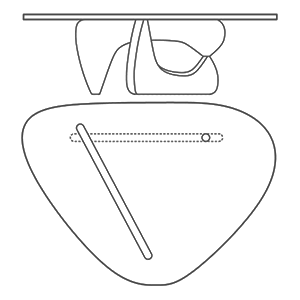
The Noguchi [nuh-goo-chee] table is a piece of modernist furniture first produced in the mid-20th century. Introduced by Herman Miller in 1947, it was designed in the United States by Japanese American artist and industrial designer Isamu Noguchi. The Noguchi table comprises a wooden base composed of two identical curved wood pieces and a heavy plate glass top.
The Noguchi table was an evolution of a rosewood and glass table Noguchi designed in 1939 for A. Conger Goodyear, president of the Museum of Modern Art. The design team at Herman Miller was so impressed by the table’s use of biomorphism (shapes reminiscent of living organisms) that they recruited Noguchi to design a similar table with a freeform sculptural base and biomorphic glass top for use in both residential and office environments.
read more »
Posted in Art |
Leave a Comment »
July 26, 2019
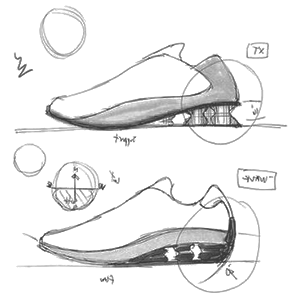
Shox is a shoe feature first released by Nike in 2000 that is incorporated in several of their flagship athletic sports shoes. The shoe design includes a support system feature, which is an arrangement of small hollow columns in the midsole supporting the shoe’s heel, which are made primarily with polyurethane.
There are different formations of the shox technology, but most models include four circular columns in a square formation to provide cushioning. Later variations in shox models added one or two additional shox, 25 mm high, though they may vary in height; as well as triangular and rectangular shox that Nike claims provide better stability. Some shoes have midsoles made entirely of Shox, like the TL series.
read more »
Posted in Games, Technology |
Leave a Comment »
June 11, 2019
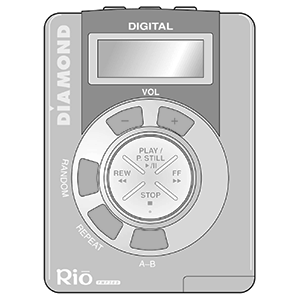
The Rio PMP300 is one of the first portable consumer MP3 digital audio players, and the first commercially successful one. Produced by Diamond Multimedia, it was introduced in 1998 as the first in the ‘Rio’ series of digital audio players, and it shipped later that year. The Rio retailed for US $200 with the ability to hold around 30 minutes of music at a bitrate of 128 kbit/s.
It shipped with 32 MB of internal memory and has a SmartMedia slot, allowing users to add additional memory. It is powered by a single AA battery, which provides between 8 and 12 hours of playback time. Connection to a personal computer is through the computer’s parallel port, with a proprietary connector on the Rio’s edge.
read more »
Posted in Money, Politics, Technology |
Leave a Comment »
April 30, 2019
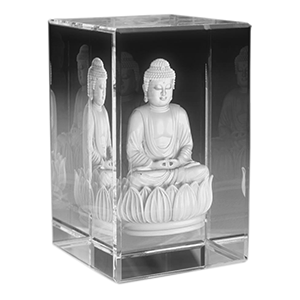
A bubblegram (also known as ‘laser crystal,’ ‘3D crystal engraving,’ or ‘vitrography’) is a solid block of transparent plastic that has been exposed to intersecting laser beams in appropriately to induce a chemical reaction via heat or photonic excitation, creating bubbles or nodes where the plastic has a different index of refraction.
A complex or highly detailed image occupying a 5 cm cubic volume typically requires the creation of tens of thousands of such points.
read more »
Posted in Art, Technology |
Leave a Comment »
November 7, 2018

A tube man, also known as a ‘skydancer,’ ‘air dancer,’ and originally called the ‘Tall Boy,’ is an inflatable moving advertising product comprising a long fabric tube (with two or more outlets), which is attached to and powered by an electrical fan. As the electrical fan blows air through the fabric tube, this causes the tube to move about in a dynamic dancing or flailing motion.
The design of the tube man was invented by Peter Minshall, an artist from Trinidad and Tobago, along with a team that included Israeli artist Doron Gazit, for the 1996 Summer Olympics. Gazit eventually patented the concept of an inflatable, dancing human-shaped balloon and licensed the patent to various companies that manufacture and sell the devices.
Posted in Art, Humor, Money |
Leave a Comment »


 The Daily Omnivore